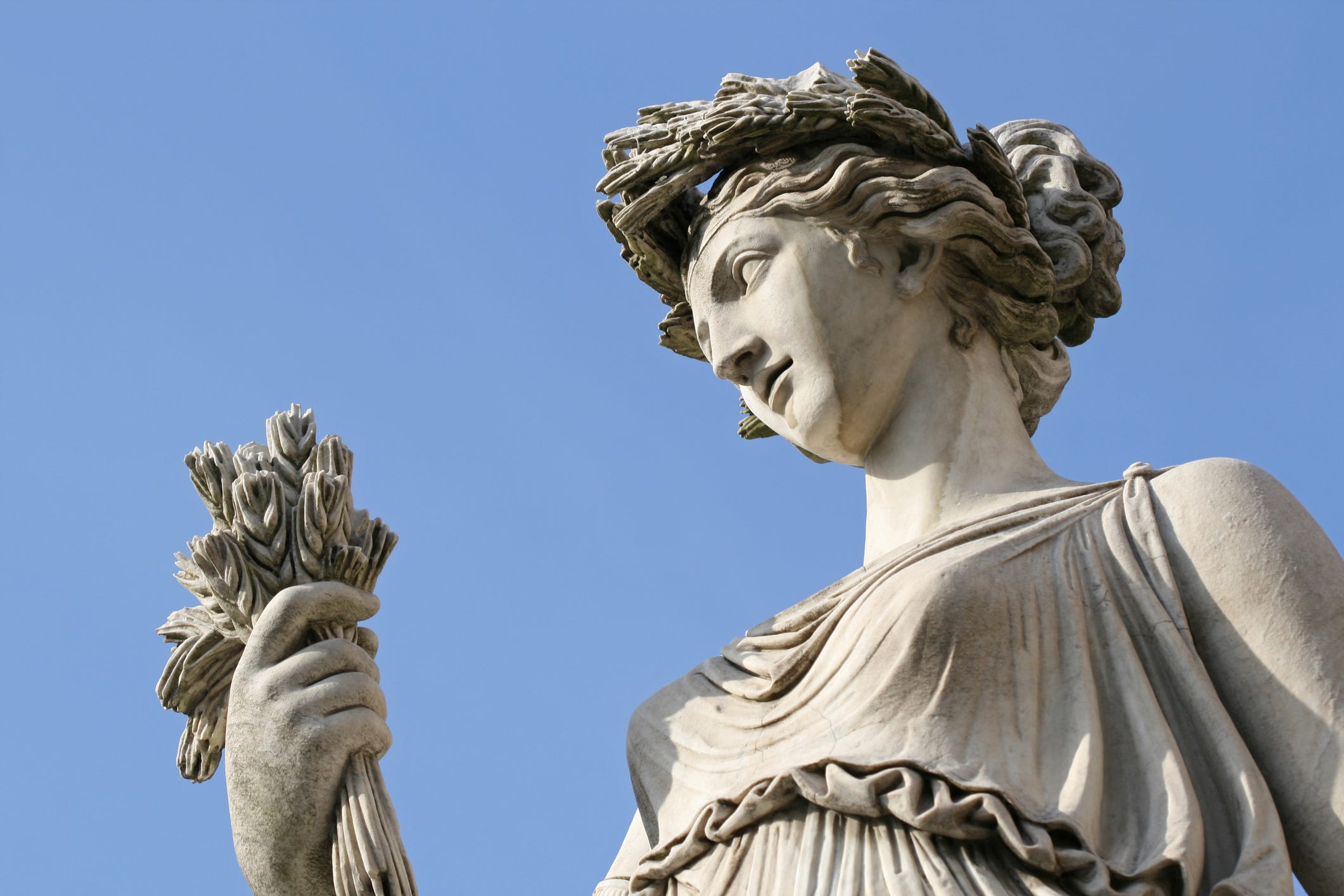
Telling the stories of the women of Ancient Rome. Image via iStock
In this issue, ancient meets modern.
A campaigner and writer on violence against women since the 1970s, Joan Smith reflects on her interest in the lives of Roman women, and what a feminist reading of classical history reveals about the vulnerability of the wives, mothers and sisters of the rulers of the Roman Empire, two thousand years ago.
We bring that story right up to date in the first in of a new occasional series, Women and the Law, with an account of how rape in marriage came to be criminalised in the United Kingdom merely a handful of decades ago.
We also hear again from the frontline of prisons, with a second piece from OceanBreathCafe on her time as volunteer prison inspector in Scotland. The job of a prison inspector, she argues, is to give a voice to those who have none and to ask the questions they cannot ask for themselves. What happens to women in prison when some questions become impossible to ask?
The button at the end of this issue takes you to our subscriber chat. As ever, you can also find us in real time on X/Twitter, at @DalgetySusan and @LucyHunterB and our shared account @EthelWrites.
We are delighted that we can now plan for our fortnightly 21st century feminist publication to remain fully accessible. But we depend on some of our readers becoming paid subscribers so that we can pay our contributors, as well as keep the newsletter free so ALL women can access it. If you can afford a paid subscription, please consider getting one.


From Ancient Rome to the modern world: The women history blamed, the men who abused them and why misogyny has changed so little in two thousand years
By Joan Smith
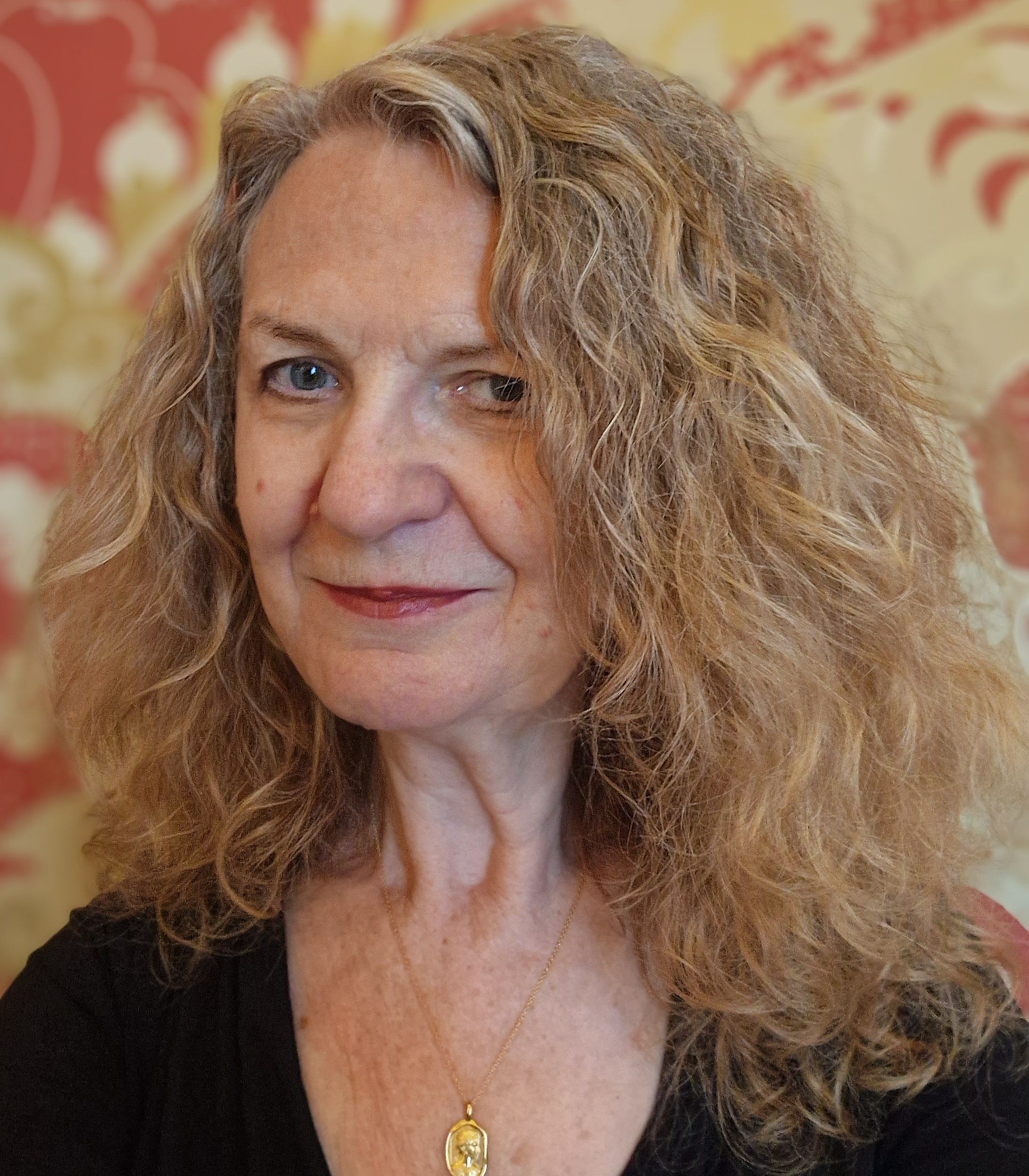
Joan Smith. Image contributed.
There is no mystery about violence against women. Both sexual and domestic violence are drearily predictable, committed by men whose behaviour follows familiar patterns. It’s one of the reasons why the current government’s determination to apply early release to men who have abused former partners is indefensible, given that they are the cohort of prisoners most likely to offend again.
I know this because of my long history of involvement with this subject. I was first exposed to it by my reporting of Peter Sutcliffe’s murders in the north of England in the 1970s, which I wrote about in my book Misogynies. Many years later, spending eight years as Co-chair of the Mayor of London’s Violence Against Women and Girls Board gave me access to raw data compiled by the Metropolitan Police, and a horrified realisation of just how many women experience rape and domestic violence.
Discovering a love of Latin
It also, perhaps unexpectedly, changed my view of Roman history. I began learning Latin at a girls’ grammar school at the age of twelve, and I loved it from the very first day. I was a serious, rather unhappy child, already on my fourth school because my parents moved so frequently, and with no siblings to share my disrupted education. I lived with my mother and father on a brand-new council estate, with next to no amenities, and suddenly I was surrounded by girls who played musical instruments, went on foreign holidays and won prizes for ‘posture’.
Latin was my escape, and I doubt whether many teenage girls ever recited ‘amo, amas, amat’ with such enthusiasm. This was a subject I was good at but ancient Rome offered me something else as well, an entree into a culture that could not have been more removed from my everyday life. Reading Roman authors exposed me to another world, one in which literature and architecture were highly valued, and I couldn’t get enough of it. Cicero taught me everything I know about rhetoric and I adored the love poems of Catullus; in those day Latin teachers edited out the visceral misogyny he displayed when the woman he supposedly worshipped said ‘no’.
Long before I ever set foot in Rome, the ancient city existed in my head, populated by towering, though mostly male, figures. When I finished my degree in Latin at the University of Reading, I was torn between applying to do a PhD and getting a job in journalism. I decided on the latter, thinking I could always return to the early Roman empire, although I never imagined the shape it would eventually take. Even now, when I visit Rome every year, I can hardly contain my excitement when I step into the lavishly decorated houses on the Palatine Hill once owned by the emperor Augustus and his wife Livia.
Recovering Rome’s forgotten women
But there is a problem, and it’s one that speaks volumes about contemporary failures to understand and prevent domestic violence. Livia was accused by my favourite Roman author, the historian Tacitus, of being responsible for the murders of anyone who stood in the way of her horrible elder son, the second emperor Tiberius. She was further traduced by the 20th century poet Robert Graves, whose portrait of Livia and other patrician women in his novel I, Claudius is an exercise in grotesque misogyny. It’s also pretty pure invention: Graves accused Livia of eight murders, seven of which were not murders at all, while the eighth - the hideous death by starvation of Augustus’s daughter, Julia - was carried out on the orders of her ex-husband, Tiberius.
So many of these women, accused by ancient authors of being sexually incontinent and ‘asking for’ the violence they suffered, were actually prime examples of victim-blaming. And I realised that no one had ever viewed the women of the Julio-Claudian dynasty through the prism of domestic violence, a story that seemed to me crying out to be told.
So that’s what I did, in a book published in 2024. I called it Unfortunately, She Was A Nymphomaniac: A New History of Rome’s Imperial Women, a title unwittingly provided by an Italian guide in the Palazzo Massimo in Rome. He bridled when I challenged him about the nonsense he was spouting about Julia, telling me her supposedly insatiable appetite for sex ‘is in the sources, signora’. He didn’t realise that I’ve read the sources as well, a great deal more critically, and I’ve come up with a very different story.
The history of the Julio-Claudian women, stripped of ancient and modern misogyny, is one of wives, mothers, sisters and daughters used and abused by staggeringly entitled men in the 1st century AD. The final emperor in the series, Nero, was a serial killer who was personally responsible for the murders of his mother, his aunt, two of his wives and his sister-in-law. My purpose in writing the book was twofold: to rescue some extraordinary women from an unforgivably distorted version of history and to explain how it’s shaped modern attitudes to domestic violence.
The book was very well received, revealing an appetite for Roman history told from a feminist perspective. Now I’ve gone back to the previous century, writing about the spirited women who kept the city functioning through six decades of civil war. Once again, the parallels with the 21st century are striking, including the sexual violence that’s recently been reported from conflicts as far apart as Ukraine and Sudan. The mass rapes in ancient Rome and Parma rarely if ever appear in traditional histories of the civil wars, but they are a reminder of the fact that soldiers have always abused women’s bodies. It’s taken much too long for these women’s stories to be told.
Uncivil: Women, War and the End of the Roman Republic will be published by William Collins in March 2027. To preorder click here.
Joan Smith is the author of more than a dozen books, including six novels and the feminist classic Misogynies. She is a former chair of the PEN Writers in Prison Committee and has advised the Foreign Office on freedom of expression. Her book Home Grown (2019) examines the link between domestic violence and terrorism.
Who guards the guards? How Scotland’s prison watchdog stopped asking difficult questions — and women paid the price
By OceanBreathCafe
Invisible women. Image via iStock
What happens when an institution becomes so committed to a belief system that it forgets why it exists?
I found myself asking that question during my time as a volunteer prison inspector with HM Inspectorate of Prisons for Scotland (HMIPS).
Most people have never heard of HMIPS. That’s understandable. If it’s doing its job properly, you shouldn’t notice it. The Scottish Prison Service runs Scotland’s prisons. HMIPS is the official watchdog to hold it to account. Volunteer inspectors from HMIPS enter prisons, speak privately to prisoners and staff, inspect conditions, ask difficult questions and report independently. It is Parliament’s eyes and ears behind prison walls.
Or at least it is supposed to be.
The purpose of a prison watchdog is not to make government policy, nor to oppose it. It exists to establish whether prisoners are being treated safely, lawfully and humanely. Institutions can hide behind process, jargon and reassuring language. The watchdog exists to ask the awkward questions. If it stops asking them, who is left to guard the guards?
There are three warning signs that an organisation has stopped following the evidence.
First, it decides what it believes before it looks at the facts.
Second, people who ask difficult questions become the problem instead of the problem itself.
Third, people stop speaking honestly because it’s safer to fit in than to stand out.
Looking back, I realised I’d walked into an organisation showing every one of those warning signs.
In fact, it became impossible to ignore when Scotland began accommodating biological men who identified as women in the female prison estate.
The women I met were not participants in an ideological debate. Most had survived domestic abuse, sexual violence, coercive control, addiction and profound mental ill-health long before they entered prison. Around 65% were mothers. Their prison files documented lives shaped by male violence. If safeguarding mattered anywhere, it mattered here.
Nor was the policy imposed only on prisoners. It was imposed on the staff expected to implement it. Most prison officers I met were ordinary working-class men and women doing one of the hardest jobs in Scotland. Staff turnover was enormous because the conditions were relentless. They weren’t interested in ideology. They wanted to keep order, prevent violence and get home safely at the end of a shift. Many privately admitted they struggled to reconcile what they were being told with what they could plainly see, but they also understood the risks of questioning the prevailing orthodoxy.
The disconnect was striking. Senior management spoke the language of gender identity. Officers spoke about the prisoner standing in front of them. One officer summed it up with characteristic bluntness:
“He’s not a ‘she’—that’s a downright lie.”
My question was simple.
If women disclosed fear, intimidation or safeguarding failures, what exactly were inspectors supposed to do with that information? Record it? Challenge it? Report it? What if official reports said one thing but frightened women quietly told us another? What if women were being punished for ‘hate speech’ because they either disagreed or couldn’t understand it.
That wasn’t a political question.
It was the central question of prison inspection.
I wrote to the Chief Inspector seeking guidance that we hadn’t received during our 6 months of training. My letter wasn’t asking whether inspectors agreed with government policy. I asked how HMIPS reconciled the policy with the standards it was supposed to inspect against. HMIPS assesses prisons against international human rights standards, including the UN Bangkok Rules for women prisoners and the Mandela Rules. Those standards place particular emphasis on the dignity, safety and protection of women prisoners. I asked how inspectors were expected to assess a policy that appeared to prioritise gender identity while women repeatedly raised concerns about sex-based safeguarding.
The reply changed how I understood the Inspectorate.
It wasn’t guidance.
It was a spreadsheet.
My questions appeared in one column. Opposite them sat the organisation expected to answer them: Scottish Government. Scottish Prison Service. NHS. Unknown. Not applicable.
I hadn’t asked who owned the questions.
I had asked how an inspector should inspect them.
The independent watchdog had effectively directed one of its own inspectors back to the very organisations it existed to scrutinise.
During one national meeting, the Chief Inspector sought to reassure inspectors that one particular male prisoner who identified as a woman would never return to the male estate because of physical transition.
I remember thinking we were discussing entirely different things.
My concern had never been how committed one prisoner was to a new identity. It was how inspectors were supposed to assess the impact of accommodating biological men within a prison population overwhelmingly traumatised by male violence.
A new hierarchy had quietly taken hold. Institutional attention increasingly appeared to flow towards identifying the most oppressed identity rather than protecting the most vulnerable people.
One particular male prisoner became more than another inmate.
He became the system’s preferred witness.
He kept a diary of his experiences, maintained regular contact with transgender advocacy organisations in Scotland and internationally, and his experiences fed into discussions about improving the prison system throughout the world.
The women had no equivalent.
No diary.
No advocacy network.
No policy meetings.
No organisations gathering their experiences.
No campaign arguing for stronger sex-based safeguarding.
The imbalance became harder to ignore as press reports later described repeated abusive and sexually inappropriate behaviour involving the same prisoner towards women prisoners and prison staff. Reports also described the prisoner and another transgender-identifying male prisoner being transferred to different prisons after repeated sexual activity in flagrante within the women’s estate.
Yet the policy itself survived.
One afternoon I stood behind a group of women as they crowded towards the prison windows, desperate for a glimpse of the protesters outside calling for men to be removed from the women’s prison estate. For a few fleeting minutes the prison fell almost silent. These women - among the most forgotten people in Scotland - weren’t watching a political protest. They were watching strangers stand up for them. You could feel the change in the room. For women who had spent much of their lives believing nobody cared, it was a rare reminder that somebody thought they were worth fighting for.
Looking back, I don’t think I witnessed a conspiracy.
I witnessed an institution so convinced of its own moral certainty that it stopped asking the questions it had been created to ask.
The consequences were not borne by ministers, officials or campaign groups.
They were borne by women.
They had no lobbyists.
No international advocacy organisations.
No campaign infrastructure.
In many cases they barely had families left to visit them.
They had us.
Or at least they were supposed to.
The job of a prison inspector is to give a voice to those who have none and to ask the questions they cannot ask for themselves.
When the watchdog stopped asking those questions, the women did not stop needing protection.
They simply became even more invisible.
The author was an independent prison monitor for three years. It is a statutory role in Scotland with 6-months training in self defence, key handling, reporting issues, human rights etc. For more information on how to become a volunteer prison monitor click here and see below for the recruitment information pack. She also on Twitter. Her first piece for us was in Issue 29.

An occasional series on key legislation that changed women’s lives for the better: Rape in marriage
By the editors
The scales of justice. Image via iStock
By the Editors
Less than forty years ago, any woman getting married was giving one man the right in law to force her to have sex against her will.
The campaign in the 1970s and 1980s to outlaw rape in marriage had deep roots. In 1736 Sir Matthew Hale had declared that ‘The husband cannot be guilty of rape committed by himself upon his lawful wife, for by their mutual matrimonial consent and contract wife hath given up herself in this kind unto her husband, which she cannot retract.’ This became known as the ‘Hale Doctrine’ and dominated legal thinking in England and beyond for over two hundred years.
Resistance to it dates back at least to the nineteenth century. So, for example, Professor Anne Phillips describes John Stuart Mill’s essay The Subjection of Women (1869) being ‘at its most passionate when Mill describes the personal subjection of women within marriage and the family, including a powerful passage where he describes the wife’s vulnerability to marital rape.’
But while some advances were made for married women in the Victorian era, not least the Married Women’s Property Act 1882, owning the word ‘no’ in the face of a husband’s sexual demands would take over a century more to achieve.
Second wave feminists
As rape was codified as an offence in statute for England and Wales from the mid-1950s, the chance to put a clear end to the exemption for husbands was shunned. It was second-wave feminism that finally made the difference.
Susan Brownmiller’s ground-breaking Against Our Will was published in 1976. In the same year grassroots group Women Against Rape was founded, and made campaigning to criminalise rape within marriage one its early priorities, arguing that ‘rape, like charity, begins at home’. A rally was held in Trafalgar Square in 1977.
Protection for women from violence and sexual abuse within marriage was a theme at the 1978 Women’s Liberation Conference. Subsequent campaigning drew in Women’s Aid, Rape Crisis and Women Against Violence Against Women (WAVAW), among others.
The Rapist who Pays the Rent: Women’s Case for Changing the Law on Rape by Ruth Hall, Selma James and Judit Kertesz was submitted as evidence by WAR to the Criminal Law Revision Committee (CLRC), in 1981 and revised in 1984, as the Committee was considering legal reform.
In 1984, the CLRC advised removing the exemption, but only where spouses were no longer co-habiting. The next year, Ask Any Women by Ruth Hall surveyed 2000 women; 1 in 7 of the married women responding reported rape by their husbands. In most cases this had happened multiple times.
Prominent TV documentary series World in Action broadcast The Right to Rape in 1989. Its own major survey of married women found, again, that one in seven women said they had been raped by their husband, compared to one in 50 by a stranger. Almost all wanted rape in marriage to be a criminal offence.
Feminists in Scotland, with its separate legal framework, had also been active. Lily Greenan later recalled ‘We lobbied around rape in marriage years before it happened… that had been there as a thing, right from the start, from 1978 they had been letter-writing about that one’. In a meeting with a Procurator Fiscal, Kate Arnott remembers women ‘arguing with him that rape within marriage was a crime, and him refuting that.’
In 1989, in Scotland, in S v HM Advocate, the High Court of Justiciary finally judged that ‘nowadays it cannot seriously be maintained that by marriage a wife submits herself irrevocably to sexual intercourse in all circumstances’ and removed the exemption, making it the first part of the UK to do so.
For England and Wales the turning point came in 1991, in R v R, where the House of Lords, then the highest court for England and Wales, determined that ‘in modern times, the supposed marital exemption in rape forms no part of the law of England.’ Removing the immunity of husbands removed ‘a common law fiction which has become anachronistic and offensive.’ The court stated, ‘a rapist remains a rapist subject to the criminal law, irrespective of his relationship with his victim.’
The legal system in Northern Ireland took a lead from this, but the first rape case was only prosecuted there against a husband in 1998.
That prosecutors were willing to bring these cases, and courts to overturn centuries of legal assumptions, was the product of an intense, years-long grassroots campaign, that often met with an angry pushback.
In 1992 the Law Commission’s Rape Within Marriage described the Hale doctrine as ‘wholly insupportable’. It noted that, ‘The traumatic effects of marital rape was stressed by women’s groups’ and quoted WAR’s comment that ‘rape by husbands is just as painful and traumatic as rape by strangers, in some ways worse.’
Rape within marriage remains legal in some countries. In the UK, levels of prosecution and conviction for rape are now so low than some argue it has been effectively decriminalised. Services for women fleeing abusive relationships are under extraordinary financial pressure. Recent high-profile cases have brought home with sickening force the continued vulnerability of women to their husbands, sometimes unknowingly, for years.
All that can be true, and yet how recently campaigners had to fight, and how hard, to establish that marriage is not a ticket in law for men to rape, is still worth pausing to appreciate.
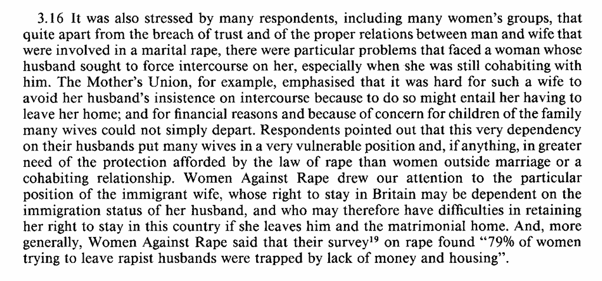
From Rape Within Marriage, The Law Commission, 1992
You can watch here a 1991 interview with Sky News with a campaigner for WAR.

Navigate the public policy maze with the editors as they keep a watching eye on the issues affecting women

Pic by: akinbostanci via iStock
We are all busy, so it is hard to keep up with what people in power are up to - particularly in relation to policies and services that affect women and girls. We can’t offer a full monitoring service, but in each edition we will highlight a few things to watch out for, and where you can find more information.
Westminster is in recess until September 7, so MPs do not have a formal opportunity to discuss the terrible case of Simon Levy, sentenced to a whole-life order at the Old Bailey on 12 August for murdering Carmenza Valencia-Trujillo and Sheryl Wilkins. He was also sentenced for the rape and attack of a third woman.
The Metropolitan Police, British Transport Police and Crown Prosecution Service have all acknowledged failures in their handling of Levy before the murders.
Victims’ Commissioner Claire Waxman OBE has called on the Lord Chancellor to commission an independent multi-agency review to establish what went wrong, identify accountability for the failures and ensure lessons are translated into changes to public protection arrangements.
Listen to Frontline contributor Joan Smith discuss the case and the institutional failures on BBC’s Women’s Hour on Thursday August 13 here.
What’s your council’s policy?
The EHRC’s updated code of practice on single-sex spaces came into effect on August 5. In Scotland, Edinburgh City Council will discuss a report on the implications of the update on Tuesday August 18. You can access it here.
For Women Scotland, who won the landmark Supreme Court ruling last year, say they are “concerned that there is no balanced advocacy within the document on behalf of women and it is produced without any input from groups who understand and welcome the importance of the Supreme Court ruling.”
They urge people living in Edinburgh to email their councillor asking them why the legal rights of women are not adequately represented within the council’s discussion and decisions.
Six London boroughs have already pledged to resist the guidance, describing it as “harmful to the rights of trans people.” The six - Lambeth, Hackney, Haringey, Lewisham, Southwark and Waltham Forest - have made a commitment to keep their services gender inclusive.
Wherever you live in the UK, it might be worthwhile checking with your local council what its plans are for adhering to the guidance.
Listen to Helen Joyce and Maya Forstater of Sex Matters discuss what the new guidance will mean for single-sex services, charities and associations.

UK Parliament: is now in recess until the start of September
Northern Irish Assembly: is now in recess until the start of September
Scottish Parliament is now in recess until the start of September
Senedd Cymru | Welsh Parliament is now in recess until 13 September

All content is protected: articles may not be reproduced without permission from the authors or this newsletter. For any reuse requests, please contact us in the first instance.