ISSUE 29: The Frontline
A 21st century feminist publication where women's voices have power
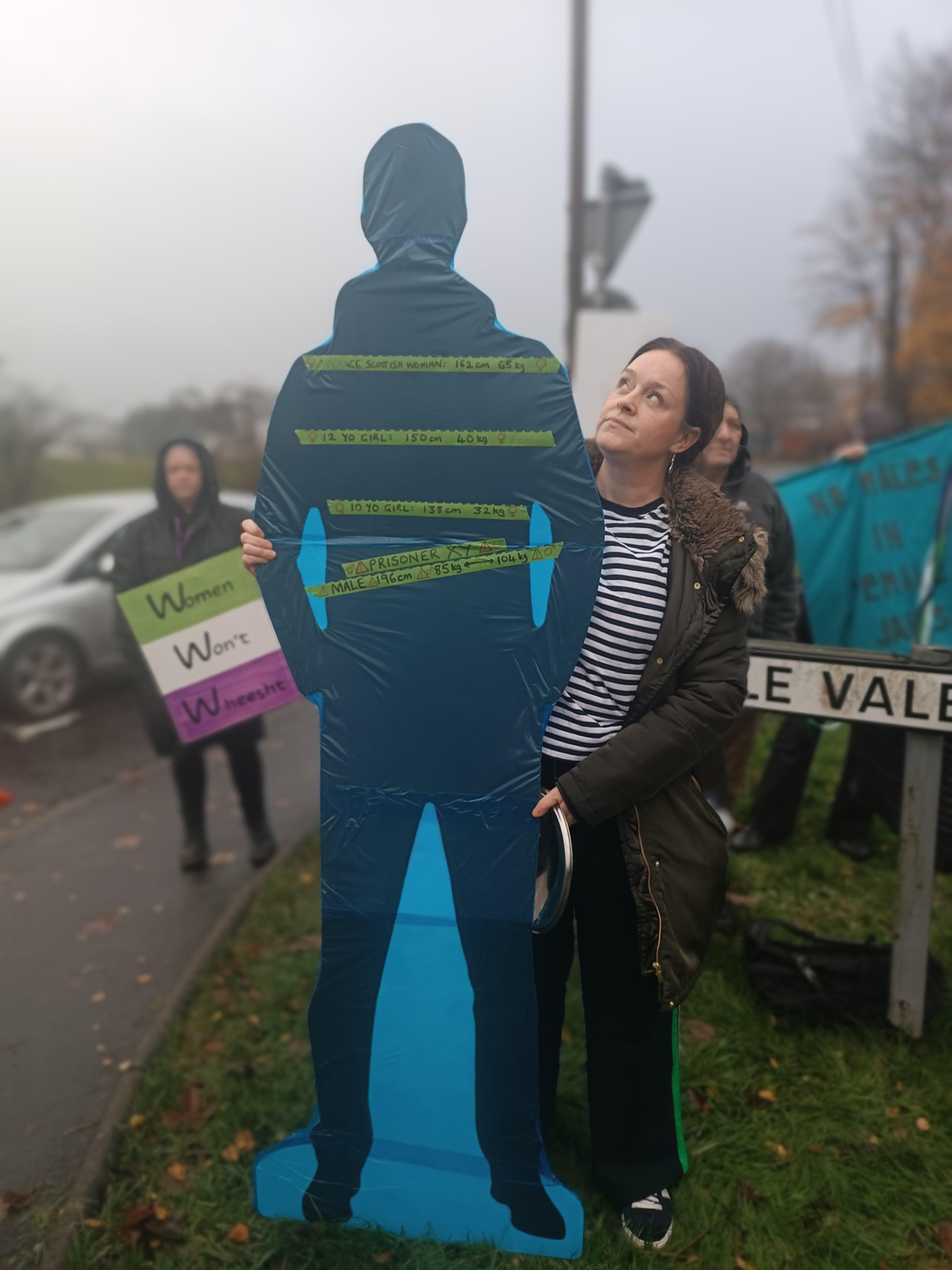
Protest outside Cornton Vale on 26 November 2022 against the Scottish Prison Service placing convicted male sex offender Lennon/Katie Dolatowski in Scotland's main prison for women. Dolatowski represented at full size. Pic via Jenny Reilly.
In the week after single-sex prisons were finally restored in Scotland, following years of campaigning, we bring you one woman’s account of her experience of challenging the use of self-ID in the prison system as a volunteer prison inspector. As our anonymous writer sets out, women are already especially vulnerable and isolated in the prison system. Being forced to live alongside violent men was an additional, unlawful punishment imposed on them by politicians and prison managers. She writes, “I had walked into prisons containing some of the most vulnerable women in Britain and found the institution and the monitoring service preoccupied with protecting everyone except them.”
We start in Scotland, but then commute to London with former lawyer and long-time feminist campaigner Carol Fox who reflects on transforming, in her words “from trailblazing single mother to an amazon knitting nana.” She celebrates warrior mothers and grandmothers and deplores the failure of policy-makers to understand the essential role many older women play in enabling younger ones in their family to work.
Our woman of the week is Dr Rita Nyampinga, whose own brief taste of imprisonment triggered a lifetime of campaigning for better conditions for women in prison in Zimbabwe, and an extraordinary record of supporting women’s rehabilitation and reintegration, after their release.
The button at the end of this issue takes you to our subscriber chat. As ever, you can also find us in real time on X/Twitter, at @DalgetySusan and @LucyHunterB and our shared account @EthelWrites.
We are delighted that we can now plan for our fortnightly 21st century feminist publication to remain fully accessible. But we depend on some of our readers becoming paid subscribers so that we can pay our contributors, as well as keep the newsletter free so ALL women can access it. If you can afford a paid subscription, please consider getting one.


Locked up, left behind: The day a male prisoner asked me for sanitary towels exposed the injustice at the heart of Scotland's prison system
By OceanBreathCafe
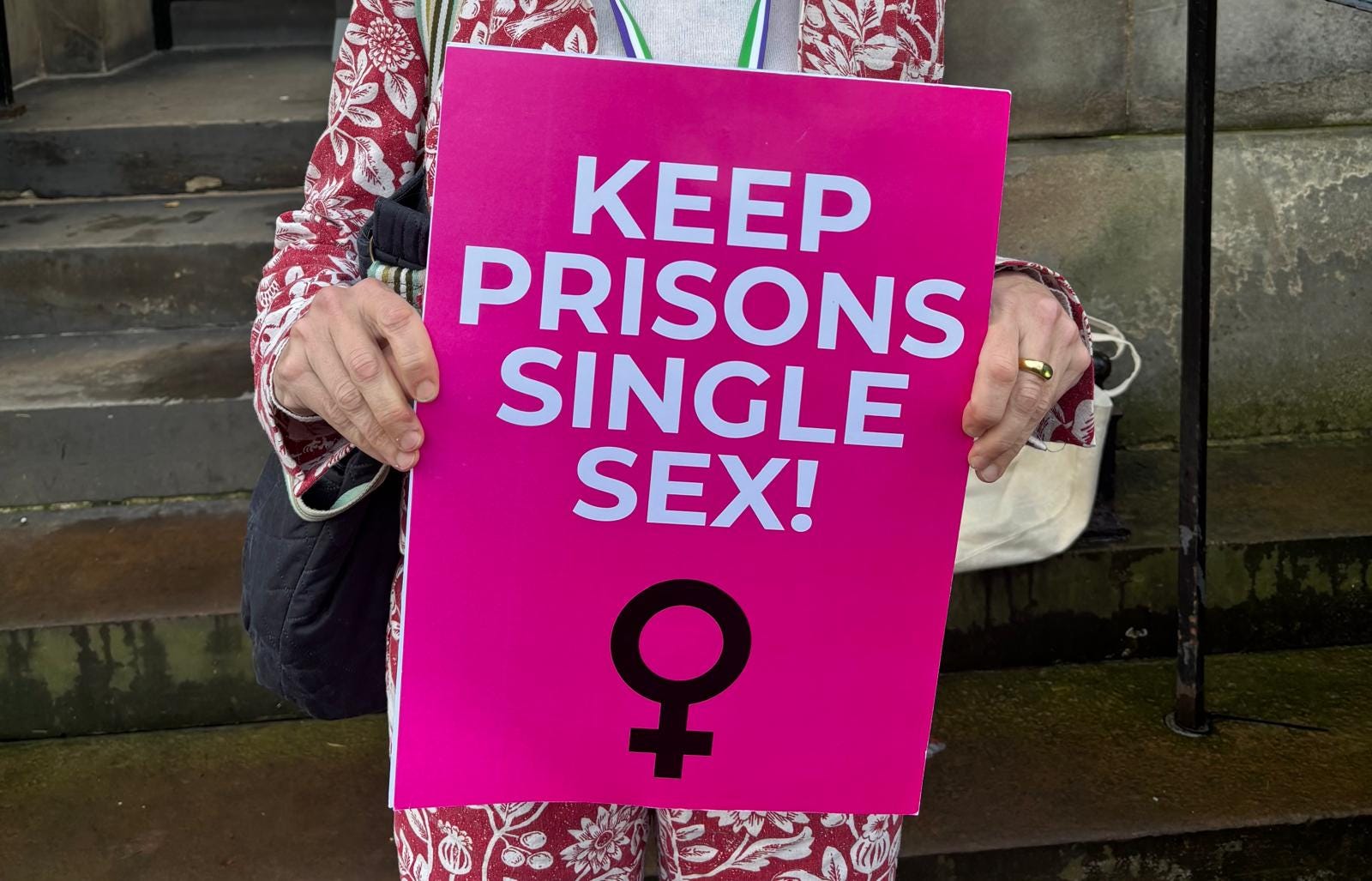
Pic via Susan Dalgety
One of the strangest conversations I ever had as a prison monitor involved a male prisoner complaining that he had not been supplied with sanitary towels. That may sound like satire. It wasn’t.
As a prison monitor with HM Inspectorate of Prisons for Scotland, my job was to establish the treatment of, and conditions for, prisoners and to report publicly on what I found. HMIPS is the state-funded monitoring service designed to provide oversight and check whether prisons are safe, decent and humane. Except, it seemed, when it came to women.
The women the system was supposed to protect
Every day I met women with histories of domestic abuse, sexual violence, addiction, self-harm, mental illness and childhood trauma. Women separated from their children. Women trying to parent children now in foster care. Women who had attempted suicide. Women whose lives would fill entire social work files before they ever reached a prison gate.
Yet somehow, amid all this, prison staff were spending time dealing with complaints from male prisoners who identified as women and demanding laser hair removal for their gender dysphoria.
Women’s prisons are not simply smaller versions of men’s prisons. The women I met were rarely there because they were dangerous. More often they had arrived at prison after a lifetime of abuse, addiction, poverty, mental illness and social collapse. More than half report emotional, physical or sexual abuse as children. Around two-thirds have experienced domestic abuse as adults. Nearly half have attempted suicide. Women account for only around 4% of the prison population, yet around a quarter of all incidents of self-harm in custody.
If you were designing a population likely to be fearful of male violence, you could scarcely have done better. The prison service knew this.
Every woman entering custody was assessed for vulnerability. Officials documented domestic abuse, sexual violence, addiction, homelessness, mental illness and suicide risk.
Which is why I struggled to understand why these same women were expected to accept male prisoners who identified as women within the female estate and why objecting could itself become a disciplinary matter.
Some of those men had histories of violence and sexual offending. Yet women were expected to share accommodation blocks, association areas and, in some establishments, changing facilities and showers with them.
Passing the buck
One woman asked me quietly why she was expected to share facilities with a man when her own prison file documented years of abuse by men. It was not an ideological question. It was a safeguarding question.
I had no satisfactory answer. I raised concerns with prison officers. “It’s above my pay grade.” I raised them with managers. “We don’t make the rules. Ask the politicians.” I spoke to the Minister for Prisons. “It’s a matter for the SPS.”
I eventually put my concerns in writing to the head of HM Inspectorate of Prisons for Scotland. I had hoped that, if anyone would engage with the safeguarding questions, it would be the body responsible for scrutinising prisons. Instead, I received a courteous reply explaining that responsibility lay elsewhere. Once again, the question was passed up the chain. They all seemed well versed in passing the buck.
At a national meeting of prison inspectors, I asked when the definition of “woman” had changed from biological sex to gender identity within the prison system and what formal risk assessment had been undertaken before introducing that change into the female estate. The room became noticeably uncomfortable. Then the discussion moved on.
The official reassurance was that vulnerable women could be transferred into specially designed community custody units. Until you looked at who actually qualified. Most women never did.
Women: The loneliest prisoners
Many women spend only short periods in custody. Around a third of women in Scottish prisons are on remand awaiting trial or sentence. Some never receive a custodial sentence at all. By the time they return home they may already have lost their tenancy, their children or both.
Women’s prisons suffer another disadvantage. There are simply too few women for rehabilitation to operate at the same scale as it does for men. I lost count of the number of educational courses, work placements and training opportunities that simply could not run because there were too few women to justify the staffing.
Then there was the loneliness. More than anything else, that stayed with me.
Male prisoners usually had somebody. A wife, girlfriend, mother, sister or aunt organising visits, bringing photographs, passing on family news and reminding them that somebody still cared. The women usually had nobody.
Their mothers were looking after grandchildren. Their children were with relatives or foster carers. Their families were exhausted, fractured or simply unable to cope. Because there are so few women’s prisons, visiting often meant travelling across Scotland. For many families, it simply wasn’t possible.
The visiting halls told their own story. The men’s visits buzzed with conversation. The women’s would be almost silent.
These were not privileged women demanding special treatment. They were among the most damaged and disadvantaged women in Scotland. Women with histories of abuse, addiction, homelessness and self-harm. Women who had lost their children. Women who often had nobody left to visit them. They were precisely the women the prison system existed to protect.
The unanswered question
During my years as an inspector I kept asking the same question. What risk assessment had justified placing male prisoners in the female estate? I never received an answer. Instead, I was told it was above someone’s pay grade, a political decision, or simply the new policy.
The sanitary towels were, in the end, a distraction. They were never really the point.
The point was that I had walked into prisons containing some of the most vulnerable women in Britain and found the institution and the monitoring service preoccupied with protecting everyone except them.
I began my work asking whether Scotland’s prisons were safe, decent and humane. I finished it asking a much simpler question.
When did women stop being the priority in women’s prisons?
The author was an independent prison monitor for three years. It is a statutory role in Scotland with 6-months training in self defence, key handling, reporting issues, human rights etc. For more information on how to become a volunteer prison monitor click here and see below for the recruitment information pack. She also on Twitter.
You’ll never be a mother, a doctor told feminist lawyer Carol Fox, but forty years later she is still defying the patriarchy - this time as a grandmother
By Carol Fox
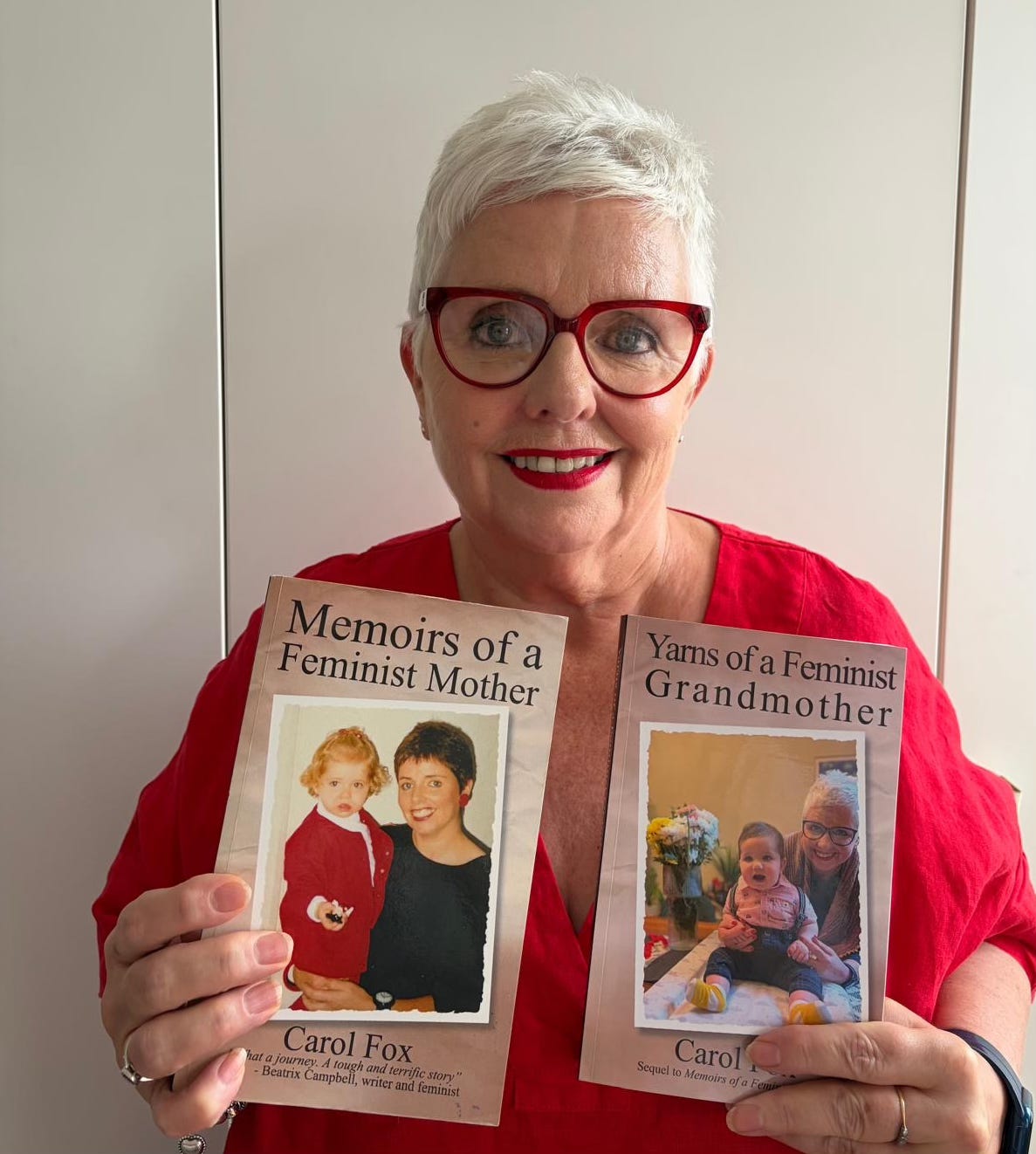
Carol Fox: Feminist lawyer, mother and now grandmother. Pic via Carol Fox
It is almost 40 years since my second major operation at 27 when I was told I would never be a mother. No ovaries. No babies. Simple as that, and delivered as bluntly as that by a paid-up member of the patriarchy in a white coat. Yet here I am, over 65, both astounded and overjoyed not only to be a proud mother but also a doting grandmother. During the last 40 years, life has dealt me more traumas, some triumphs and a few very interesting surprises. In my experience as a fabulous old lady feminist, in order to navigate the ups and downs of life, it is best to be determined and to listen to our instincts. Above all, it is best to tell the patriarchy to get stuffed.
Determined to prove them wrong
My determined journey to motherhood is shared in my first book, Memoirs of a Feminist Mother, newly republished in a second edition with a positive preface - a plea to younger women to think hard and to make their own reproductive choices.
My new sequel, Yarns of a Feminist Grandmother, recounts my experience of becoming a carer, looking after my mother and becoming a grandmother. It is important, after all, to record the real-life struggles of different generations of women.
Sharing our feminist history is vital. I like to think I played my part in challenging the narrow life choices and stereotypes offered up to us in the 1960s. My tales of exploding ovaries, judgemental doctors and my ultimate triumph as an unapologetic single parent took place in the late 1980s and early 1990s when I had to leave Scotland. My daughter was born in London in 1992.
Motherhood is still a feminist issue
It remains dispiriting that although younger women, in theory, now have greater life choices and career opportunities, it is still so difficult to be a working mother. The National Records of Scotland highlight the record low birth and fertility rates, the lowest since records began in 1855. The institutions of marriage and motherhood still saddle women with impossible expectations and immeasurable guilt. Women must be allowed the freedom to make our own decisions to have or not have children in the circumstances that life affords us. It doesn’t need to be perfect, and God knows motherhood is not an easy gig, but where are the voices or stories of women telling us that for them motherhood was a powerful and life-affirming choice?
Are we only expected to moan and be downtrodden or can we celebrate our kids and grandkids too? Surely in 2026, after decades of feminist struggle no judgemental doctor, unhelpful boss, hectoring bank manager, or sound-bite politician should be able to dictate important life choices, to be a mother or not. To be a grandmother or not.
All my energy is now focussed upon being the best grandmother I can be to my toddler grandson and my new granddaughter due later this year, all being well. I still have to pinch myself that this is my new reality. As ever though, life can be complicated. I am a commuting nana, regularly taking the train to London to support my daughter and her family. They are my sole focus now as I have divested myself of all external commitments and demands. In the past three years I have transformed myself from trailblazing single mother to an amazon knitting nana. I did not bend to the laughable expectations and stereotypes of the patriarchy in previous decades, and I am not inclined to do so now. I will create and live my own reality.
Knitting, trains and quiet acts of rebellion
During my journeys south, I have reclaimed knitting. It is possible to knit a hat on the nearly 5-hour journey to London. I enjoy knitting because it is a powerful skill passed down by generations of women. I might not be able to change the world, but I can knit an impressive Fair Isle hat. Knitting helped me through some very difficult times when I gave a woolly two fingers to the world. The bald heads of the patriarchy (in need of a warm hat) may belittle such female skills, but frankly who cares? I will do my thing on my terms, while doing my best for my family. A family that would not exist had I been cowed by the judgemental attitudes of the 1980s.
Recently I met another Scottish nana in London, in the local park in E17. She told me that she lived in Bathgate but flew down by Easyjet from Edinburgh every week for two days to support her family as they could not afford nursery fees. Being a modern grandparent involves more than the occasional spot of babysitting. Indeed, working families depend on the support of grandparents, particularly nanas, to balance the demands of modern life. Thirty-odd years ago, I would not have managed as a single parent without the dedication and help of my mother Agnes.
If politicians value families, they must value grandmothers
Yet now it is so much harder to offer support to different generations. My mother become a grandmother at 56 and retired at 60. I don’t qualify for my state pension until I am 66 and ten months. Our short-sighted politicians and policy wonks have raised the state retirement age for women from 60 to 68, making it impossible for many working women to support the next generation or even look after their elderly relatives. Those self-same politicians want to set up commissions on social care and bed blocking or wring their hands and worry about the falling birth rate and future pensions. Honest to God, give me strength.
Rise up sisters! Demand that life is made easier for working parents, that it should be much easier to look after our mothers and, if we are lucky enough to become mothers and grandmothers, it is vital that caring for the next generation happens when we all have the health and financial security to enjoy our children and grandchildren.
Carol Fox was a lawyer until 2015. She was an award winning solicitor best known for fighting mass equal pay cases for low paid women throughout Scotland. As a young woman she experienced serious fertility problems. Her greatest battles became very personal. In the late 1980s she made the positive decision to become a single parent and have a child on her own while she still could. Refused help in Scotland, Carol moved to London where her only daughter was born in 1992. You can find her books here.

After one terrible night in a Zimbabwe police cell, human rights activist Dr Rita Nyampinga has dedicated her life to restoring dignity, hope and second chances to the country’s forgotten women prisoners
By the editors
A 2025 Big Give fundraiser featured Dr Rita Nyampinga, video via Womankind Worldwide on YouTube
Human rights activist Dr Rita Nyampinga had her first taste of life for women in Zimbabwe’s prisons when she was arrested and briefly detained in Harare’s police cells during a 2007 demonstration campaigning for the widespread distribution of ARV drugs.
The conditions she was exposed to that night shocked her and have remained with her ever since. She shared a tiny cell with six other women with a bucket in the corner serving as their toilet. She spend a sleepless night wondering what to do with her soiled sanitary pad.
From empathy to action
As she later told Ruth Butaumocho, Gender Editor of The Herald newspaper, that long night was to haunt her and led directly to her setting up FEMPRIST (Female Prisoners Support Trust) in 2010. The NGO, which was incorporated in 2012 offers rehabilitation programmes for female prisoners as well as campaigning for reform. It started out of “empathy,” she explained later.
For several years Dr Nyampinga and her fellow activists worked without pay, visiting women and girls in prison where they distributed sanitary products and toiletries, as well baby supplies. They were often the only contact the women had with the outside world as their family and friends had abandoned them.
“At one time I had to use my own resources and move around with a begging bowl to friends, colleagues and relatives, to ensure that the project kicks off,” she told the Herald. In 2019 Womankind Worldwide became the first organisation to fund FEMPRIST’s work and today remains one of its few funders.
Changing prisons, changing lives
A key part of Dr Nyampinga’s work is helping women to integrate back into their community after they have served their sentence. While women are less likely than men to commit the most serious crimes, she found that those who do face greater obstacles to reintegration. She told The Herald,
“Life becomes unbearable for female ex-convicts when they are released from prison especially after serving sentences for murder, infanticide and other serious crimes. More often than not, they come back to find that their husbands have remarried or relatives simply don’t want them back.”
“Society is still to come to terms with the fact that women can commit crimes as men. Women are often regarded as timid, nurturing and not able to perpetrate violent crimes.”
She recalled working with one woman who was chased from her village after serving a seven-year sentence for theft. She said: “We initially gave groceries and the family took her back. When the groceries ran out, they chased her away with her son saying they could not deal with an ex-prisoner.
“We had to rope in the headman who eventually offered her a place to stay and she has since been reconciled with her three children,” she said.
One of FEMPRIST’s biggest successes to date is their campaign for a women’s open prison. The Marondera Female Open Prison opened in 2021, one of the first open prison for women in southern Africa. Women who have served a third of their sentence, with a record of good behaviour, are eligible for transfer. One of the first inmates described life in the new facility: “At the closed prison, we had to leave our babies at the nursery every morning, but here we get to breastfeed them as much as we want and spend most of time with them…and we will be allowed to go home and visit families and be in the community for five days every month. That time is important to maintain relations, our husbands and boyfriends.”
The gift of a second chance
In March 2020, Dr Nyampinga was one of 12 women that year to receive an International Women of Courage Award (IWOC) from the US State Department. She used her IWOC grant to fund a mushroom farming project for 15 former female prisoners. “Our process is about reintegration, rehabilitation, reconciliation, and restoration,” she said. “Restoration occurs when the women work and generate income. Once this happens, they are accepted by their families and communities,” she explained.
In 2014, Dr Nyampinga received Zimbabwe’s Female Human Rights Activist of the Year award. She is also a holder of an honorary degree from the International Institute of Philanthropy. But the 68-year-old activist’s career is not measured by awards but by her philosophy that underpins all her work, including prison reform. She believes in giving people a second chance in life. She said: “We are not condoning the heinous activities of women, but we want them to be rehabilitated in a non-violent judgmental manner, while giving them a second chance to lead a better life.”
To find out more about FEMPRIST click here
A 2025 Big Give fundraiser featured Pamela, a former prisoner, who describes how FEMPRIST changed her life. Video via Womankind Worldwide on YouTube

Navigate the public policy maze with the editors as they keep a watching eye on the issues affecting women

Pic by: akinbostanci via iStock
We are all busy, so it is hard to keep up with what people in power are up to - particularly in relation to policies and services that affect women and girls. We can’t offer a full monitoring service, but in each edition we will highlight a few things to watch out for, and where you can find more information.
The Patient Safety Commissioner for England, Dr Henrietta Hughes, has written to ministers giving them until 16 July to confirm whether they will establish a redress scheme for women injured by pelvic mesh, following recommendations in the Hughes Report (February 2024). This is only the second time since taking up her role that she has used her statutory powers under the Medicines and Medical Devices Act to seek a formal response from the government. Campaign group Sling The Mesh is urging the Government to introduce a compensation scheme.
On 5 June, the UK government published a consultation, A fairer end to relationships, with proposals to reform the law in England and Wales for families when relationships end, covering financial remedies on divorce and dissolution, the law for cohabitants on separation, and the law for cohabitants on intestacy. It notes that “the very limited set of protections under the current law can leave cohabitants facing significant financial difficulties when relationships end, which disproportionately affects vulnerable groups such as women, children and victim-survivors of domestic abuse (including economic abuse).” The deadline for responses is 14 August.
UK Parliament: click here for future business
Northern Irish Assembly: click on ‘Business Diary’ for a week by week schedule
Scottish Parliament is now in recess.
Senedd Cymru | Welsh Parliament click on “View full calendar”

All content is protected: articles may not be reproduced without permission from the authors or this newsletter. For any reuse requests, please contact us in the first instance.