ISSUE 31: The Frontline
A 21st century feminist publication where women's voices have power
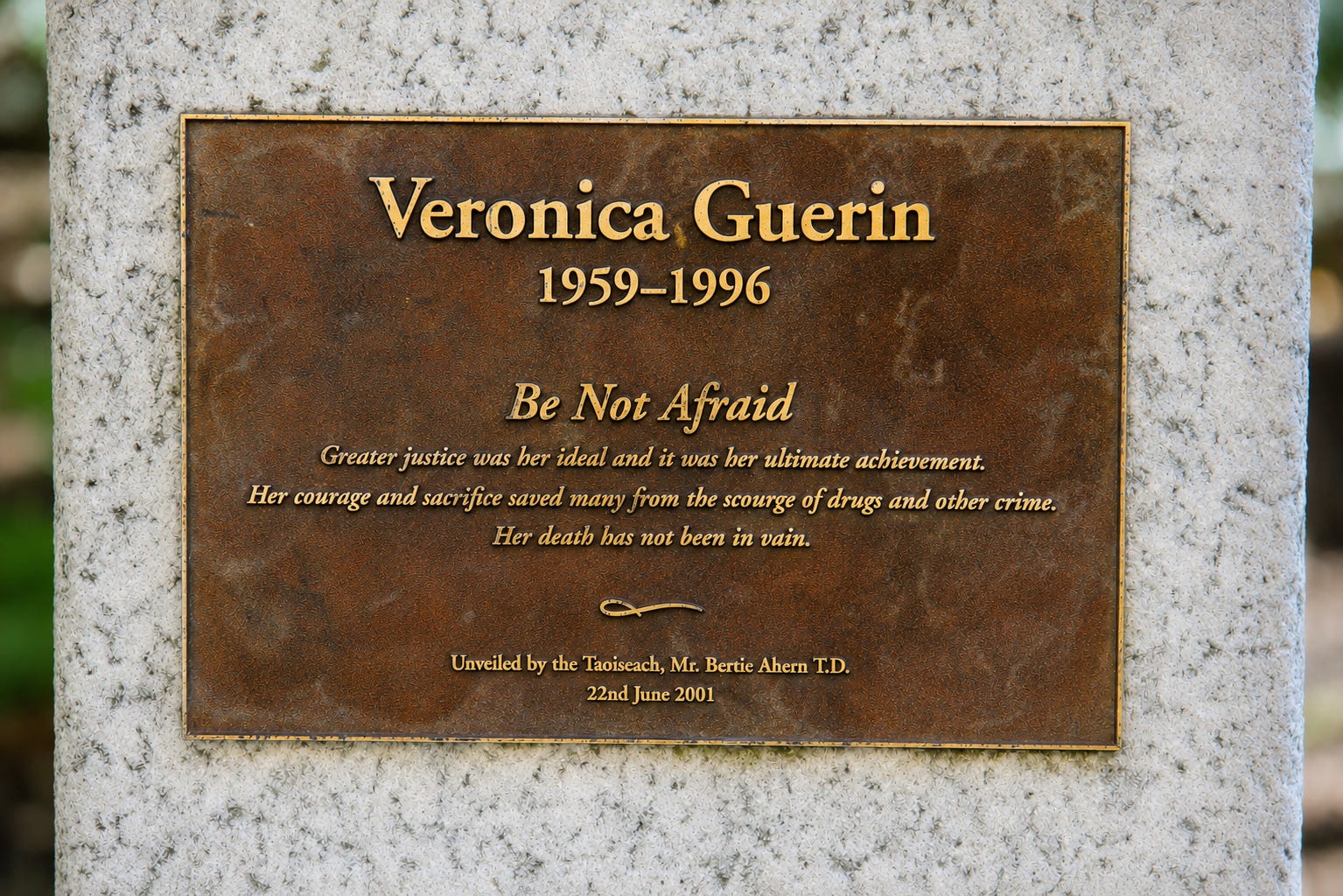
Be not afraid: The memorial to Veronica Guerin in Dublin’s Dubhlinn Gardens. Image by J.-H. Janßen via Wikimedia Commons.
In this issue we turn the spotlight on women in journalism. As the journalist, suffragist and civil rights activist Ida B Wells-Barnett famously wrote: “The way to right wrongs is to turn the light of truth upon them”. But telling the truth can come at price, sometimes the most terrible one.
Thirty years ago, on June 26, 1996, our Woman of the Week crime reporter Veronica Guerin was shot six times through the window of her car as she sat at traffic lights near her home on the outskirts of Dublin.
Veronica, a crime reporter for the Sunday Independent, was assassinated for her award- winning work on exposing organised crime in Ireland. The gangland boss accused of ordering her death was never convicted of the crime.
Speaking after her death her husband said: “Veronica stood for freedom to write. She stood as light, and wrote of life in Ireland today, and told the truth”.
Former Guardian reporter Janet Murray writes about how the simple act of speaking plainly almost destroyed her career. She lost her successful media business and had to rebuild her freelance career after objecting to the phrase “pregnant people”. But as she argues, silence is what allows cancellation culture to continue.
Another leading woman journalist Catriona Stewart reveals how insecure the profession is today and she highlights how the industry remains stubbornly sexist. But, she concludes, if you have a “stomach sick at injustice” there is no other career quite like it.
The button at the end of this issue takes you to our subscriber chat. As ever, you can also find us in real time on X/Twitter, at @DalgetySusan and @LucyHunterB and our shared account @EthelWrites.
We are delighted that we can now plan for our fortnightly 21st century feminist publication to remain fully accessible. But we depend on some of our readers becoming paid subscribers so that we can pay our contributors, as well as keep the newsletter free so ALL women can access it. If you can afford a paid subscription, please consider getting one.


How a frappuccino led me into journalism — and why despite everything, I’d choose the newsroom all over again
By Catriona Stewart
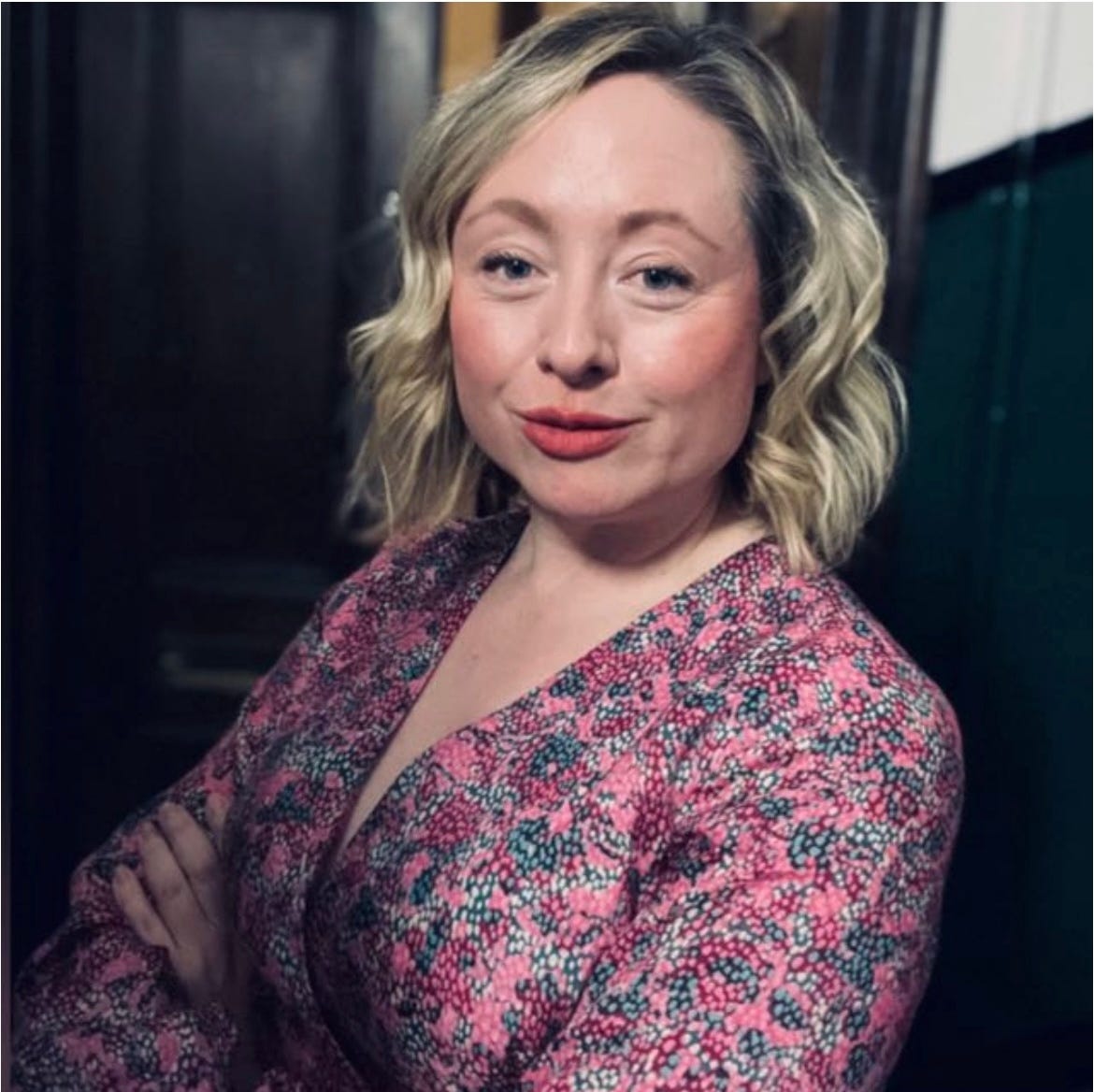
Catriona Stewart. Image contributed.
I became a journalist through the medium of Frappuccinos.
Frappuccinos, and a sort of Mr Bean-esque improbable luck whereby one bends to pick up a dropped penny just as the painter spins his ladder violently into the space freshly vacated by one’s head.
I’ll explain. I’d gone for a job in an electrical goods store in a retail park in Airdrie and through great good fortune was knocked back.
Good fortune because the Starbucks on Renfield Street in Glasgow, where my cousin and I convened on Saturday afternoons to drink short hazelnut steamers and pretend we lived in Seattle or California or New York City, had a little card by the till saying they were hiring.
I scored an interview. The barista, Reg, wrote me a note reading, “I like metal and loud noise at late times”. This was 1999 and that remains seared in my brain.
I had absolutely no idea what it meant but Reg told me to recite it in the interview, which I did, and the job was mine. (The manager, Andy, was a big death metal fan. I was a straight A student who played clarinet and taught Sunday school, so Lord knows how he was convinced by my feigning simpatico interests.)
And there I was for eight years. I bloody loved being a barista but knew I couldn’t stick around forever.
I’d been shunted off to university meantime. My first pick of uni was a financial impossibility so I went with my third choice. I had no interest in any particular subject, so read English because I was good at English and psychology because I knew what that was.
I hated university, worked full time to support me and my mum and had absolutely no idea what sort of job I might do on graduating.
My first experience of the trade
Happily, however, many of my Starbucks regulars were journalists. The news anchor, Shereen Nanjiani (tall mocha Frappuccino), arranged work experience at STV for me.
I was so ignorant I looked veteran presenter John McKay square in the eye and asked him what he did. We have laughed about it since; I remain mortified.
From there, I ricocheted to the Scottish Daily Mail. The news editor (double tall semi-skimmed latte) granted me work experience and I stayed for five years.
It was a marvellous yet utterly terrifying training ground. I was barely 20, from a Lanarkshire steel town and working with predominantly middle aged, middle class men who were very, very good at their jobs while I was a lump.
A grateful lump, though, a quick study who quickly realised she’d landed on her feet. I did a Masters degree in journalism, kept up the Starbucks job (you never know), worked at the Mail and was also helping care for my beloved grandmother, who was terminally ill and wanted to die at home.
It was a lot but never too much because I loved the newsroom desperately and it suited me. I am astonishingly, disgustingly nosey, which serves a reporter well.
I have a horror of consistency and news reporting is a daily multi-sensory kaleidoscope. At the risk of sounding twee, I also believe work has to serve positive purpose.
I worked for a Glasgow newspaper after the Mail and could see an immediate community benefit to the stories I was writing. It was also pure, tremendous fun. A proper newsroom is stuffed with eccentrics and leaves you daily breathless.
Of course, reality did butt against the romance of it. For the young women, there was normalised sexual harassment. The bulk of my anecdotes are suitable only over a drink but rest assured, they would pop your brows clean off your forehead.
It is better now and that is partly a societal shift and largely thanks to the work of women who have laboured - as do we always labour - to force improvements.
Women in journalism
I sit as vice-chair of Women in Journalism Scotland (WiJS) and have been on the committee since day one. I believe as much as I believe in any other tenet that women in our industry must have each other’s backs.
I am also grateful every day to Shereen, who shaped the course of my life and want every day to pay that forward.
I had the uncanny experience of going 20 years without a job interview because I was fortunate enough to be headhunted and in the right places at the right times.
The shock of losing my job
Key advice for young journalists - the industry will acknowledge merit but your success rests on who you know. Network the shit out of it.
This astonishing luck ran out in 2024 when I lost my job (on my birthday!), which everyone but me saw coming. I’m not sure what I thought - if you love something enough you can keep it forever?
I was in anticipation of a new role in politics and was having IVF at the same time so one moment the future was a vivid thing and the next moment (on my birthday!) it was all loss.
That might have been the moment to concede defeat but I genuinely do not know what else I would do. So I networked the shit out of it. Some of the capers necessary to secure freelance work are also only fit for over a drink. Sometime I’ll tell you my Michael Gove anecdote.
The upside was a complete reinvigoration that led to the best year of my career and, as the cherry on it, a new job as education correspondent at The Scotsman working closely with the finest politics team in Scotland.
I was not long in the Holyrood lobby when I was de-employed and I determined to stay in it largely because there remain so few women in Scottish political print journalism - only one female newspaper political editor. She’s currently on maternity leave and her stand in is a man.
At May’s Scottish Press Awards, in the 28 mixed-sex categories (WiJS set up a women-only award) a whole two women won. One for food and drink writer and one for feature writer.
There were four women and one man up for Reporter of the Year. The bloke won it. His name? Graham Mann. A brilliant reporter, no doubt, but the nominative determinism is a hoot.
The worst element of this vainglorious sausage fest was the completely no-toss-given attitude of all of the boys. One bloke suggested on BBC Radio Scotland that so many men won because men are just better journalists.
So would I recommend it? With caveats. The pool of opportunities shrinks and competition is fierce. Newsrooms expect journalists to be social media personalities, often without support for young women who will be harassed online.
There is money, but less of it. There are no jobs for life. But the opportunities for portfolio careers are limitless and thrilling.
If you have a rough hide and a stomach sick at injustice and a big appetite for simply knowing stuff then the world is yours and you should revel in it.
Catriona Stewart is The Scotsman’s education correspondent. She has covered an array of beats, from crime, court, politics and foreign reporting to travel, features and the arts. Catriona has written for The Times and The Sunday Times, the Daily Mail, The Spectator, The Guardian, The Observer and The Telegraph. She is a regular contributor to the BBC, STV and Sky News. Catriona is vice chair of Women in Journalism Scotland and a children’s panel member.
Cancellation cost me my business - but not my integrity
By Janet Murray
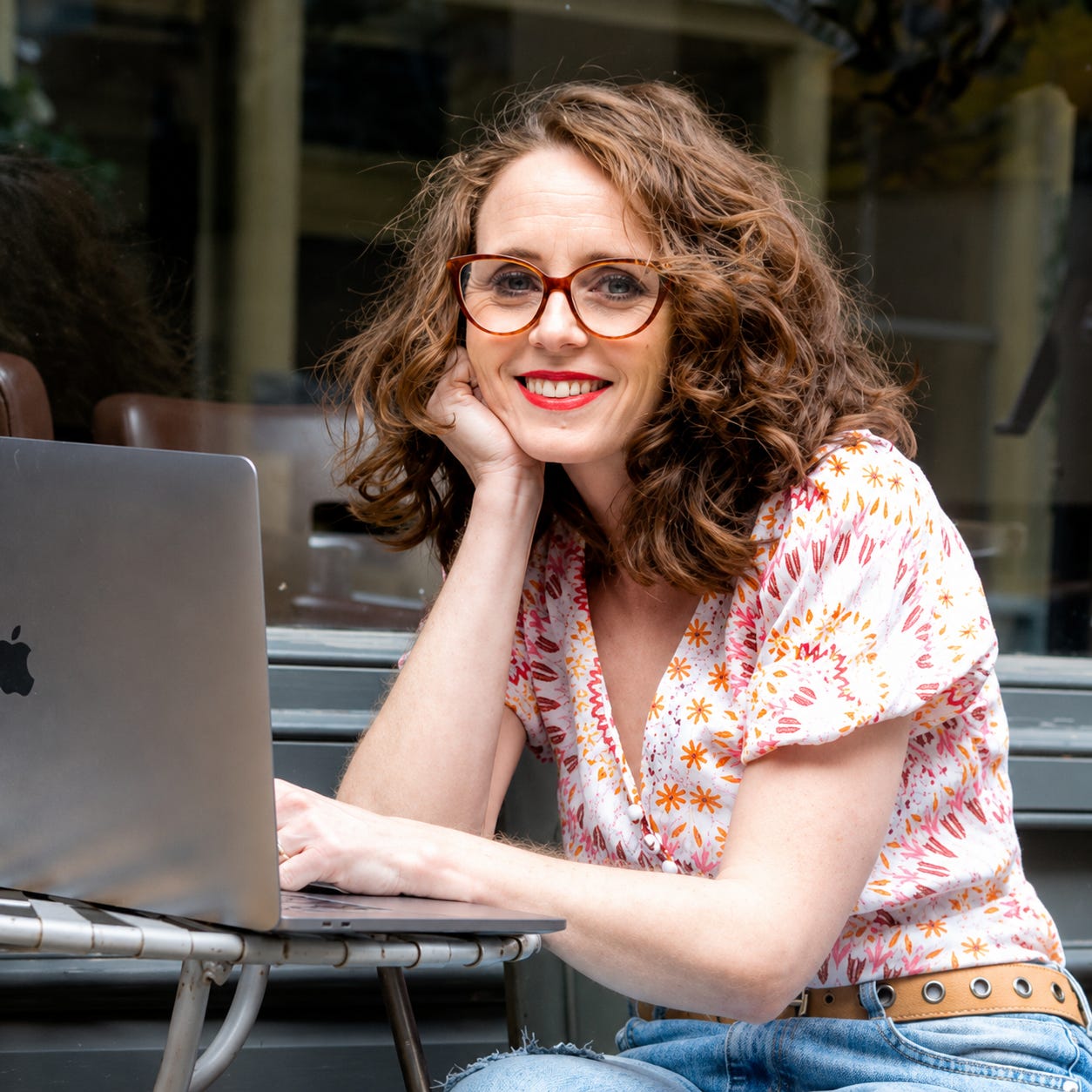
Janet Murray. Image contributed.
Earlier this year, Dragons’ Den star Deborah Meaden asked for examples of people who’d been cancelled for expressing lawful opinions. Did she really need to ask?
Meaden had become embroiled in a public spat on X with publican and broadcaster Adam Brooks over his claim that expressing your views in Britain “can get you cancelled, sacked or even arrested”. She appeared deeply sceptical.
I tagged her in a post listing examples: a children’s author, barrister, journalist, poet, dance company founder, social worker, professor, comedy writer and doctor. All had faced serious professional or legal consequences after expressing lawful views relating to biological sex.
Cancelled for speaking out
Then I shared what had happened to me: how I’d lost the digital marketing business I’d spent more than eight years building - after saying I disliked the phrase “pregnant people”.
After infertility, miscarriage, ectopic pregnancy and premature birth, it was an issue on which I felt more than qualified to hold an opinion. Surely people could respect my position, even if they disagreed? Apparently not.
There was public abuse. Clients distanced themselves. Contractors and long-standing service providers withdrew. Professional relationships disappeared. People who had known me for years publicly denounced me.
At its height, my business had turned over almost half a million pounds a year. I’d spoken internationally and built a sizeable online community. Within days, I knew I was no longer welcome in an industry in which I had once been prominent.
Gender-critical beliefs may be protected under the Equality Act, but for self-employed people that protection can feel theoretical. As I pointed out to Meaden - herself a self-employed businesswoman - there is no disciplinary hearing or employment tribunal when clients, collaborators and recommendations quietly disappear. The career you built simply ceases to exist.
I tried to hold my business together for several months. I knew I had supporters, although most were afraid to say so publicly. My inboxes were full of messages that started: “Please don’t share my name.”
A few months later, I was diagnosed with breast cancer. As my income and reputation collapsed, I underwent surgery and radiotherapy, wondering whether I would ever support myself again. I sold my car to stay afloat during treatment.
In January 2026, I returned to my former career in freelance journalism. It was tough at first - rates have barely improved in a decade. I’m glad I did, but what choice did I have? Who else would employ me?
As Jenny Lindsay observes in Hounded the process rarely ends with a single attack. Trans activists typically deploy an array of tactics to silence women - which means another attack may always be waiting around the corner.
For me, it came in April 2026. The Singing Striders, the community choir I founded, was stood down from supporting the disability charity Scope at the London Marathon because of my lawful gender-critical views.
Lawyers became involved and the invitation was reinstated the night before the marathon. By then, singers were distressed about being associated with me, so I assembled a scratch choir and we performed elsewhere. Several of us are now pursuing legal action, although I hope the dispute can be resolved without going to court.
Starting again at 51
I’m 51 now - and feel like I’m starting again. I previously wrote and edited mainly for The Guardian. I now investigate activism and policies affecting women and girls for The Telegraph, the Mail on Sunday and GB News.
The work brings daily abuse, doxing threats, vexatious complaints and numerous reports to the police.
Abuse from strangers is one thing. Friends and family are another.
Relationships with some relatives are now strained because they disapprove of my views, with consequences for the wider family.
Recently, former clients, friends and contractors who had worked with me for years collectively disassociated themselves from me in a public social-media post - because I was taking legal action against a charity. One had attended my wedding.
They hadn’t read the newspaper report or understood that I had tried to resolve the dispute privately. The word “charity” appeared to override any curiosity about whether we might have experienced discrimination.
Some choir members have now distanced themselves. My sense is they agree Scope behaved badly but wish I’d stayed quiet. Understandably, they found the fallout distressing.
This is what people mean when they say the process is the punishment.
I was late to understand the harm gender ideology was doing to women and children, and how deeply it had entered our institutions under the guise of “kindness”. I cannot change the past, but I can use my voice and skills to keep these issues in the public eye now.
For me, this is bigger than gender ideology. If people can be coerced into agreeing that a man is a woman, they can be persuaded to affirm almost anything. In a democratic society, that’s dangerous.
I’m not particularly religious, but I believe life sometimes sends you where you need to be.
I recently became Director of Seen in Journalism, a professional network committed to improving the accuracy and impartiality of reporting on sex and gender.
In its next phase, I want us to speak directly to journalists - going into newsrooms and journalism colleges, starting constructive conversations and giving reporters the confidence to cover difficult subjects accurately, impartially and without fear.
I’m also working on a book sharing the untold stories of women affected by gender ideology. It was inspired by the hundreds of messages I received following my first cancellation. Its working title is Please Don’t Share My Name.
I understand that fear. But silence is what allows this culture to continue.
I couldn’t save the business I built. What I can do is use my cancellation - and the skills it could not take from me - to make it safer for others to speak.
Have you been affected by gender ideology but felt unable to speak publicly?
Janet would like to hear your story for Please Don’t Share My Name.
You can contact her confidentially at janet@janetmurray.co.uk
Nothing will be published without your explicit consent.
Janet is on X as @jan_murray and you click here for her Substack [Un]Captured

Veronica Guerin: the fearless investigator of Ireland’s most dangerous gangland bosses, who paid the ultimate price for her commitment to truth
By the Editors
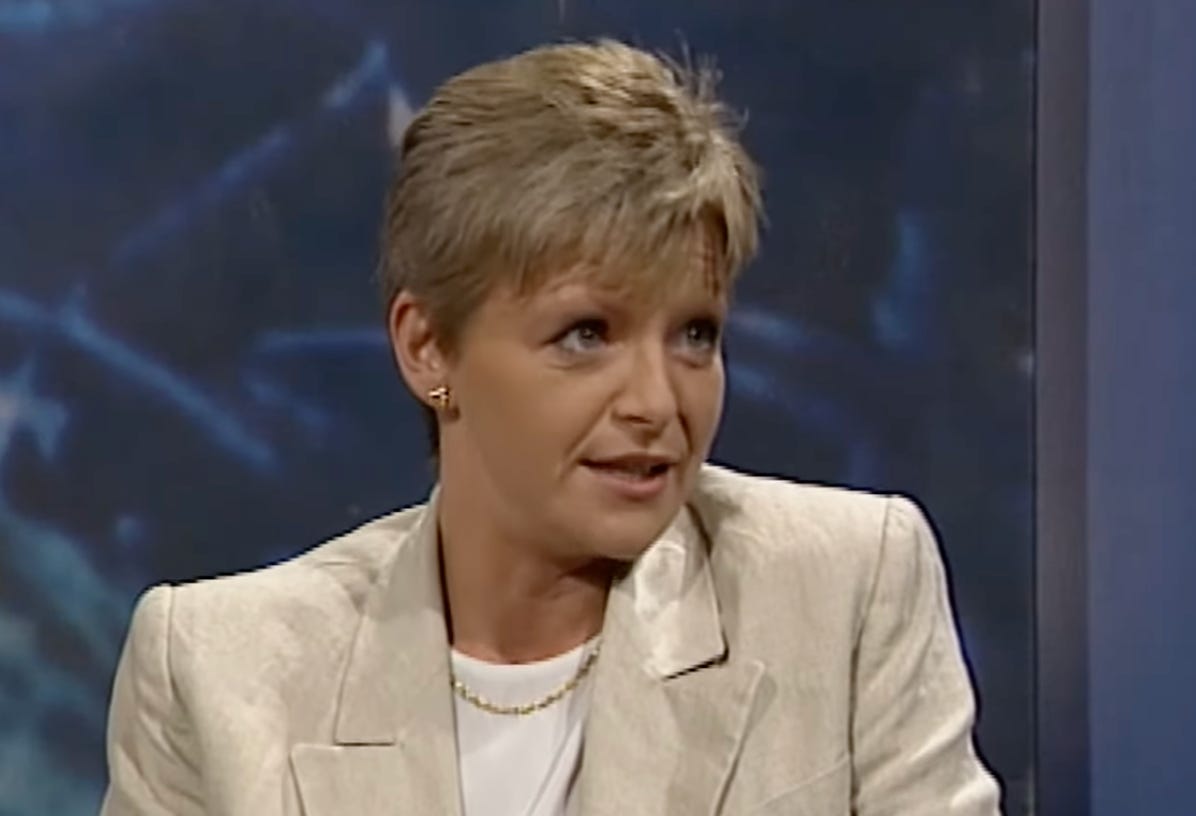
Veronica Guerin interviewed in 1995 about her work. Image via YouTube
It is thirty years since investigative journalist Veronica Guerin was shot dead while waiting at a traffic light on the outskirts of her home city, Dublin, on 26 June 1996. She was a few days short of her 38th birthday. The cold-blooded contract killing, which took place in broad daylight, shook Ireland. No journalist had been killed in the decades of the Troubles in the North. Four years later, the International Press Institute would include her among its World Press Freedom Heroes of the second half of the twentieth century.
Guerin grew up sporty, representing Ireland in basketball and football at school, and as a young woman. She came relatively late to journalism, working first in accountancy, then in public relations, and then in the backroom of politics, for Fianna Fáil. There she became friends with Micheál Martin, Ireland’s current Taoiseach. Remembering her last month, he recalled “a vibrant, exuberant young woman… a force of nature who touched the lives of many people and in her far too brief life changed her country and made it better… a person driven to tell stories which others couldn’t.”
She moved into reporting in her early 30s, soon after the birth of her son. Her focus became on gangland and paramilitary bosses, where she put her background in accountancy to use, unpicking the operations of organised crime. Her friend and colleague, Lisa Hand, wrote recently:
“It was a job tailor-made for Veronica. She was immensely sociable, a crackling, sweary ball of energy, dogged and determined. She had a strong sense of social justice, and hated how a handful of drug lords had wreaked havoc in poor inner-city streets and how they were growing rich and powerful on the proceeds from selling large quantities of E, coke and hash to increasingly affluent punters.
She watched the ‘crims’ swanking about in expensive cars and splashing out on big houses with complete impunity. “Follow the money,” was her favourite mantra. That’s how to nail them – that, and hauling them out of the shadows and into the spotlight by describing who they are, what they look like, their identities covered only by a gossamer-thin disguise of a nickname: the Warehouseman, the Coach, the Penguin, the Boxer.”
Early in 1995, a gunman arrived at Guerin’s home, aimed a gun at her head and then shot her in the thigh. After leaving hospital, and still on crutches, she did a round of visits to crime bosses, to make it clear that intimidation would not work. She said, “I vow that the eyes of justice, the eyes of this journalist will not be shut again. No hand can deter me from my battle for the truth.” She rejected round the clock security offered by the police. In 1995, she won International Press Freedom Award from the Committee to Protect Journalists.
Lisa Hand was the last person Guerin spoke to, from her car, moments before the pillion passenger on a motorbike shot her six times through the window of her car. She was murdered only days before she was scheduled to give a speech titled “Dying to Tell the Story: Journalists at Risk”, at a conference in London. The then Taoiseach, John Bruton, described her murder as “an attack on democracy” and attended her funeral.
Her death caused an outcry in Ireland, and beyond. There was a national silence on 4 July. Hand recalls, “Thirty years ago, Ireland was a different place. We were still shockable back then, not so desensitised to violence and brutality. The cold-blooded, meticulously planned daytime public execution of a journalist – a well-known, greatly-trusted female journalist – by criminals who really believed they were untouchable, shook the country to its very core.”
The assassination was linked to an assault Guerin had suffered at the hands of a key player in Dublin’s organised crime scene, who had made further serious threats against her and her son. Guerin had pressed charges against him.
A huge criminal investigation, the largest ever in Ireland, was launched. The fall-out from it was messy, however, involving some members of the gang which was assumed to be responsible turning state witness, convictions that were later overturned, but several of the men assumed to be involved being convicted for other offences. The gangland boss who had assaulted and threatened her was acquitted of involvement, but later given a long sentence for drugs offences.
The establishment of Ireland’s Criminal Assets Bureau, which investigates the proceeds of criminal activities, is often linked to her work, and her murder cited as one of several incidents that meant the legislation to set it up was completed urgently, weeks after her death.
Speaking a year later, Guerin’s husband Graham Turley said simply: “Veronica stood for freedom to write. She stood as light, and wrote of life in Ireland today, and told the truth. Veronica was not a judge, nor was she a juror, but she paid the ultimate price with the sacrifice of her life.”

Navigate the public policy maze with the editors as they keep a watching eye on the issues affecting women

Pic by: akinbostanci via iStock
We are all busy, so it is hard to keep up with what people in power are up to - particularly in relation to policies and services that affect women and girls. We can’t offer a full monitoring service, but in each edition we will highlight a few things to watch out for, and where you can find more information.
Westminster may be in recess, but politics is not on holiday. New prime minster Andy Burnham’s speech on social care (Monday July 27) has sparked off a national conversation about social care and not before time. Social care is one of the biggest challenges facing society today and, not surprisingly, it affects more women than men. Women make up 56 per cent of the people receiving adult social care support and there is a much higher number of women living in care homes, largely because women live longer than men. And of course, the majority of unpaid carers and those employed in social care are women.
You can read Andy Burnham’s speech here.
Women also make up the majority of trade union members today. The TUC recently reported that there are now 3.72 million female members compared to 2.85 million male members, yet in an astonishing move four of the UK’s top unions have revealed that they will boycott this year’s Labour women’s conference.
In Issue 11 of The Frontline we showcased three women who are currently challenging their respective trade unions in court over their stance on women’s rights.
Click here to read their stories.

On September 7, when Westminster returns from its summer break, parliament will debate a petition which would see surrogate mothers stripped of their rights at birth.
As campaign group Surrogacy Concern points out this would be a disaster for working class women and children. To object, you can let your MP know your views via Surrogacy Concern.
Click here to take part in the campaign

UK Parliament: is now in recess until the start of September
Northern Irish Assembly: is now in recess until the start of September
Scottish Parliament is now in recess until the start of September
Senedd Cymru | Welsh Parliament is now in recess until 13 September

All content is protected: articles may not be reproduced without permission from the authors or this newsletter. For any reuse requests, please contact us in the first instance.