

ISSUE 3: The Frontline
A 21st century feminist publication where women's voices have power

Pic by Mammuth via istock

For our 4 July issue, The Frontline looks to the United States of America as it celebrates Independence Day. Long-time Democrat and radical feminist Kara Dansky shares her experience as one of the Women on the Frontline of sex-realist feminism in America, where mainstream “feminist” organisations have abandoned women and girls. Continuing the American theme, our Woman of the Week is Anne Royall, one of the first political journalists in the United States. Her “vituperative powers” led to a narrow miss with the ducking stool.
We are delighted that The Women Who Wouldn’t Wheesht, the story of women in Scotland who risked their job, reputation, even the bonds of family and friendship, to make their voices heard is available in the US. With over thirty essays and photographs, our best-selling collection introduces readers to women from across society: grassroots campaigners and poets, journalists and politicians, not forgetting one of the world’s most famous authors, J.K. Rowling. These courageous women have shaped recent political history in Scotland, and beyond.
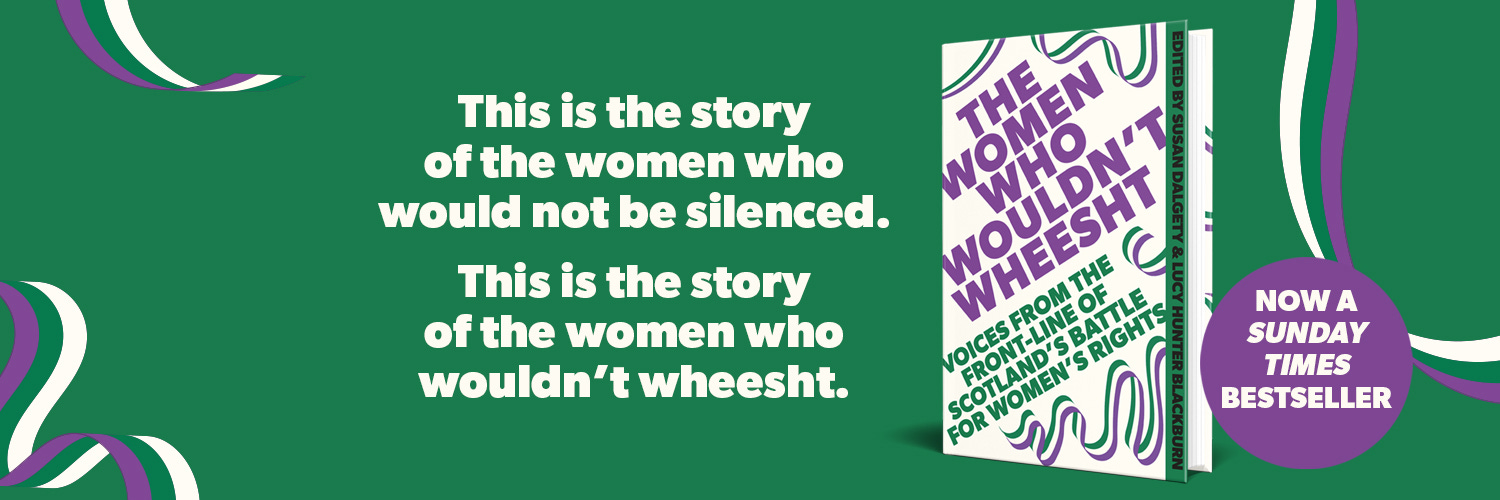
wheesht (Scots) (wi:ʃt): a plea or demand for silence (exclamation); to silence (a person, etc.) or to be silent (verb)
Staying in Scotland, we return to the theme of mothers raising boys, with the second part of Betha Dalziel’s reflections on life with Tiny Son.
In Policy and Power, we link to Ash Regan MSP’s Unbuyable Bill in the Scottish Parliament, and to a briefing on the impact on women of proposed changes to disability benefits at Westminster. As summer arrives, we also include information on parliamentary recesses across the UK.
The button at the end of this issue takes you to our subscriber chat. As ever, you can also find us in real time on X/Twitter, at @DalgetySusan and @LucyHunterB, and our shared account @EthelWrites.
Our fortnightly 21st century feminist publication, where women's voices have power, remains fully accessible to those who cannot afford a paid subscription, and is able to pay its contributors, because of the support of our paid subscribers. There are now over 1,000 of you. Thank-you for joining us.


“Trans” and the State of Feminism in the USA
By Kara Dansky
I registered to vote as a Democrat in 1990, when I turned 18. I considered myself politically left of the Democratic Party, but registering to vote as a Democrat made the most sense at the time. I registered Green in the early 2000s, and re-registered Democrat to vote in the 2008 presidential primary. One day in November of 2014, I was sitting with a friend in my apartment, drinking wine and talking politics. At that point, I knew I was a feminist, but I had not paid close attention to “trans.” Like any good political leftist, I had heard about “transgender rights,” and assumed I was in favor. My friend said, “Everything about transgender rights is anti-woman.” I had never heard that before. She said, “Think about it, Kara. It’s basically the ultimate penetration of our bodies by men.” My life would never be the same.
In 2015, I moved to New York and joined a radical feminist meet-up group. There, I met a woman who told me about the Women’s Liberation Front (WoLF), and I joined immediately. I have been fighting for the sex-based rights of women and girls ever since. It has not always been easy, but I have no regrets.
The state of feminism in the USA
For American Terfs, the state of feminism in general is dreadful, because the large mainstream “feminist” organisations have abandoned women and girls. The National Organization for Women, Planned Parenthood, the Women’s March, and the National Women’s Law Center all champion the idea that ‘trans women are women.’ On June 8, 2025, the National Center for Lesbian Rights went so far as to change its name to the National Center for LGBTQ Rights (while conveniently keeping the acronym NCLR).
However, the movement to protect the sex-based rights of women and girls, though much less well-known, remains strong and is growing. I served on the WoLF Board of Directors from 2016 to 2020. Those were some very lonely years for US Terfs. We felt like we were screaming into a void. But we crept along, doing our best. Things have changed considerably since then. Women’s Human Rights Campaign (now Women’s Declaration International, or WDI) was launched in the U.K. in 2019, and the U.S. chapter launched in 2020. I served as President and member of the Board of Directors of the U.S. chapter from 2021 to 2024. Like WoLF, WDI consists of radical feminist activists who fight to protect women and girls as a sex class. I am confident that we will eventually win the “gender wars.” We have a lot of work to do, but we’re strong and determined.
Why I put my head above the parapet and at what personal cost
I put my head above the parapet before I fully realised there was a parapet. It just seemed so bleeping obvious that women and girls need to stand up as a sex class and say no to this nonsense. Who knew in 2015 that saying that a woman is an adult human female can cost you your friends, family, and job? Maybe I was naive. I don’t know.
I do know that I lost a 20-year career for speaking out. The last time I had a salaried job was in 2019, when I was working at a city-run criminal justice agency. Multiple people complained (anonymously) to my boss via email and social media that there was a Terf at the agency. Every time she got a complaint, we had to discuss it. It distracted her, her superiors, and me from getting the agency’s work done. I had a choice: Shut up about women’s rights and keep my job, or quit. So I quit.
In 2022, a cousin took to Twitter (now X) to call me a far-right fascist bigot and then blocked me. We haven’t spoken since. At a family gathering last year, a different cousin refused to even look at me, even though we knew each other fairly well and spent time together when we lived in the same area. I emailed her to ask why and her response was that I “hate transgender people” and that she wants nothing to do with me. We also haven’t spoken since then.
A woman who I considered to be one of my oldest and closest friends hasn’t spoken to me for several years because of this issue. A different friend from childhood once posted on Facebook that J.K. Rowling was responsible for the murder of a “trans woman” in Indianapolis. I commented to the effect that even if you accept “gender identity” as a real thing, it’s a bit ridiculous to blame a murder that took place in Indianapolis, Indiana, on J.K. Rowling. She unfriended and blocked me.
Trump, the Democrats, and the 2024 presidential election
I loathe Donald Trump and think he has no business being anywhere near the Oval Office. By 2020, I knew how toxic “gender identity” is for women and girls as a sex class, but I was desperate to get Trump out of office, so I reluctantly cast a vote for Biden/Harris and celebrated when they won. What I was not prepared for was just how viciously Biden would come after women and girls as a sex class. The Biden Administration was a war on women and girls.
Did the Democrats’ stance on “gender identity” affect the 2024 presidential election? Absolutely. I hear from rank-and-file Democrats all the time who say they will never vote for Democrats again because of their embrace of all things “trans.” We know from post-election polling that this issue, along with inflation and immigration, played a role in getting Donald Trump elected again.
I could not bring myself to vote for either major candidate for president in 2024. I just couldn’t do it.
Where next for feminism in the USA?
The US Terfs need a crack in mainstream media. It pretends that we do not exist. Over the years, I have submitted countless op-eds and letters to the editor, nearly all of which have gone ignored.
I did manage to get one piece published in Newsweek in 2022, titled, “The Global Abolition of Sex,” about the Scottish Parliament’s vote on the Gender Recognition Reform bill. I have gotten a few articles published in the outlet The Hill, one shortly after the 2024 presidential election, titled, “Will the Democrats finally start listening to the TERFs?” The other was earlier this year, and titled, “With their trans stance, Democrats are pushing women right out of their party.”
When they’re not ignoring us, they cast us as stooges for the right. To the best of my knowledge, the only time radical feminists have been covered in a truly mainstream media outlet was in 2020, when the Washington Post ran an article titled, “Conservatives find unlikely ally in fighting transgender rights: Radical feminists.”
If the Terfs can manage to get a crack in the mainstream media, that will be it. We’re leftists who can speak to liberals and let them know that it’s perfectly fine to say out loud that a woman is an adult human female.
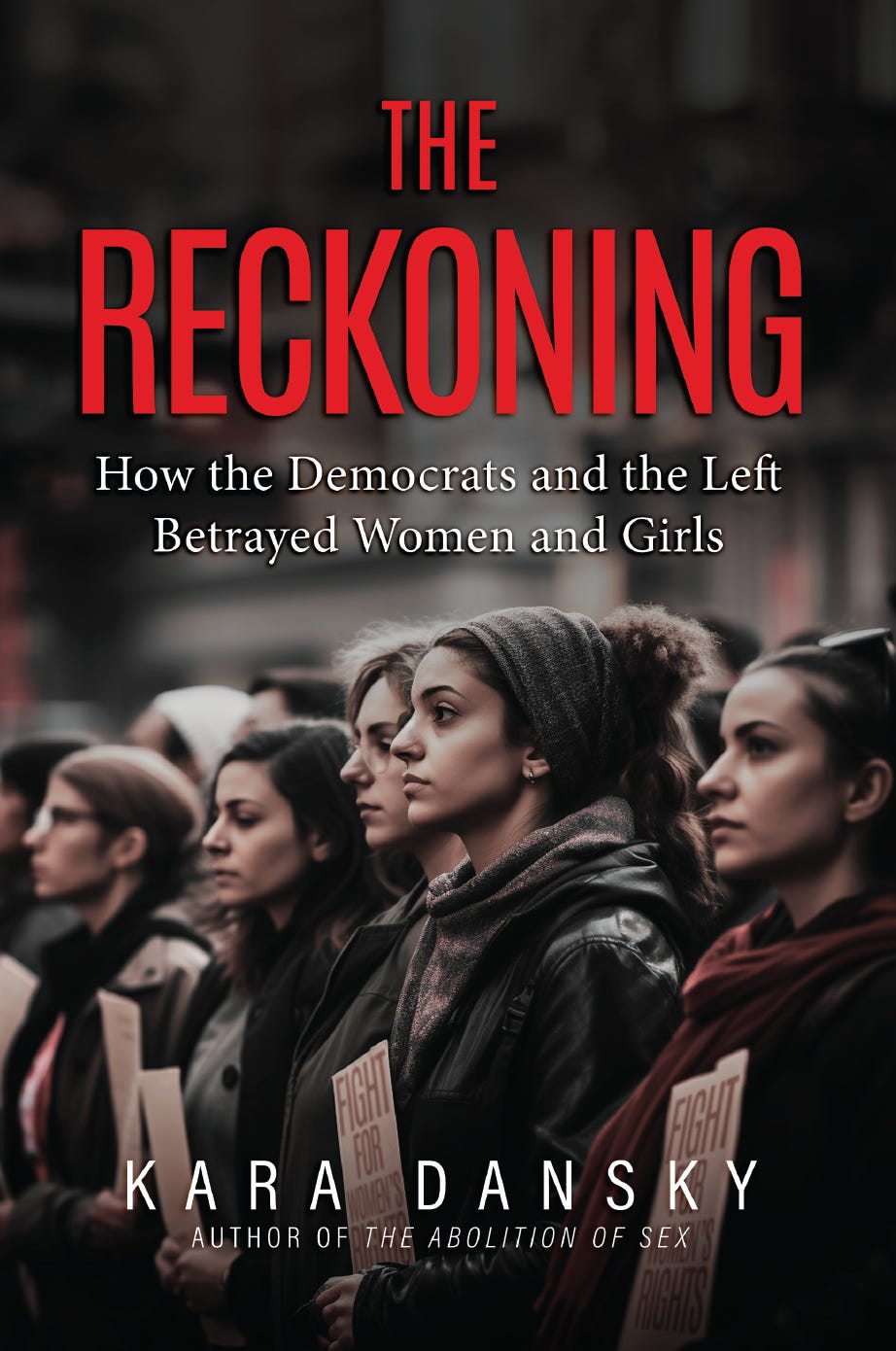
Kara Dansky is a lawyer, author, and speaker. She writes a Substack newsletter called The TERF Report. She is also the author of The Abolition of Sex: How the ‘Transgender’ Agenda Harms Women and Girls and The Reckoning: How the Democrats and the Left Betrayed Women and Girls. She served on the board of the Women’s Liberation Front from 2016 to 2020 and as president of the US chapter of Women’s Declaration International from 2021 to 2024. She has a J.D. from the University of Pennsylvania Law School and a B.A. from Johns Hopkins University.
Boy Mum (Part 2): Experience
By Bertha Dalziel *
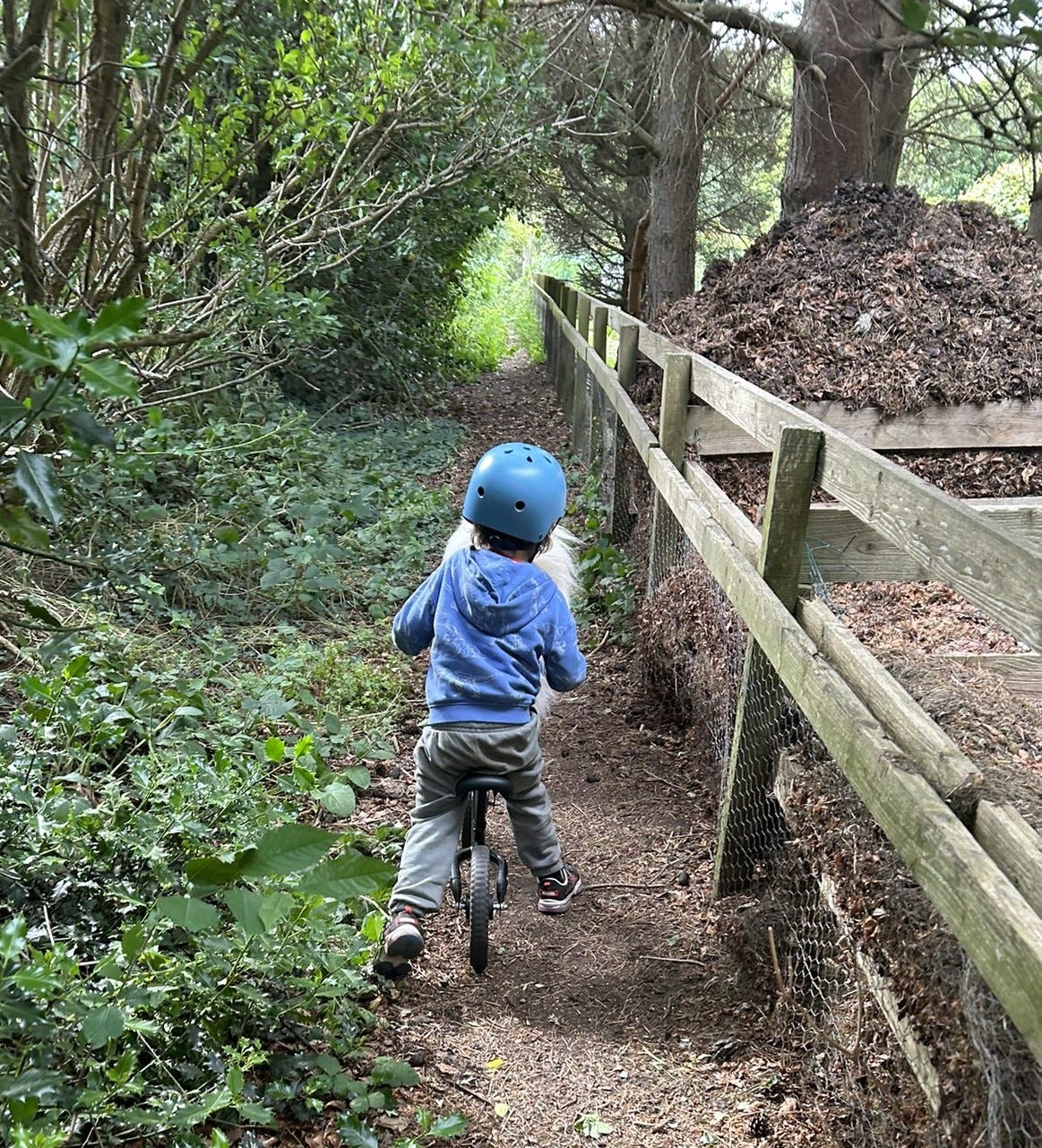
Tiny Son, with Cloud the dog (ahead) Pic by Bertha Dalziel
As Tiny Son became more of a Twitter moniker than an accurate descriptor, he proved fearless to a degree that marked him as unusual, even among his peers. He jumps straight into (and off of) everything in the playgrounds, the woods near our house, the furniture, flinging himself around with abandon. He gleefully scrambled up trees and climbing frames far beyond what would be expected for his small age. Men I meet with sons the same age tend to envy this trait, women to be alarmed by it.
The boy and the bell curve
And here I will say something I have truly come to believe. There really are average differences between the sexes across various traits that play out on every playground the world over. Average, mind, but they are there. This need only be a problem, I think, if fairness is conflated with sameness and outright bad behaviour left uncorrected. Same rules for everyone, allow them to play, and you will see a bimodal distribution of physical fearlessness (or recklessness) reliably in evidence. There's a clear bell curve and my son is very firmly on the rambunctious side of it.
This is the character trait of his that worries me most. I am torn between wanting him to be free and quietly calculating how long I can keep him from discovering the existence of motorbikes.
He is always emphatic too about what he wants. I remember us taking him to the supermarket when he was two. ’Mum we must have ham! NO ONE can be healthy without ham!’ Such was his conviction that I find myself moving to buy ham, although no one in our house will eat it, including him. I have heard people speak with less conviction about their religion. He was like a tiny John the Baptist among the cornflakes. His dad, frazzled, defeated already: ‘today is Saturday, not… not… I want day.’
Poor husband. You and I know every day with this one is ‘I want day’.
Setting rules
Discipline as you may guess is a tricky subject. You may as well accept straightaway that a mother’s place is in the wrong, whatever you do. There will be plenty of people around to remind you of this fact. I have read and listened to plenty of opinions on the topic. You may even have some yourself.
A change in the dynamic for my generation, which is of course to the good, is physical punishment is right out. I tried gentle parenting, I really did. I have come to the conclusion that in order for this to work, other people must have gentle children. As with all schools of thought, there are things to admire and learn from.
An emphasis on age appropriate response, bearing in mind these people are very very new to the world is a good idea. However. Tiny Son needs to know some things are right out and will not be accepted by anyone in his life or he will do them. Again, we are in ‘average differences’ territory, but I notice this playing out with my friends’ children, too.
Boys, girls and Butler
This fearlessness can lead to some altercations with boys but more rarely with girls, interestingly. Tiny son is a sunny extrovert (his father and I assume some kind of recessive gene is involved) and he happily assumes everyone wants to be his friend, male or female. One of my favourite memories is of him turning to another toddler in the playground saying, “and this is my friend, mummy” for all the world as if we were all at a cocktail party.
My sister’s little girl, Tiny Niece, a year or so his senior, is invariably in charge when they play together and he falls in with that happily enough. In fact, he would probably follow her through the gates of hell if she asked him; she’s his top person. And heaven knows his life needs order. I have noticed this deferral to have a pattern. If playing with boys, they fall first to competing as to who is the fastest , strongest and so on, like a pair of tiny Bear Grylls. But put him with a girl, and my boisterous boy is spell-bound and will happily be bossed around without question.
Nursery has added a new dimension to gender relations. This seems to be the age when children become more clannish about being a boy or a girl. It has only recently struck him as a concept. His first entry into the gender discourse was to say, "mummy, sometimes everyone is boys", followed by a pause and the further thought, "except for when they are girls". And he has, to my knowledge, not even read Judith Butler.
How the world shrinks
It is quietly heartbreaking to watch a kid who, left to himself, will unabashedly climb a tree then paint his nails with his cousin, rummaging in the dressing up box for glittery things to wear to be "even more fabulous," now keep asking "is this [book/clothing/toy] for boys or girls?" I answer him with the obvious but nevertheless deeply felt point, that all these things are for boys OR girls if the particular boy or girl likes them. But my heart sinks watching his world getting that little bit smaller as he absorbs the idea from the world around him that, as much as I might wish it, this is still not really true.
In a few ways though, I think my task, as grinding and difficult as motherhood inevitably is at times, is the easier one. I know I am not going to be the one to teach my son what it is to be a man. Indeed, I cannot do this. That falls to his father. And, whatever challenges the world may hold for Tiny Son, motorbikes and all, I know that he has a great guide to that.
Bertha Dalziel is a pen name for a perennial expat who is dipping her toes into her forties. She became a mother while living in the Netherlands and a stay-at-home mother by accident. She has recently returned to Scotland and is enjoying it enormously, much to her surprise. She can be found messing about on X under @BertDalziel when she should probably be doing something else.

Atta girl! American author and newspaper editor Anne Royall whose weapons of choice were satire and ridicule
By Lily Craven, known to her many fans on Twitter/X as @TheAttagirls
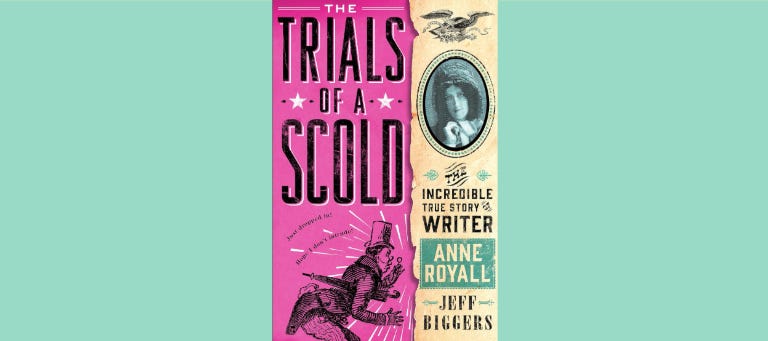
Image: Jeff Biggers’ 2017 biography of Anne Royall, Trials of Scold
The Woman of the Week is one of my chance finds, author and newspaper editor Anne Royall, born on 4 July in 1769 in Baltimore, possibly the first political journalist in the USA. She fought a one-woman battle against political corruption, fraudulent land schemes and banking scandals, and her weapons of choice were satire and ridicule.
United States v. Anne Royall
I found Anne when I was researching devices used to control and silence women - the scold’s bridle and the ducking stool among them - and learned that in the summer of 1829, she was tried at the Circuit Court of the District of Columbia, accused of being “an evil disposed person…a public nuisance, a common brawler and a common scold” and narrowly avoided the ducking stool.
The US District Attorney had conjured up the creative charge from English common law once used in cases of witchcraft and long dismissed in England as “a sport for the mob in ducking women.”
The case, United States v. Anne Royall, attracted much press attention and Anne made a spirited defence from the stand. The New York Observer spoke of “the vituperative powers of this giantess of literature”, but despite the presence of a nearby ducking stool, the Circuit Court decided to fine her $10 instead (about $350 or £260 in today’s money). Anne was always on the margins of poverty so her fine was paid by two reporters from The National Intelligencer, the first newspaper in Washington.
The itinerant storyteller
First though, a potted history of her life. Born into poverty, Anne became a servant to an older man who had served as a major during the War of Independence. He introduced her to the works of Voltaire and Shakespeare and gave her free run of the contents of his extensive library. They married when she was 18 but fifteen years later, she was widowed. She was immediately plunged into a bitter will dispute with his relatives. Left penniless, she became an "itinerant storyteller", petitioning Congress for a war widow’s pension and securing what may have been the first ever interview of a President.
The story goes that she spotted President John Quincy Adams swimming naked in the Potomac early one morning and sat on his clothes until he answered her questions. It’s probably not true, although he was known for his swimming habits and he did support her case for a pension, even introducing her to his wife, Louisa, at their home. Louisa gave her a white shawl.
The pension was eventually granted by legislation but most of it was snaffled by his relatives, so Anne decided to make her living with the pen. She wrote the Black Books, a series of sardonic pen portraits of the rich and elite in several states in New England that enjoyed success for the laugh-out-loud way they punctured pomposity and exposed the privileges enjoyed by the powerful elite.
The risks of writing
You’ve heard the saying, “Men are afraid that women will laugh at them. Women are afraid that men will kill them.” Well, Anne knew how to make her readers laugh at men, and for this she was ejected from taverns all along the East Coast, horsewhipped in Pittsburgh and brutally assaulted in New England, leaving her with a limp.
Her honest and accurate writing couldn’t be challenged on the facts, so she was criticised relentlessly for her appearance: “homely in person, careless in dress, poor in purse…vulgar in manner” and dismissed as “hysterical”, “a virago”, and a “literary wild-cat from the backwoods".
Making “life a burden to the public men of her day”
In 1831, 62-year-old Anne launched Paul Pry, a newspaper exposing political corruption and fraud. She spared no one. When it was succeeded by The Huntress in 1836, she announced, “Our course will be a straightforward one. We shall oppose and expose all and every species of political evil…We shall advocate the liberty of the Press, the liberty of Speech, and the liberty of Conscience.”
“Let all pious Generals, Colonels and Commanders of our army and navy who make war upon old women beware.”
She was as good as her word. For two decades, her take-no-prisoners style of investigative reporting and her fierce defence of freedom of speech won her as many friends as it did enemies. An editor in New England wrote, “She could always say something which would set the ungodly in a roar of laughter.”
Anne’s career preceded the first united push for women’s suffrage by at least two decades, but she evidently carried on living rent-free in the Washington Post’s head, because nearly half a century after her death in 1854 at the age of 85, it carried this headline: “She was a Holy Terror: Her Pen was as Venomous as a Rattlesnake’s Fangs; Former Washington Editress: How Ann Royall Made Life a Burden to the Public Men of Her Day.”
Somehow, I think Anne would be pleased with that.
In her misspent youth, Lily Craven spent 28 years in prisons in England writing risk assessments, operational orders and contingency plans. Now retired, she spends her time finding ordinary women whose extraordinary achievements were buried in dusty footnotes in history books and writes about those instead.

Navigate the public policy maze with the editors as they keep a watching eye on the issues affecting women

Pic by: akinbostanci via iStock
We are all busy, so it is hard to keep up with what people in power are up to - particularly in relation to policies and services that affect women and girls. We can’t offer a full monitoring service, but in each edition we will highlight a few things to watch out for, and where you can find more information.
In the Scottish Parliament, on 25 June Ash Regan MSP appeared before the Criminal Justice Committee, as Stage 1 of her private member’s bill, the Prostitution (Offences and Support) (Scotland) Bill, began. All information about the Bill and its progress can be found here. The Committee is currently seeking views on the Bill here and the consultation closes on 5 September.
Regan has also lodged a motion in the Scottish Parliament expressing “grave concern” at the failure of public bodies to amend unlawful policies, following the ruling of the Supreme Court, and calling on the Scottish Government “to immediately revoke any unlawful policies, oversee a full audit of all relevant public policies and publish findings within 60 days.”
At Westminster, ahead of the second reading of the Universal Credit and Personal Independence Payment Bill on 1 July, the Women’s Budget Group produced a briefing paper on the Impact of disability benefit changes on disabled women. The Bill passed its Second Reading after the Government offered significant concessions. The Hansard record of the debate is here.
Also at Westminster on 1 July, Dr Mary-Ann Stephenson (currently Director of the Women’s Budget Group) appeared before a meeting of the Joint Committee on Human Rights (JCHR) and the Women and Equalities Committee (WEC) as the government's preferred candidate for Chair of the Equality and Human Rights Commission from this autumn. The proceedings are available to watch here.
The Welsh Government is currently consulting on Rights, respect, equality anti-bullying guidance for schools. The consultation closes on Thursday 31 July.

Northern Ireland Assembly in Belfast. Pic by RogerBradley via iStock
Each legislature across the UK has a helpful ‘what’s on’ section on its website.
Northern Irish Assembly (click on “View full agenda” for the detailed forward look) Recess dates: 5 July 2025 to 31 August 2025
Scottish Parliament Recess dates: 28 June to 31 August 2025
Senedd Cymru | Welsh Parliament (click on “View full calendar”) Recess dates: 21 July to 14 September 2025
UK Parliament Recess dates: 23 July to 31 August 2025 (Commons), 25 July - 29 August 2025 (Lords). The Conference recess runs for four weeks from mid-September.
