ISSUE 21: The Frontline
A 21st century feminist publication where women's voices have power
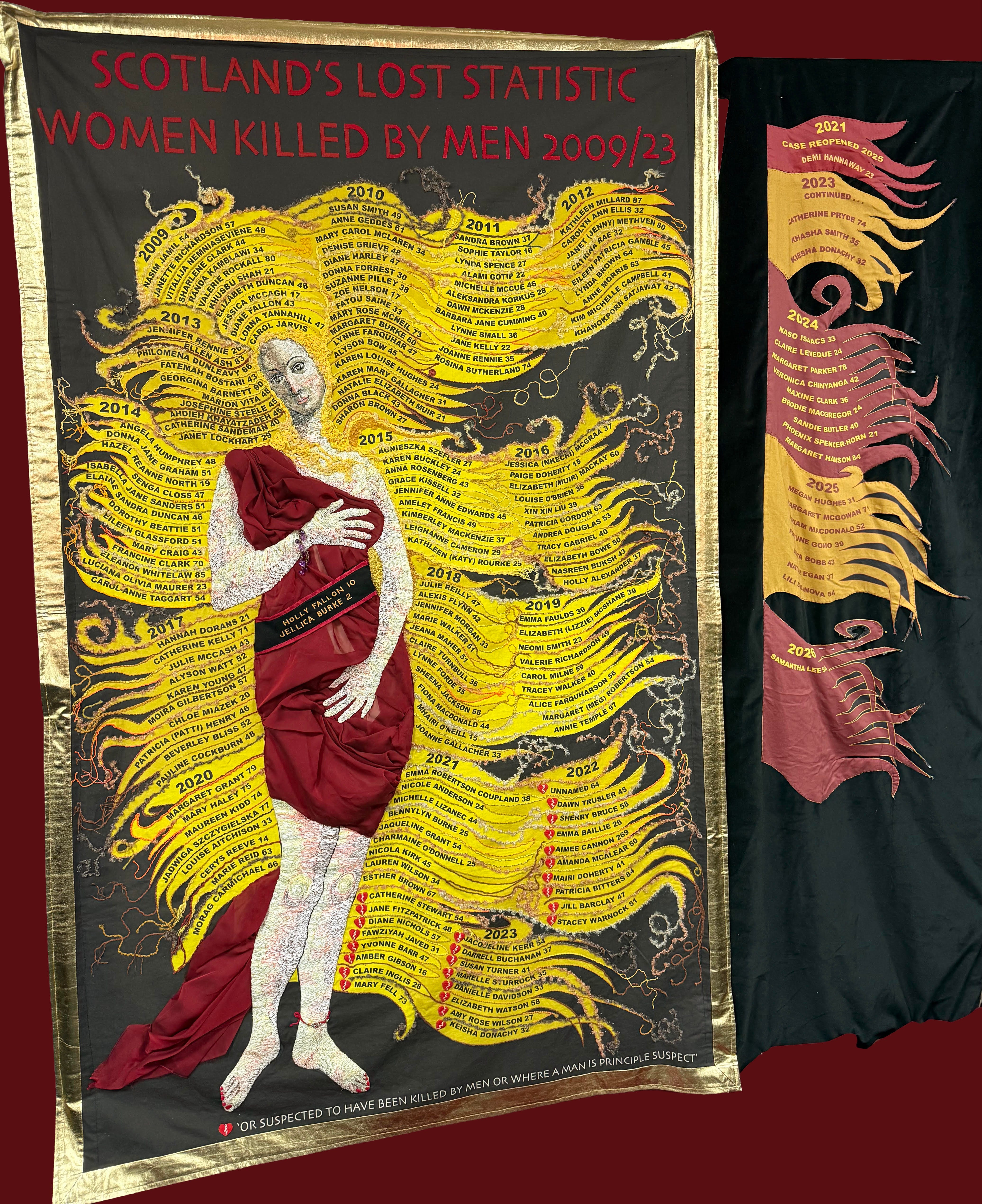
LOST WOMEN banner. Pic via Jenny Lupton

Welcome to issue 21, published in the aftermath of International Women’s Day.
On some accounts, the first International Women’s Day, in 1911, was inspired by an earlier protest by women factory workers in New York. Celebrated across a handful of countries, its focus was on voting rights, sex discrimination and women’s disbarment from public office. It was taken up by Russian revolutionaries and in Communist China. In Italy, it became La Festa della Donna, from 1946 symbolised by gifts of mimosa. Teresa Mattei, a partisan and political activist, and feminist campaigner Rita Montagnana, suggested mimosa, known also as acacia, as a cheap, widely-available, seasonal blossom that will survive even in the hardest of landscapes. They gave bunches of it to other women as a symbol of support, respect and sisterhood. That practice continues. Lucy’s first memory of IWD is of such a gift from an Italian woman friend, in 1989.
Because, although the UN adopted IWD in the mid-70s, it took years for 8 March to achieve its current high profile. We might now wonder at what cost that has come.
It is only in the last decade or two that IWD has become quite such a focus of corporate and political message–sending. This happened just as those worlds became transfixed by the idea that being a woman has nothing to do with what sex you are. As Jo Bartosch wrote this week, these days “the organisations that make a fuss about IWD are those that penalise self-respecting women who dare to suggest that sex matters.” As a result, official IWD events now feel to be heavily-laced with messages about keeping out such women. The signal from the better-funded sections of the women’s movement is that a sex-based analysis of women’s rights and needs is distasteful, and even dangerous. Thus sisterhood, respect and support from the growing class of salaried women’s activists increasingly comes with the strict term and condition that we will not make a fuss about sex. It all feels a long way from exchanging simple gifts of mimosa.
It remains to be seen if, like the mimosa, a day with such deep roots can survive its current hard conditions. Meantime, the physical reality of women’s lives, and deaths, goes on.
In this issue Jenny Lupton writes about the LOST WOMEN banner project, the product of a collaboration to ensure that every one of the women killed by men in Scotland since 2009 should be remembered. She argues that visual art has the power to make us stop and look, and take in the scale of violence and loss.
Against the backdrop of a dominating politics of identity, Anni Donaldson celebrates the late Dr Elspeth King, a woman fired by determination to preserve working class history, and that of working class women particularly. Dr King’s work in Glasgow is a case study of how urban redevelopment can erase the a community’s history, and how hard the fight can be to prevent that, and hold on to the stories and artefacts that keep memories alive.
Our women of the week continues the theme of working class history. We remember the women of Dagenham who played a pivotal role in securing equal pay legislation in the UK. The original women’s day in 1911 had workplace sex discrimination in its sights. The UN put equal pay at the heart of IWD in the 1970s. In 2026, that equality still has not been achieved. Pay discrimination remains real and material, with the heaviest impact on the lowest paid women.
The button at the end of this issue takes you to our subscriber chat. As ever, you can also find us in real time on X/Twitter, at @DalgetySusan and @LucyHunterB and our shared account @EthelWrites.
We are delighted that we can now plan for our fortnightly 21st century feminist publication to remain fully accessible. But we depend on some of our readers becoming paid subscribers so that we can pay our contributors, as well as keep the newsletter free so ALL women can access it. If you can afford a paid subscription, please consider getting one.
As a thanks to all of you who have done that, we are continuing our occasional ‘In Conversation’ series, and are delighted that Victoria Smith has agreed to be the second woman to join us for that. With her book ‘(Un)kind: How Kindness Culture Punishes Women’ just out in paperback, we look forward to surveying together the wreckage of International Women’s Day and looking to the future. We will share that conversation with our paid subscribers just ahead of our next edition, due out on Friday 27 March.


The story of how we remember the women lost to male violence and the work of art that will never by finished
By Jenny Lupton
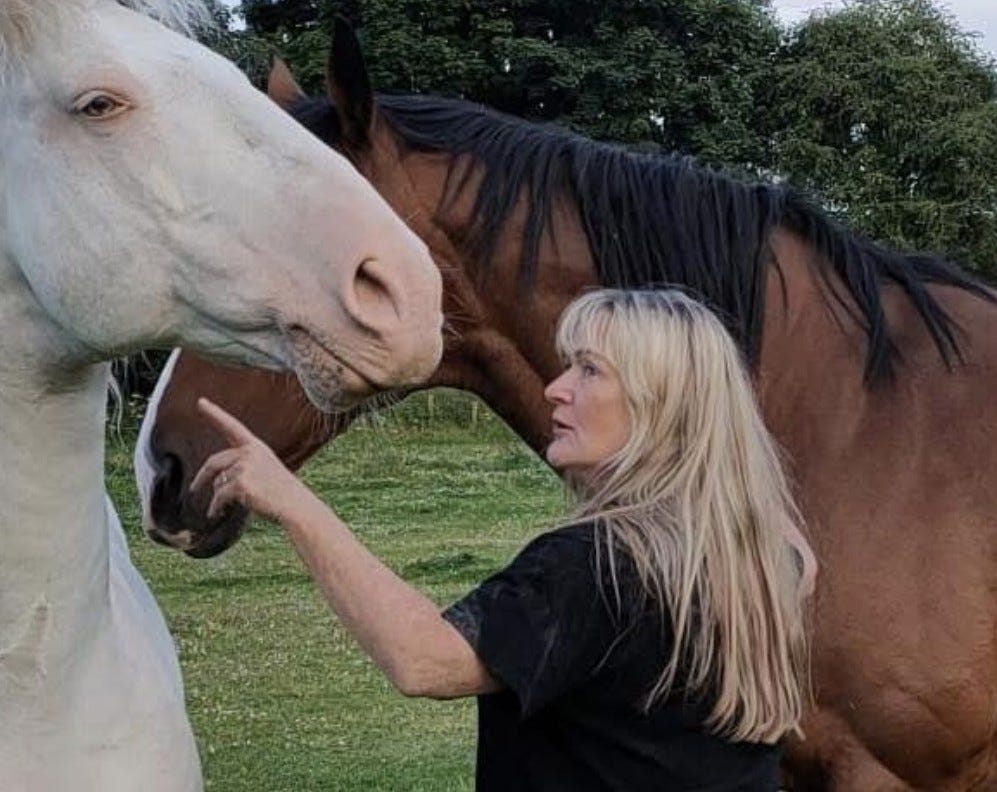
Jenny Lupton, and horses. Pic via Jenny Lupton
Across Scotland, just as in the rest of the UK, there are women furious at the cavalier, societal dismantling of women’s rights to safety, privacy and dignity. From meeting up to protest and getting to know each other, some of us formed a group to make banners echoing the ethos of the Suffragette movement, to make the protesting visible.
We call ourselves Selkie Stitching, after the mythical Celtic and Norse legend of a half-woman/half-seal, who is said to have powers to control the waves. (Veiled reference to witch trials and James VI here!)
We intend these banners to be powerful textile art, to make people stop and look, and to eventually hold their place in history relaying to future generations how big this fight is, how angry women are, how we rage against our erosion.
Every banner starts with an idea, we discuss, and then I lose myself in thousands of potential arrangements and options, and have to be gently pulled back to the point in hand, what we are actually aiming for. I finish the design phase with getting the composition right, playing with colours, and then print a flat image onto calico. Some are just line, some are line/colour. This is where the fun starts, as we fold and attach gorgeous tweeds, silks and velvets, dye raw sheep wool for hair, embroider, embellish, bejewel and make plans and boost each other up. Gathering over cloth is something that women have done forever, from ‘waulking the wool’ to a ‘stitch’n bitch’.
In 2023, I attended a conference organised for the first anniversary of Beira’s Place. There were so many incredible speakers, but Karen Ingala Smith’s speech, with harrowing statistics of women killed by men across the UK, made me curious what percentage happened in Scotland. I had a wee bit of a light bulb moment to create a banner for these lost Scottish women, and I mentioned it to Elaine Miller. She asked me if I wanted to be introduced to Karen. I said yes, and was immediately dragged (in extreme awe) across the room and met Karen who promised me an email with the information.
So many women and girls
The email arrived, and the number and names of Scottish women killed by men since 2009 absolutely floored me. So many women, such a huge disparity in ages.
I’ve read every sickening detail of these women’s stories. So many endured years of abuse, but stayed in the hope of maybe changing the man they loved, or being too scared to leave him, terrified of the repercussions.
I was incredulous at the sheer violence and brutality of the killings, the hundreds of wounds inflicted on some women, the variety of weapons used against some women. I was shaken by the callousness with which these women’s bodies were treated once their life had gone. These men who had once claimed to love them, clumsily and heinously tried to hide their crimes with fire, dismemberment, beheading, disposal.
Then those too cowardly to face the consequences took their own lives.
How could I serve their memory?
How was I going to create an image that would mention them all, convey the magnitude, the horror, be respectful but still impactful, and draw the viewer?
I felt the responsibility of getting this right, this banner was my baby, my idea taking wings, so whilst involving my fellow Selkies through the process, I kept free rein.
A conventional list of names would just disappear, visual white noise, and I could have done something emphasising violence, hitting hard, but that wasn’t remotely appropriate. I’d created an image for another group, and then I realised how perfect she would be for this banner. Botticelli’s Birth of Venus. Painted in the 15th century, she is the iconic image of womanhood through the centuries. She also rose from the sea, so seemed an apt symbol for us Selkies.
She began to take shape, I wove the names into her hair, and then wondered if there was space for enough hair. The awful, watershed realisation of the relentlessness of MVAW came in that short space of time from idea to design, needing more space because more women were murdered, more names had to be added.
Giving life to the lost women
From my perspective, visual art is a hugely powerful tool, often a means to provoke emotion, to stop you in your tracks, to make you want to look closer, deeper. Within the Selkies I have my limitations - I am a 2D artist and designer who can’t embroider. Luckily, the incredible Lorraine Sneddon is our Selkie Queen of all things textile, so I handed her my baby, with the utmost trust that she would make her stark reality something incredibly beautiful with her fabric, her stitching, her imagination and immense talent to make a banner sing. She did, and gave life to our LOST WOMEN.
There was a worry of course, that this may not be well received by relatives of those listed, but several family members of different women have reached out, thankful we have done this, wanting to see her somewhere in the flesh. I’ve already met fathers, and mothers, and extended family of some of the women. When I began this, I had no idea we were creating something so much bigger than us.
LOST WOMEN is the memorial for their families and friends. This is for those missing mothers, daughters, sisters, nieces, aunts, and grandmothers. We are now working on a diptych panel, with space below knowing the harsh reality means there will be more, she will never be finished.
Two more women are to be added since LOST WOMEN was launched mid February. One woman killed just 4 days later, and one woman missed by the FOI releases. She was murdered at a party in 2017 by a man who thought people were laughing at him. Her story is Margaret Atwood’s quote literally made reality.
“Men are afraid that women will laugh at them. Women are afraid that men will kill them.”
Jenny Lupton: I’m a professional animal portrait artist of 35 years working to commission. I paint differently for myself. I’m currently painting a series of Island Women at the beginning of the last century, putting them as central figures in their landscape, a position more commonly occupied by men. I’m a stroppy mare.
My tribute to Dr Elspeth King: How one woman took on Glasgow’s museum establishment in her fight to preserve the social history of Glasgow’s women and its working-class communities - a tale with echoes for today
By Anni Donaldson
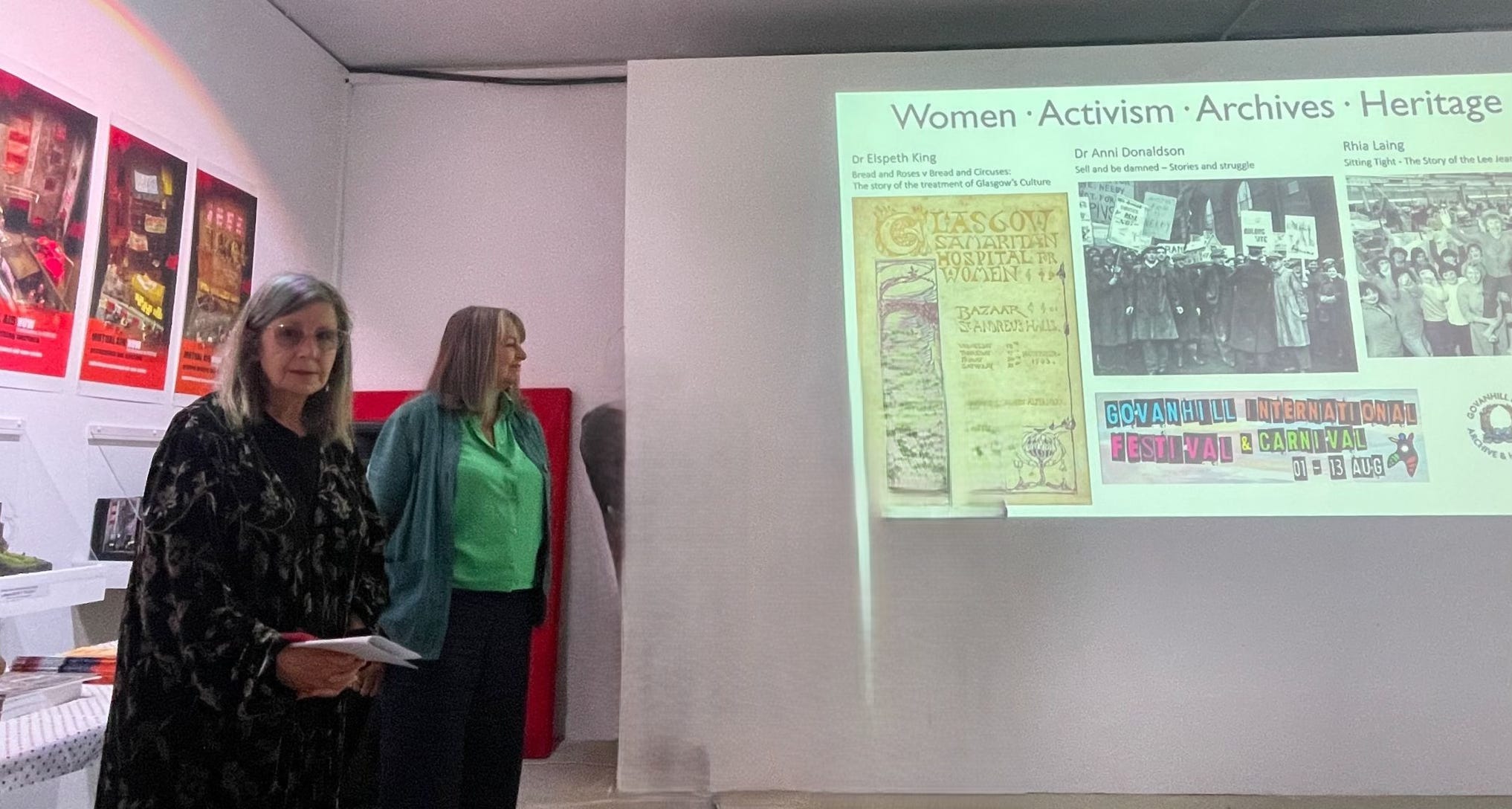
Elspeth King (left) with Dr Anni Donaldson, speaking at the 2023 Govanhill Festival and Carnival on ‘Women, activism, archives and heritage’. Pic via Dr Donaldson.
‘Elspeth King - a coalminer’s daughter with a first-class honours degree; a woman; a Scot; the wrong class, the wrong sex, and she does not toe the Establishment line.’
Written in The Herald in 1990, the quote above described a woman, who, by the time of her sudden death in November 2025, was recognised as one of the foremost social history curators and historians of her time. She was a remarkable woman, fiercely knowledgeable with a determination and strength behind her gentle, quiet-spoken manner.
Born in Fife, Dr Elspeth King studied medieval history at St Andrews. A museum curator to trade, she became Curator of Glasgow’s People’s Palace Museum and Winter Gardens in 1974.
I first met her during all the kerfuffle over her not getting the Head Curator of Social History job at Glasgow Museums in 1990. She was extremely well qualified and had been doing that job all along. Why didn’t she get it? See above. The issue became very public, personal and political as Glasgow Museums’ recruitment policy landed them in a fierce culture war. The city’s ruling Labour administration clashed with left-wing activists including the Workers’ City Group, to which I was connected, over whose culture was to be celebrated during Glasgow’s European City of Culture in 1990. It was a perfect storm of class, gender, politics, ideology, culture and social history. Aye, those were the days!
What Glasgow’s museum hierarchy thought worth collecting and preserving merged with the city fathers’ dreams of a city swept of its murky past.
The vanishing stories of the working class
Redevelopment and depopulation had laid waste to Glasgow’s working-class communities, their artefacts, their rich mix of customs, religions, traditions and cultures as the buildings vanished. Elspeth toed nobody’s line in her collection policy as she and her staff scoured the Barras Market, demolition sites, auction houses, skips and middens searching for stained glass, ceramics, architectural salvage and church fittings in a race to gather up and preserve the city’s heritage before it was lost forever. Elspeth and her Assistant and partner Michael Donnelly succeeded in growing the People’s Palace Museum collection, transforming it into an important and well-loved museum - the city’s social history WAS worth preserving and people came in their droves.
Described as a “powerhouse”, Elspeth held no quarter in her determination to preserve Glasgow’s rich social history: of working-class communities, women, women’s guilds, community groups, sports clubs, industries, crafts, protest movements, hospitals, radicals, trade unions, orange lodges, theatres, churches and faiths. And that’s the moment her work clashed with the city fathers’ and the museum hierarchy’s priorities.
As she reflected in 2025 on Glasgow’s 850th birthday, ‘For the last 170 years, Glasgow has operated in the belief that culture is a commodity which comes from elsewhere and local history does not matter. That the city could and should be shaped by culture comprising works of art from elsewhere, to eliminate the perceived negative culture of Glasgow, the dirty place with polluting industries, poor health, and housing and dangerous, dangerous left-wing politics, especially the politics which would frighten the tourists and the investors’.
It all mattered very much to Elspeth.
Honouring protest
She was passionate about collecting and curating Glasgow’s radical history of protest. In 2023, she co-authored a history of the Calton Weavers’ strike of 1787. Six men were shot by troops during the strike – Scotland’s first working class martyrs - and she was heavily involved in locating and preserving their burial ground.
She despaired that the Palace’s large collection of trade union banners would never see the light of day. While London, Manchester and Edinburgh’s museums have published splendid books on their trade union banner collections, Glasgow’s are in storage under wraps.
Elspeth was a feminist; women’s struggles and women’s history mattered very much to her. In her work on the movement for women’s suffrage, she wrote about the role of Scottish working- and middle-class women in the fight for women’s suffrage which had been under-represented in the movement’s documented history.
In 1993, she published her most important book, The THENEW Factor, The Hidden History of Glasgow’s Women. It was the first comprehensive history of the city’s women. Women’s history, in a field dominated by men, was then still relatively underexplored – hidden. Her meticulous research uncovered the stories of women in Glasgow from medieval times to the twentieth century. The title, The THENEW Factor, beautifully illustrates her argument right up front.
St Thenew, the daughter of a sixth century Scottish Pagan king, became the mother of Glasgow’s patron saint, St Mungo. Persecuted for her Christian beliefs, hers is a story of forced marriage, rape, pregnancy, attempted femicide, exile and single motherhood; timeless stories of women’s lives even now. She survived drowning and her son became the first Bishop of Glasgow, she was beatified, became the first ‘named’ Glaswegian and lived out her days peacefully with her lad.
Renamed St Enoch after the Reformation, everyone thought she was a man and she became ‘invisible’ until Elspeth revived her story. Thenew’s forgotten history symbolised a gap in Glasgow’s history where women ought to be. A gap Elspeth King began filling with histories of many fascinating, important, ordinary, forgotten Glasgow women and girls. I was given the book as a present in 1993. It transformed this history woman into a feminist history woman. I’m not the only one. The book is now out of print and should be republished as a fitting memorial to a brilliant woman, feminist, activist, social historian, writer, curator.
Dr Anni Donaldson is an historian, researcher and writer. She is an Honorary Research Fellow at the University of Strathclyde; an Associate Fellow of the Royal Historical Society. Follow her on X: @AnniDonaldson. Access her Academia.edu profile and publications here. Access her website here

Atta girl! How the working women of Ford Dagenham and Halewood forced Britain to confront the injustice at the heart of women’s labour and changed the law for good
By the Frontline editors
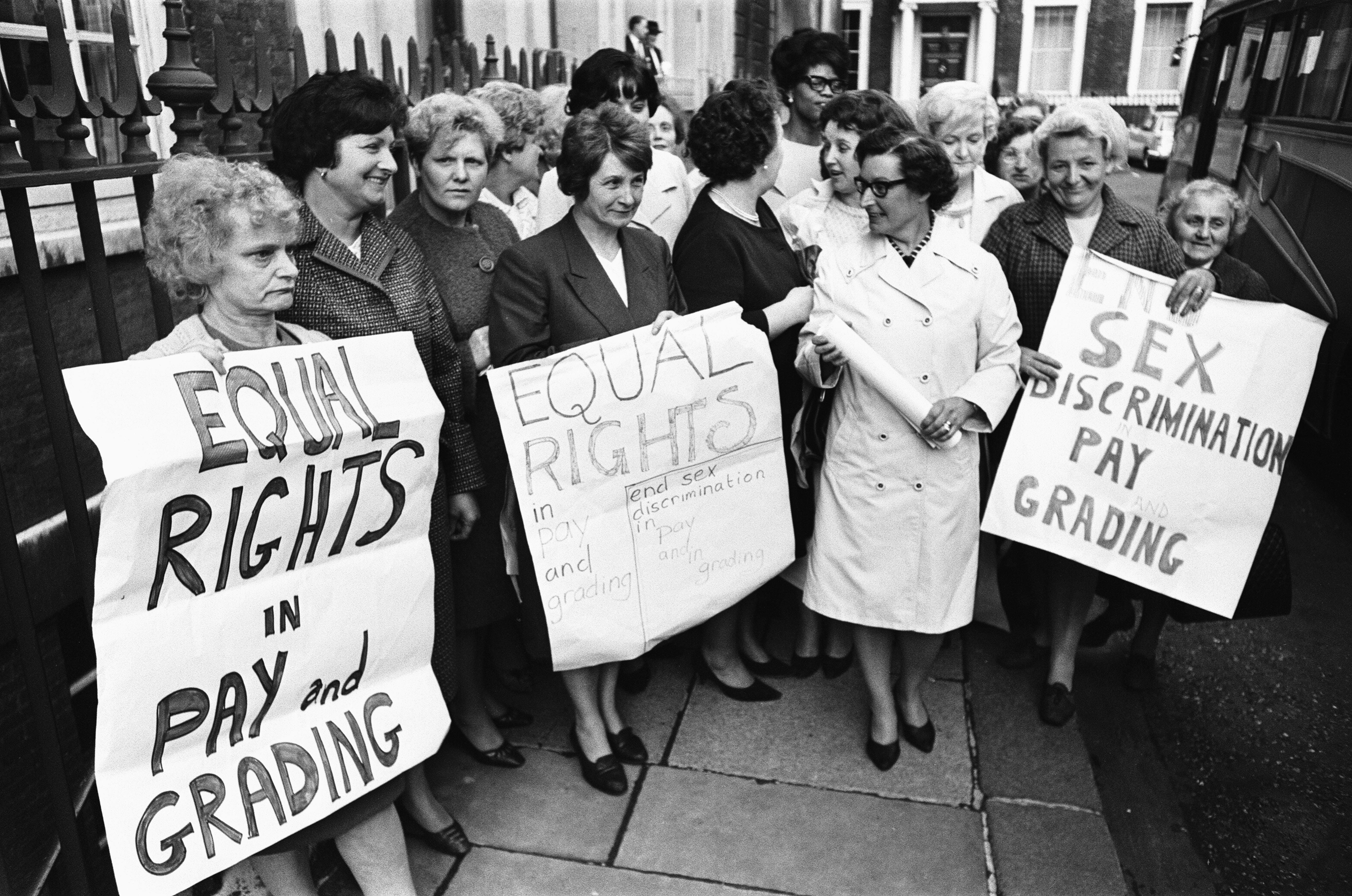
The Dagenham women. Pic via Alamy
The history of women’s rights is often a story of middle class and aristocratic women with the time, resources and confidence to campaign for equality, but working women are as central to the history of feminism as the Pankhurst sisters or Betty Friedan.
In this issue, we highlight not one Woman of the Week but hundreds of working women whose determination and courage led directly to one of the UK’s most important pieces of equality legislation – the 1970 Equal Pay Act.
Women’s work deemed “unskilled”
In the early summer of 1968, the women responsible for sewing the seat covers at Ford’s car factory in Dagenham walked out on strike in protest at a new grading system that classified their work as “unskilled labour”. Their job was expert work that required training, accuracy and experience. It was as integral to the manufacture of Ford’s cars as any other component, since badly sewn seat covers damaged Ford’s brand. Yet, despite their work’s central importance to the business, the “unskilled” classification meant that the female machinists earned roughly 15 per cent less than men doing comparable work in the plant. It was a situation that resonated with women across the country – female work being routinely treated as inherently less valuable than men’s labour.
After the regrading, the machinists turned for support to their trade union, the National Union of Vehicle Builders, only to be told by male union officials to accept the decision. Undeterred, on Friday June 7, the women switched off their sewing machines and walked out. Within days, production at the plant slowed. Without seat covers, Ford could not finish any of its cars on the production line. Workers across the factory were laid off. The company lost millions of pounds in sales and the dispute spread to its Halewood factory on Merseyside, where its machinists joined the strike. What had started as a minor spat between fewer than 200 women and their factory bosses became a national story and a potent symbol of working women’s battle for equal rights.
Give women everywhere equal pay
“We only want what the men get,” said Rose Borland, who had become the main spokesperson for the women, and in a powerful letter to the Prime Minister Harold Wilson, the women warned the Labour government that their fight was not an isolated one, they were fighting for all working women. They wrote: “Give us what we want, not only us at Fords all Women everywhere, we refuse to go back so what can you and the government & Mrs Castle and Jack Scamp do.”
Barbara Castle, who as Secretary of State for Employment and Productivity had responsibility for industrial relations, showed exactly what she could do. When talks between Ford management, the unions and the machinists stalled, she intervened, meeting with Rose Borland and others to broker an agreement that ended the three-week strike. On 28 June, the Ford Dagenham women went back to work, having secured an increase in their wages to 92 per cent of the male rate (it had previously been about 85 per cent). They also won a commitment to review the grading of their jobs. But it was to be another 16 years before the Dagenham women won full equal pay. Even after the 1970 Equal Pay Act, for which they had helped create the political momentum, the machinists had to go through another round of industrial action in 1984 before Ford graded their work as “skilled”, bringing their pay into line with that of comparable male workers.
The women who walked out of the Ford plants in Dagenham and Halewood in June 1968 may not have seen themselves as pioneers. They were skilled workers who simply refused to accept that their labour was worth less because they were women. Yet their three-week strike forced Britain to confront a deeply embedded injustice and helped pave the way for the 1970 Equal Pay Act. As Barbara Castle later put it, the case they made was disarmingly simple. She said: “The principle of equal pay for equal work is simple justice.”
The fight goes on
More than half a century later, the pay gap between men and women persists. It has decreased slowly over time, with the latest ONS figures showing that, over the last decade, it has fallen by more than a quarter among full-time employees. And in April 2025, it stood at 6.9 per cent, down from 7.1 per cent in April 2024. But achieving the “simple justice” of equal pay remains unfinished business.
As Frances, one of the Halewood strikers, told the Liverpool Echo on the 50th anniversary of the strike “…equality certainly has not been achieved. People are still struggling to get equal pay. After all these years, I don’t think it’s worked, although we tried our best.”
The 2010 film Made in Dagenham tells the story of the women who helped secure equal pay in the UK. Watch the trailer here:
Our right hand woman Lily Craven is taking a sabbatical from The Frontline. She sends her love to her many fans and hopes to be back soon. In the meantime, the editors will do their best to fill her shoes!

Navigate the public policy maze with the editors as they keep a watching eye on the issues affecting women

Pic by: akinbostanci via iStock
We are all busy, so it is hard to keep up with what people in power are up to - particularly in relation to policies and services that affect women and girls. We can’t offer a full monitoring service, but in each edition we will highlight a few things to watch out for, and where you can find more information.

Westminster. Pic by: sborisov via iStock
On Wednesday 18 March, the Women and Equalities Committee at Westminster will take evidence from representatives of the Human Fertilisation and Embryology Authority. The session is scheduled to start at 2.20pm and can be watched online. The session is part of the Committee’s inquiry into Egg donation and freezing. The inquiry is examining whether women donating and freezing their eggs do so with sufficient information about the process, health impacts and consequences and whether the current regulatory framework provides sufficient safeguards to people who go through these procedures.
The UK Women In Tech Taskforce is seeking evidence on ‘the interventions needed to help build a tech sector that works for everyone.’ They are looking for evidence on the impact of emerging technologies on women’s participation, progression, and leadership in tech. Their call for evidence was published on 12 March and closes at 11:59pm on 23 April 2026.
Wherever you live in the UK, make sure you are registered to vote on Thursday 7 May
2026 is a big year for elections in the UK. There are around 5,000 council seats in England up for grabs, including in all 32 London boroughs. In Scotland, voters will decide who will run the Scottish Parliament for the next five years and in Wales the Senedd election will elect 96 members to the expanded Welsh Parliament.
It is less than 100 years since women secured their full right to vote on equal terms with men when the Equal Franchise Act was passed in July 1928, so make sure you are registered to vote in May, and if you need a postal vote, secure one now. Access all the information you need here.
There is still time to register, up to mid-April.
UK Parliament click here for future business
Northern Irish Assembly click on ‘Business Diary’ for a week by week schedule
Scottish Parliament click on “Read today’s Business Bulletin”
Senedd Cymru | Welsh Parliament click on “View full calendar”

All content is protected: articles may not be reproduced without permission from the authors or this newsletter. For any reuse requests, please contact us in the first instance.