ISSUE 19: The Frontline
A 21st century feminist publication where women's voices have power
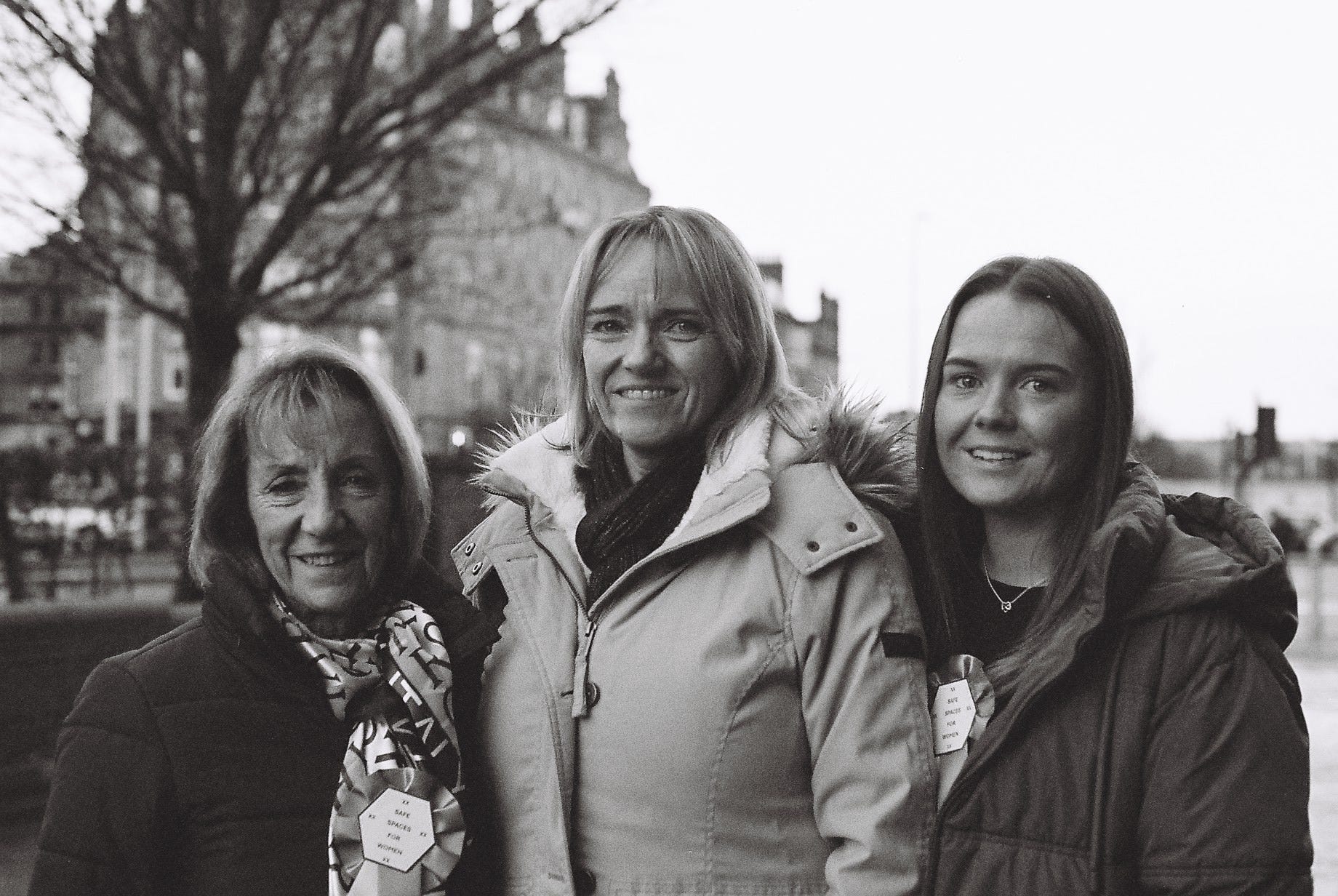
Sheila Bell (Sandie Peggie’s mother), Sandie Peggie and Nicole Peggie outside the tribunal in Dundee, February 2025. Image credit: Bryndís Blackadder

Welcome to Issue 19. A very warm welcome to all our subscribers, including almost 200 new ones since our last edition. We are delighted you have joined us.
We are overwhelmed by the reaction to Issue 18, as is our anonymous author. Almost 20,000 people have read her account of what happened when a frontline women’s activist in post-apartheid South Africa came up against contemporary academic culture. Reactions from readers included “a must read”; “powerful, insightful and enraging”; “this made me cry with both sadness and anger”; “Wow. Just wow. Why women speaking up matters so much. Read. Learn”; and “Brava Fezikile and all the heroines standing up for women”.
We started this newsletter to continue the project we began in The Women Who Wouldn’t Wheesht, as we want to help women write their own history in their own words. The book covers the five years over which the Scottish Government attempted to cement self-ID into law. We chose to begin it on Valentine’s Day 2018, when women first met in Edinburgh to discuss the government’s plans, while men outside banged pots and pans and yelled.
We closed the book with the resignation of Nicola Sturgeon, Scotland‘s first woman First Minister, on 15 February 2023, in the aftermath of the outcry that followed a male rapist being placed in a women’s prison. However, that outcry and her resignation were far from the end of the story here. In the last week, we have watched the Scottish government arguing in court for the right to continue placing men, including at the moment three murderers, in women’s prisons, based on self-ID. You can read a detailed report of what was said in court here.
Eight years since that first Edinburgh meeting, this edition comes back to Scotland. We feature Nicole Peggie, daughter of nurse Sandie Peggie, whose battle with NHS Fife over single-sex changing rooms was playing out in a court room in Dundee and across the world’s media this time last year. Sandie’s case came too late to be included in our book, but she has spoken movingly elsewhere about what it has been like to find herself at the centre of a storm, simply because she wanted to be able change her clothes at work away from all men - however they describe themselves.
Nicole writes for us about what this experience has been like for Sandie’s family and for Nicole herself, both as a daughter supporting her mother and as a woman dragged into the spotlight in her own right by the crude legal tactics of NHS Fife.
Staying in Scotland, Venessa McLeod, a survivor of prostitution, tells her story, culminating in sitting in the Scottish Parliament last week to watch MSPs vote down Ash Regan’s ‘Unbuyable’ Bill. (We spoke to Ash about her Bill in Issue 7). This piece is an especially tough read, we should warn readers.
We also have our regular Woman of the Week who is Josephine Butler, a 19th century social reformer and campaigner for women trapped in prostitution, sometimes described as a “forgotten feminist”.
Stories grounded in a place and time
‘Fezikile’ told us she was surprised that her story resonated beyond South Africa, because it was so strongly rooted there. But if the scale of response was far beyond what we predicted, we are not at all surprised that it spoke to readers so strongly. The belief which led us to pull together The Women Who Wouldn’t Wheesht and to establish The Frontline is that stories which are well-grounded in their place and time speak most powerfully. Since we began publishing last May, we have shared women’s stories from around the world, experiences spanning decades, from authors in their early teens through to their 70s. You can find our whole archive here.
If you have a story about being on the frontline of what it means to be a woman, whether recently or from earlier in your life, we are interested in hearing from you. Don’t worry if you’ve not written for a wider readership before. Our job is to help you find your own words. We normally carry two or three pieces a fortnight. Please get in touch if you think you have a story other women might want to hear.
The button at the end of this issue takes you to our subscriber chat. As ever, you can also find us in real time on X/Twitter, at @DalgetySusan and @LucyHunterB and our shared account @EthelWrites.
We are delighted that we can now plan for our fortnightly 21st century feminist publication to remain fully accessible. But we depend on some of our readers becoming paid subscribers so that we can pay our contributors, as well as keep the newsletter free so ALL women can access it. If you can afford a paid subscription, please consider getting one. Thank you.


Standing up for every woman: Nicole Peggie tells how her family’s life was turned upside down and her own sexuality raised in court, all because her mum, nurse Sandie Peggie, said ‘NO’ to sharing a women’s changing room with a trans-identified male doctor.
By Nicole Peggie
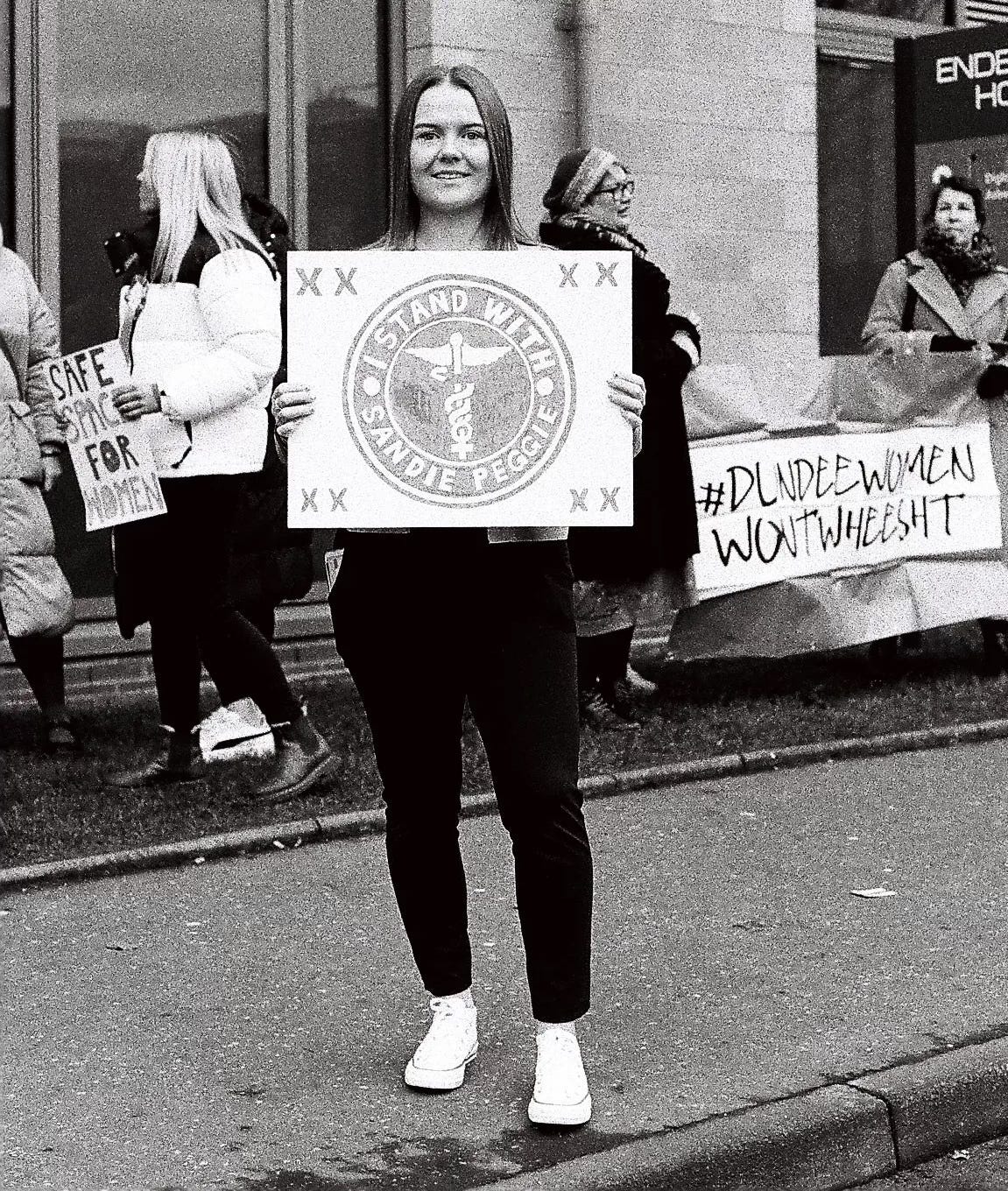
Nicole Peggie outside Endeavour House, Dundee 14 Feb 2025. Image credit: Bryndís Blackadder
It’s a year since my mum’s employment tribunal started on 3 February 2025 and so much has happened since then – both good and bad. My family and I have met so many amazing people. I have learned so much. Can you believe that a year ago, I didn’t know what a Terf was? I do now.
I didn’t use Twitter/X much either before last year. I used to scroll it now and again, but I didn’t post much at all. Then I posted a message from my mum, thanking everyone for their donations to my late grandad’s fundraiser and my feed blew up. My grandad – my mum’s father - died just before the start of the employment tribunal, and we had set up a fundraiser for the Scottish Society to Rheumatology in his name. It raised more than £11,000 and my mum and I wanted to thank people. Now I have nearly 10,000 followers. It’s mental.
But perhaps the craziest thing is that we get recognised – we can’t leave the house without being stopped by people. Everywhere we go, Asda, Marks and Spencer, even the chippy, people stop us, but we have never had a bad experience. They say: “Oh my God, you’re that nurse!” It is bizarre, everyone knowing your name and being recognised in the street. Even at my work, people would stop me and say they had seen me on the telly.
Toll of being in the public eye
Being in the public eye is a big thing. It gets easier to deal with, but it is still a shock to see yourself and your mum in a newspaper and on the TV. Like most kids, I used to dream of being famous, of being a celebrity, but I think I would tell my wee five-year-old self being in the public eye takes its toll.
When my mum’s lawyer Margaret [Gribbon] asked me to be a witness, I thought I didn’t have much to talk about, but then the NHS barrister, Jane [Russell], raised my sexuality in court. It felt as if she thought, ‘Great, I am going to get to Sandie Peggie through her daughter’.
I felt exposed, yes, that is probably the word. I like to live a private life, who needs to know about my sexuality? So, for it come out in court that I was a lesbian was quite a lot to handle. I wasn’t prepared for the impact. It was quite a nasty line of questioning to be honest.
But the biggest shock when was when my mum’s so-called friend Lindsay Nicoll took to the stand. I was in the courtroom that day. I had met Lindsay before, yet she spoke about me as if she didn’t know me. It seemed to me that she was trying to use me against my mum when she inferred my mum was unhappy about me coming out. The wasn’t true. Lindsay wouldn’t even use my name. It was a wicked thing to do.
My girlfriend Morgan and I have had to cope with some negative stuff on social media. Morgan has lost a couple of friends, they shared vile posts about my mum and that is pretty hard to see. I get a lot of hate comments on my social media, but it won’t stop me from defending my mum and standing up for women. And a highlight is that India Willoughby has blocked me.
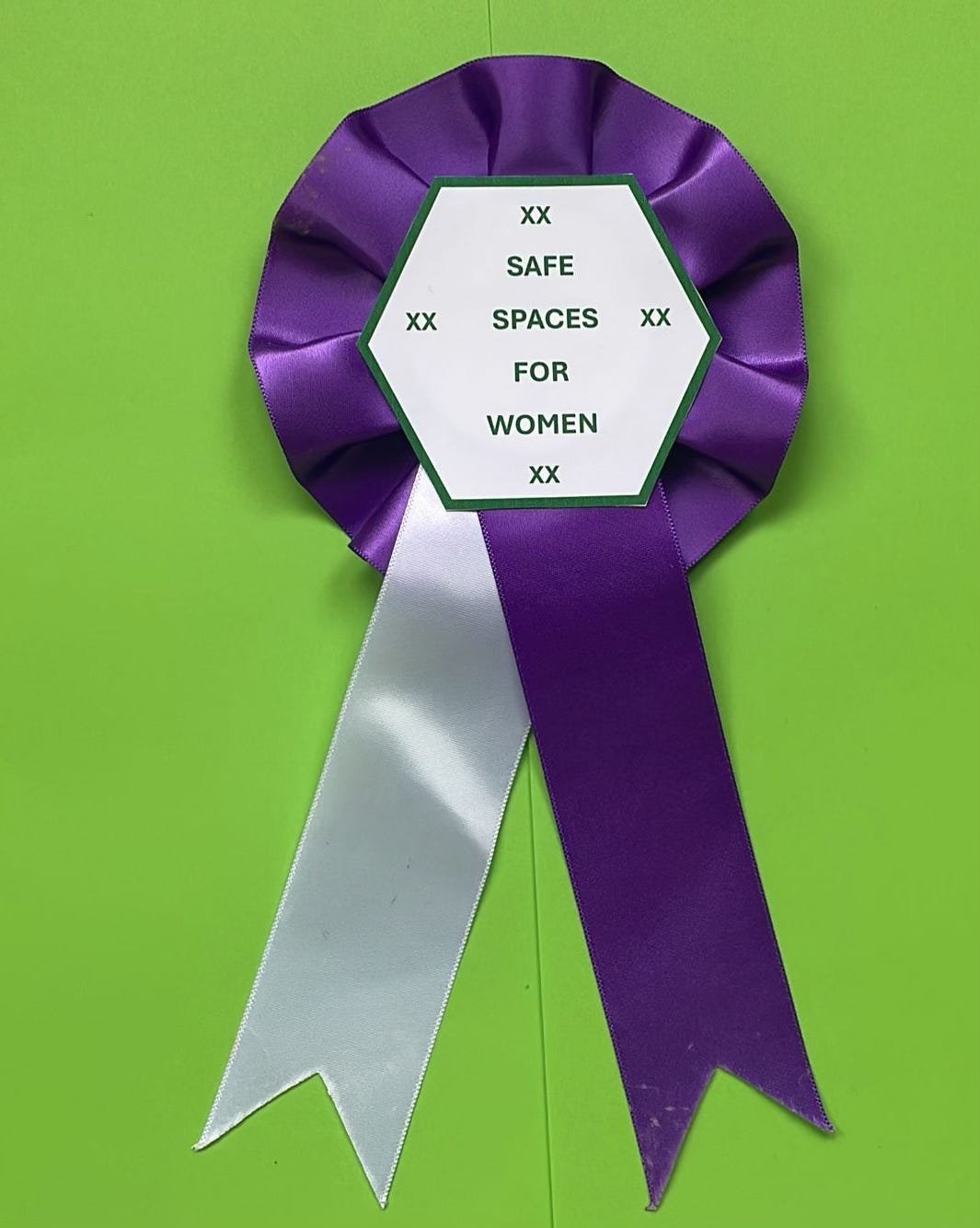
A rosette made by members of Sandie’s family and given to supporters who attended her tribunal case in February 2025
A bizarre year
Looking back on the last 12 months, it all seems a bit bizarre. It was a shock when my mum was suspended from work, for speaking the truth. And it affected her more than you think. She pretends everything is fine, and she puts a brave face, but sometimes she will take herself away and cry. My sister Emma works in the same hospital, and that can be quite tough for her.
It was also a difficult year for the whole family. Emma and I lost both our grandads, my mum’s dad and my dad’s too - so we have had a lot to go through, but it does get easier. We are just a normal family, a strong one, we stick together.
My mum was standing up for her rights on that Christmas Eve. Not to get anywhere, not for any gain, other than her own rights. If I could spend five minutes with John Swinney, I would tell him that, but I don’t think he has taken the time to understand my mum’s case to be honest.
I hope my mum’s experience and what our family has been through changes things. I hope it sets boundaries and encourages young people not to fall for this ideology. It has definitely changed me. I will not hold back on the truth. I will stand up for myself. Just like my mum stood up for herself - and for every woman.
Nicole Peggie (26) is a personal trainer and gym instructor. She loves to travel and hopes one day soon to spend time in Australia.
A survivor of Scotland’s sex trade watched as the Scottish government refused the opportunity to protect women and girls by introducing the Nordic Model of prostitution, choosing instead to protect sex-buyers, pimps and traffickers
By Venessa Macleod

Edinburgh’s Stockbridge - one of the most city’s desirable neighbourhoods - where the sex trade flourishes behind closed doors. Image by Stephen Bridger via iStock
You are never safe from the widespread clutches of the sex industry, because it has permeated every aspect of our society. It’s on our streets; it’s on our phones and in our homes. Whether provided by their hand or someone else’s, orgasms are available on demand for men to purchase, while every woman is just one series of unfortunate events away from turning to prostitution to survive. This patriarchal beast is always hungry, and it constantly hunts for fresh, perky sacrificial lambs to slaughter. If you’re a woman, all it takes is one redundancy, one divorce or one eviction notice, and you could be forced to lay back on the patriarchal altar. To spread your legs and present for the revolving door of men that are chomping at the bit to penetrate your vagina in exchange for a tenner.
Sex ‘work” is not a glossy fantasy - it’s grim
From firsthand experience, I can confidently say that the glossy, shiny, hypersexualised world which you’ve grown accustomed to being synonymous with ‘sex work’ does not exist. The empowering fantasy we’ve been repeatedly sold in popular culture and iconic modern mythology is fiction; Pretty Woman is no more than a pretty lie. The reality is grim, dirty and the economics are simple. Men are penetrating your holes so you can put food on your table.
My series of unfortunate events started in childhood through abuse, and by 17 I was on the verge of becoming homeless for a second time. Tragically, my story is not unique. Most women involved in prostitution are groomed into it as children. Under the pretense of a cash-in-hand job, I was lured to a sauna by an older female ‘friend’, and by the time I realised the premises was a brothel, I was locked inside with no escape. My interview involved descending below the streets of Stockbridge - one of Edinburgh’s most desirable neighbourhoods - to a dingy basement that was lined with secluded rooms hidden behind locked doors. There, I was forced to give a blowjob to the 60-year-old manager, and from that point forward, I was owned and treated like a piece of property. The manager threatened and coerced me into returning to the brothel so that hundreds of vile, sweaty, Scottish men, who knew I was underage, could thrust into my body. Husbands, uncles and fathers paid to rape a girl who should have been sat in a classroom beside their daughters and granddaughters.
The client who never beat me, but was the worst
Although I was subjected to violence and constant degradation, the worst client I saw never beat me. His requests broke me in different ways, ones that I can’t yet articulate. At first, he held me down and started to rock back and forth inside me. After a few moments of this thrusting, he released one of my arms, and with his breath panting into my face, he told me to flick his nipples. Then he told me to speak to him like a child. He wanted me to pretend that I was his six-year-old sister. Often, I think of the women and children he undoubtedly went on to abuse after me, and I blame myself for not speaking up to protect them. At the time, had I been brave enough to run to the police, I would have been prosecuted for solicitation because our current laws in Scotland state I was the one committing a crime. Even fifteen years later, no law has been introduced to hold men like this accountable for their actions.
Reliving trauma to spare other women and girls our fate
On Tuesday February 3, 2026, the Scottish government was presented with an opportunity to pass the Prostitution Offences and Support (Scotland) Bill, introduced by Ash Regan and her dedicated team. If it had become law, it would have criminalised sex buyers, rather than vulnerable, desperate and trafficked women. Survivors spent months prior to the vote campaigning and sharing our deepest wounds in public. We kept reliving our trauma so other women and girls might be spared our fate of fear-fuelled flashbacks. In the week before the vote, I even tried appealing to politicians’ humanity by sharing snippets of my story on X and tagging their political parties.
In the debate chamber though, Jamie Hepburn (SNP) complained there had been no opportunity to speak with survivors; this despite an open invite to multiple in-person events; an online survivors’ panel the evening before the debate; and an email of our voices and stories emailed to all. Also presented was insurmountable evidence from countries which had already implemented the Nordic Model, alongside emphatic support from frontline organisations, Police Scotland, the United Nations and the Crown Office and Procurator Fiscal Service. The government’s party policy acknowledges that prostitution is male violence against women and girls, but they still refused to back the bill and whipped their MSPs to vote against it. They chose to side with pimps and threw a pathetic tantrum in the chamber to score political points. All because Ms. Regan, the member who proposed the bill, had the audacity to display integrity by stepping down from her government ministerial position in 2022 over the Gender Recognition Reform Bill. When Maggie Chapman (Scottish Greens) insisted ‘sex work’ was work like any other and defended men’s right to purchase women’s bodies for sexual gratification, survivors passed a stress ball back and forth between us in order to silence our screams. This deeply personal insult reminded us that so many are privileged to retain their innocence doused in ignorance.
Motion failed
After four hours glued to the same spot, listening to a ping pong of passive aggressive insults bounce around the chamber, the voting concluded and the result trickled in. My leg anxiously bounced, and I was reminded of the human cost if this motion failed, because we were living proof of it.
The Presiding Officer announced: “54 for, 64 against, 0 abstained, 11 did not vote.”
The difference of ten cowardly politicians had just subjected thousands of women and girls in Scotland to a lifetime of trauma, and many of them will not make it out of this industry alive. My heart shattered for them, and after exchanging a tear-filled glance with the survivor beside me, I shakily typed two words on WhatsApp to our sisterhood of prostitution survivors and passionate abolitionists at Nordic Model Now!
‘Motion Failed.’
Standing to leave the debate chamber, we were greeted by hugs, handshakes and words of support. We were immersed in widespread admiration for our bravery in speaking out against a powerful system that sought to shame us into silence. Punters feel safe in that silence and our silence is fuelled by shame, but now I realise that the shame was never ours to hold. By speaking with you and by telling my story, I unburden myself and hand my shame back to the men who stole parts of me. The shame is now theirs to carry, whether Scots law reflects that yet or not.
Make no mistake though; by rejecting this bill, the government has sent a chilling message to all women in Scotland. For a price, they believe that our bodies belong to men, and that message should terrify us all.
After publicly speaking about her lived experience of prostitution at the Scottish Parliament, Venessa MacLeod now uses her voice to address how commercial sexual exploitation affects all women and girls in our society. A passionate feminist and human rights activist, she advocates for women’s equality with thought-provoking articles.

Atta girl! Josephine Butler, the devout, middle class woman who became a formidable campaigner against the state degradation of prostitutes, leading one of Britain’s first feminist campaigns
By the Frontline editors
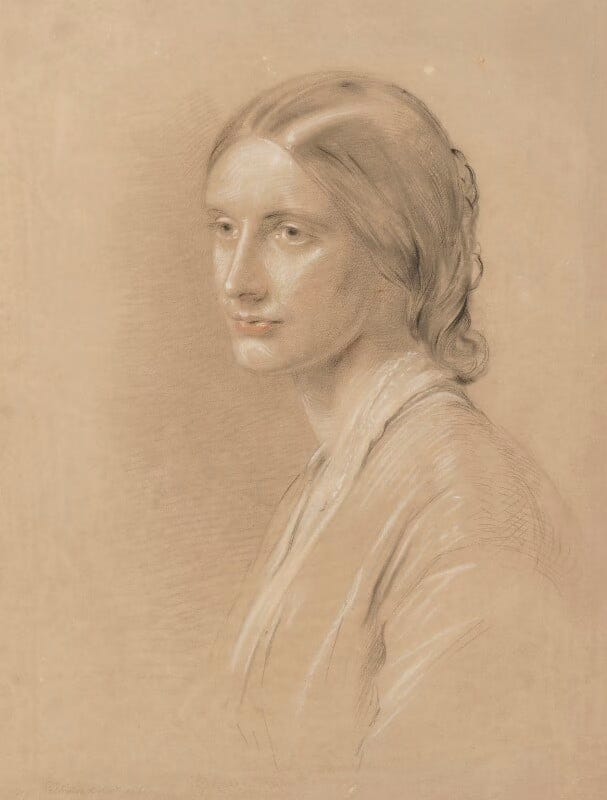
Josephine Butler by George Richmond (1851) in the National Portrait Gallery, London Image via Creative Commons
Victorian Britain was built on Christian values, public order and scientific progress. Yet women remained second class citizens, unable to vote, subservient to their husbands. And women engaged in prostitution were considered worthless, even a threat to the nation’s defences.
In the 1860s, in response to the high rates of venereal disease among the military, the government passed the Contagious Diseases Laws – a series of acts which allowed the police to seize women suspected of prostitution and subject them to invasive internal examinations, without their permission. If diagnosed with a venereal disease, a woman could be detained in a secure hospital for up to a year - all in the name of public health. The men who purchased sex, of course, were not touched.
For social reformer Josephine Butler, the issue was not about disease control, but power. She argued that a state that accepts prostitution as necessary and disciplines only women is not protecting public health — it is entrenching sexual inequality.
Josephine Elizabeth Grey was born in 1828 into a politically engaged Northumberland family shaped by abolitionist ideals. A well-educated, devout young woman, in 1852 she married George Butler, an Anglican clergyman and educational reformer, and settled in Bristol, where George was Vice-Principal of Cheltenham College. The tragic death of their five-year-old daughter Eva in 1864 was to alter Josephine’s life. Soon after her beloved Eva’s accident, the family moved to Liverpool, where Josephine began visiting workhouses and engaging directly with women in prostitution, the victims of the new Contagious Diseases laws.
Butler described the forced examinations the women endured as “surgical rape”, and in 1869 she founded the Ladies’ National Association for the Repeal of the Contagious Diseases Acts. It was an astonishing move for a ‘respectable’ middle-class woman. She toured the country, addressing packed, often hostile meetings and organised petitions signed by tens of thousands of women — a staggering feat of political mobilisation at a time when women had no vote and no formal power.
She ignored the jeering crowds, the newspaper attacks and the accusations of ‘indecency’, simply for describing what the law permitted. And she refused to soften her feminist argument. If the state could invade the bodies of poor women in the name of public health, no woman’s liberty was secure.
She argued repeatedly that the Acts were not about health. Instead, they were about disciplining women while protecting male access to women’s bodies. They were about the state managing prostitution, not challenging the conditions that created it.
“We abolish the Contagious Diseases Acts, not because we are opposed to all sanitary legislation, but because we are opposed to injustice and cruelty. We oppose the system because it is immoral in principle, because it violates the persons of women, and because it places the whole burden of a national sin upon one sex.” Josephine Butler
Butler’s campaign, one of the first national political movements led by women in Britain, proved a significant success. The Acts were suspended in 1883 and repealed in 1886. But she did not retire from public life. Instead, she broadened her campaigning work across Europe in countries where prostitution was regulated through the medical supervision of women.
She also campaigned against the trafficking of girls and young women — what Victorians termed the “white slave trade.” Her activism fed into reforms that strengthened the age-of-consent laws in Britain, including the Criminal Law Amendment Act 1885. It made it a criminal offence to have “unlawful carnal knowledge” of a girl under 16, and sexual intercourse with a girl under 13 was classified as a felony. The Act also introduced new offences relating to procuring girls or women for prostitution and brothel-keeping.
After years of exhausting public campaigning — often under hostile conditions — Josephine Butler gradually withdrew from frontline activism following the death of her much-loved and very supportive husband George in 1890. She died on 30 December 1906, aged 78, at her home in Northumberland. After her death, Millicent Fawcett wrote that “no other woman in history has had such far-reaching influence”.
“The prostitute is not the cause of the evil, but its victim.” Josephine Butler once said, a feminist analysis that remains as true today as it was more than 160 years ago.
Read Frontline contributor Susanna Rustin’s article on Josephine Butler, the forgotten feminist here.
Our right hand woman Lily Craven is taking a sabbatical from The Frontline. She sends her love to her many fans and hopes to be back soon. In the meantime, the editors will do their best to fill her shoes!

Navigate the public policy maze with the editors as they keep a watching eye on the issues affecting women

Pic by: akinbostanci via iStock
We are all busy, so it is hard to keep up with what people in power are up to - particularly in relation to policies and services that affect women and girls. We can’t offer a full monitoring service, but in each edition we will highlight a few things to watch out for, and where you can find more information.

Pic via iStock by Mayur Kakade
In Northern Ireland a consultation available here closes this Friday, 20 February, on a proposal for a law to allow all pupils to wear trousers at school, so that this becomes a universal right. The Assembly’s Committee for Education has worked extensively on the issue of school uniforms this year. It has heard that for the most part, girls in Northern Ireland “do not currently have the right to choose to wear trousers (or shorts) to school, so they are the pupils in question.”
The UK government is currently consulting on a new process for employers to follow when handling flexible working requests, as well as seeking insights on flexible working practices more broadly. The consultation covers England, Scotland and Wales and is available here and closes at 11:59pm on 30 April.
Wherever you live in the UK, make sure you are registered to vote on Thursday 7 May
2026 is a big year for elections in the UK. There are around 5,000 council seats in England up for grabs, including in all 32 London boroughs. In Scotland, voters will decide who will run the Scottish Parliament for the next five years and in Wales the Senedd election will elect 96 members to the expanded Welsh Parliament.
It is less than 100 years since women secured their full right to vote on equal terms with men when the Equal Franchise Act was passed in July 1928, so make sure you are registered to vote in May, and if you need a postal vote, secure one now. Access all the information you need here.
There is still time to register, up to mid-April.
The UK Parliament is now in recess until 23 February. Click here for future business
Northern Irish Assembly is not in recess this month. Click on ‘Business Diary’ for a week by week schedule
Scottish Parliament is not in recess this month. Click on “Read today’s Business Bulletin”
Senedd Cymru | Welsh Parliament is now in recess until 23 February. Click on “View full calendar”

All content is protected: articles may not be reproduced without permission from the authors or this newsletter. For any reuse requests, please contact us in the first instance.