ISSUE 17: The Frontline
A 21st century feminist publication where women's voices have power
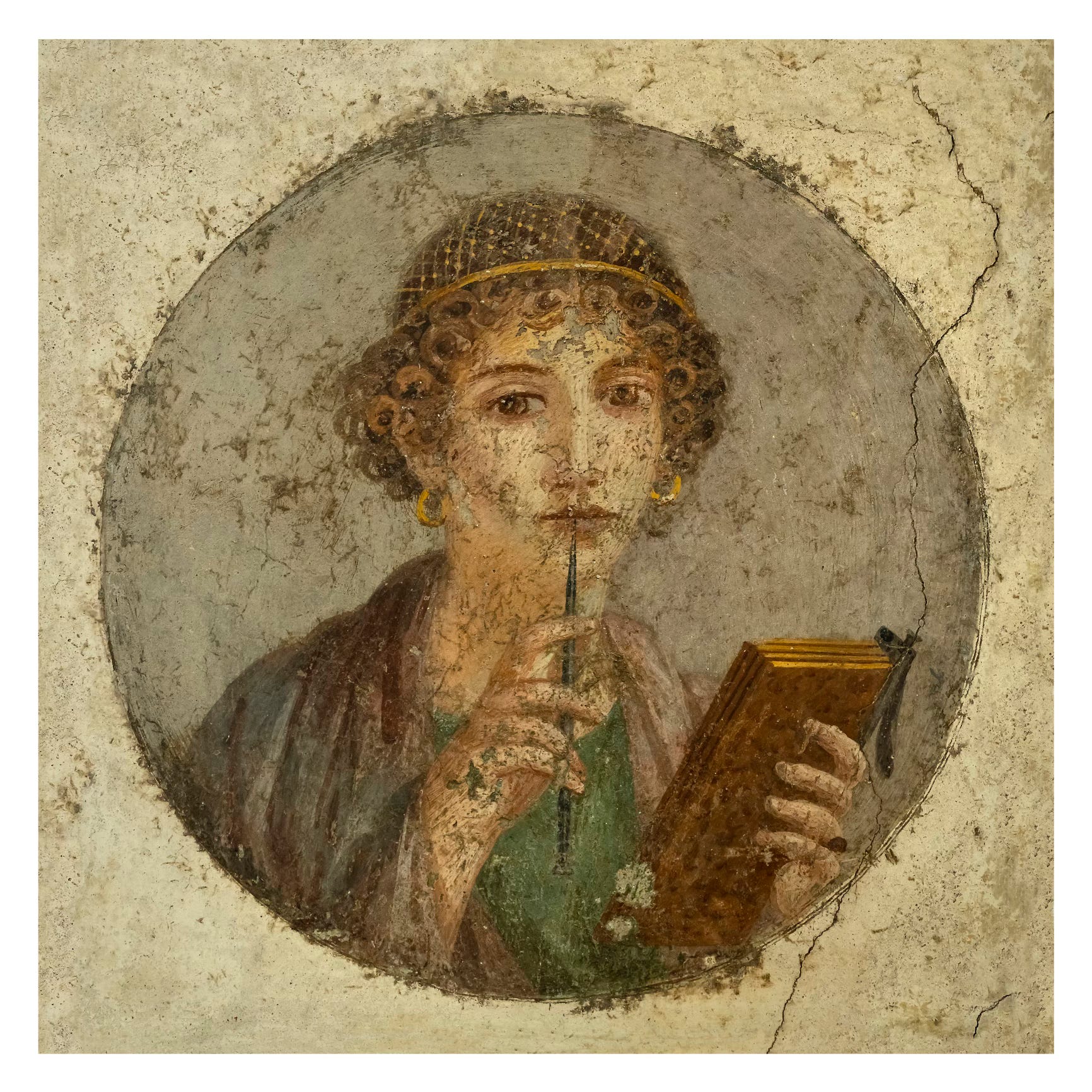
Young woman with wax tablet and stylus, Pompeii, 55-79 AD, often called the “Sappho fresco”. Pic from iStock via Grafissimo.

Welcome to Issue 17, where our Scottish roots are showing.
January 25th is Burns Night, a celebration of Scotland’s most famous poet, Robert Burns. So this is our poetry edition.
Magi Gibson tells the story of how she put together Unbridled, a collection of poems by women who have been on the frontline of campaigning against the imposition of self-ID.
Susan remembers her childhood relationship with Burns, who spoke to her in her own language, shares her discovery of Maya Angelou’s passion for his poetry, and appreciates his egalitarian and liberating instincts, regardless of the gap between his idea of women’s rights and contemporary feminism.
A poetry edition needs poems, and Sonya Douglas, from Wales, has given us two, about reality and defiance.
These take us to this edition’s Woman of the Week, Iranian poet Simin Behbahani. Known as the Lioness of Iran, she wrote and demonstrated for women’s rights right up until her death at 87, in 2014.
In Policy and Power, we focus on recent research on maternal mortality across the UK, and a current parliamentary petition in front of Westminster to appoint a maternity commissioner to improve maternity care.
To all our readers we want to say a huge thanks for your support. The first six months have succeeded beyond our expectations and we are excited about what lies ahead in 2026. If you would like to write for The Frontline, email us at ethelmwrites@gmail.com.
The button at the end of this issue takes you to our subscriber chat. As ever, you can also find us in real time on X/Twitter, at @DalgetySusan and @LucyHunterB and our shared account @EthelWrites.
We are delighted that we can now plan for our fortnightly 21st century feminist publication to remain fully accessible. But we depend on some of our readers becoming paid subscribers so that we can pay our contributors, as well as keep the newsletter free so ALL women can access it. If you can afford a paid subscription, please consider getting one. Thank you.


Poetry as resistance: Leading poet Magi Gibson recounts how Unbridled, an anthology of women’s poetry achieved publication despite a chilly climate of cancellation
By Magi Gibson
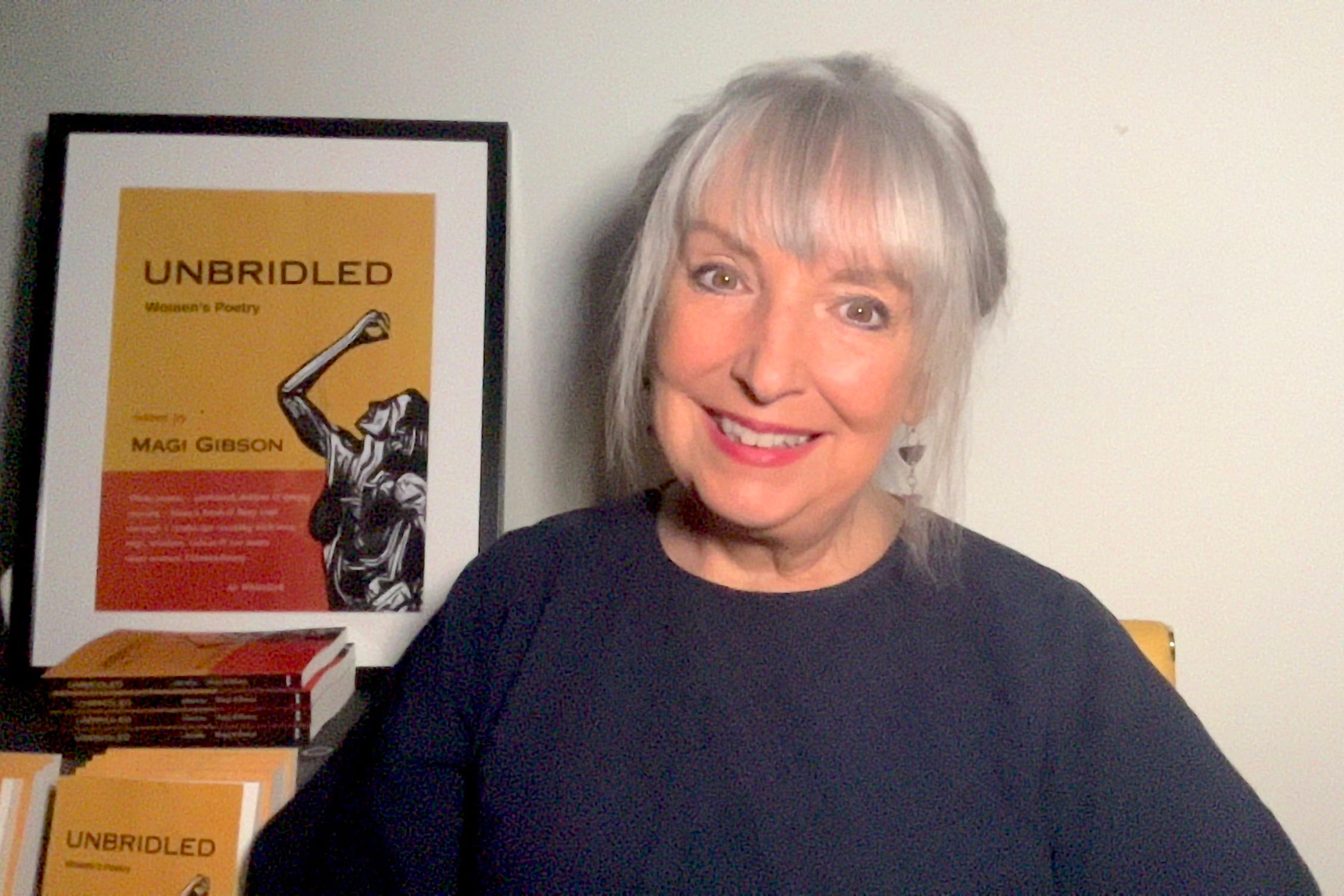
Magi Gibson with copies of Unbridled
I was delighted to be invited in 2023 to speak at the Forth Valley Feminist Conference in Scotland on Women’s Poetry of Witness, Protest and Dissent. As a poet and writer, I’m acutely aware of language and its importance, how it can be used to manipulate the unsuspecting public, how it can be employed to eradicate political dissent. And how it can be used positively to express our lives and thoughts as women.
By 2023 I’d already been a ‘cancelled’ poet for six or seven years. Invites to read at events or lead creative writing workshops, which was essentially how I’d earned my living, had steadily dwindled, my books were being hidden in back storerooms by over-zealous bookshop assistant activists. I knew I’d been branded by many as a poet to be ostracised.
Women under attack
Around 2015 I’d realised that the word woman itself - its very meaning - was under attack. I’d argued strongly on social media that this would endanger women’s rights. I quickly found out that no dissent would be tolerated. Language, the very meaning of everyday words, so important to me as a poet, was not only in the battleground, it was on the frontline.
Poetry can be a powerful tool in political resistance. From the Suffragettes to Black American poets like Audre Lorde, June Jordan and Maya Angelou, poetry has been used to highlight issues, to fight injustice, to express dissent. A poem with its rhythms and imagery can cut through to those who ‘don’t quite get it’ from political arguments alone. And to those who do get it, it can mainline straight to the heart and strengthen resolve.
I soon noticed that at women’s demos against proposed self-ID legislation, as well as women taking the mic to speak, there was often at least one woman reading a poem. A poem she’d written herself. It struck me that if such poems are not collected, gathered together in a pamphlet, say, or a book, they – and their part in the resistance – were at risk of being lost to future generations.
My promise to women poets
On the platform at that conference in February 2023 I committed to publishing an anthology of such poems. How I’d finance it, I didn’t know. What I did know was that it needed done.
I put a flier out to the many grassroots women’s resistance groups in UK. I invited poems not only about the current struggle, but about any aspect of being a girl or woman in today’s world. I was hyper-aware there would be transactivists who’d want to scupper the project before it even got off the ground if they got wind of it. Earlier that year I’d come under extreme pressure and threats of disruption for an all-women poetry and comedy event I was involved with organising in Glasgow.
Meanwhile, I kept an eye out on social media and whenever I spotted a video of a poem being performed by a woman at a rally, or a poem in a Facebook or X post, I’d save it and contact the poet to ask for permission to include it. No one refused.
It soon became clear that hard editorial choices would need to be made. The pamphlet I’d originally envisaged was developing into a book, and a substantial one at that.
A bonus was when a couple of poets in Dublin offered to spread the word to women in Ireland they thought would like to be involved. Their contribution enriches the anthology hugely.
Editing down the submissions was hard. There were obvious choices for inclusion like Rachel Rooney and Jenny Lindsay, two poets who, like myself, had had their poetry careers derailed for holding sex realist views. Sometimes I had to choose between poems where the subject matter was similar and I felt for the poets who didn’t get included.
But how could I fund what was turning into quite a big project? First, I’d do everything myself. From editing to admin to typesetting to cover design to selling. I’d published some books already so knew the ropes. But that was before the constant threat of attacks from TRAs.
Typesetting and executing the cover design were new challenges. I had to teach myself the software. I chose this labour-intensive route rather than risk Unbridled being sabotaged. The one bit I couldn’t do myself was print and bind it. I chose the printer I’d use with care. Even so, I was still braced for disruption at any point.
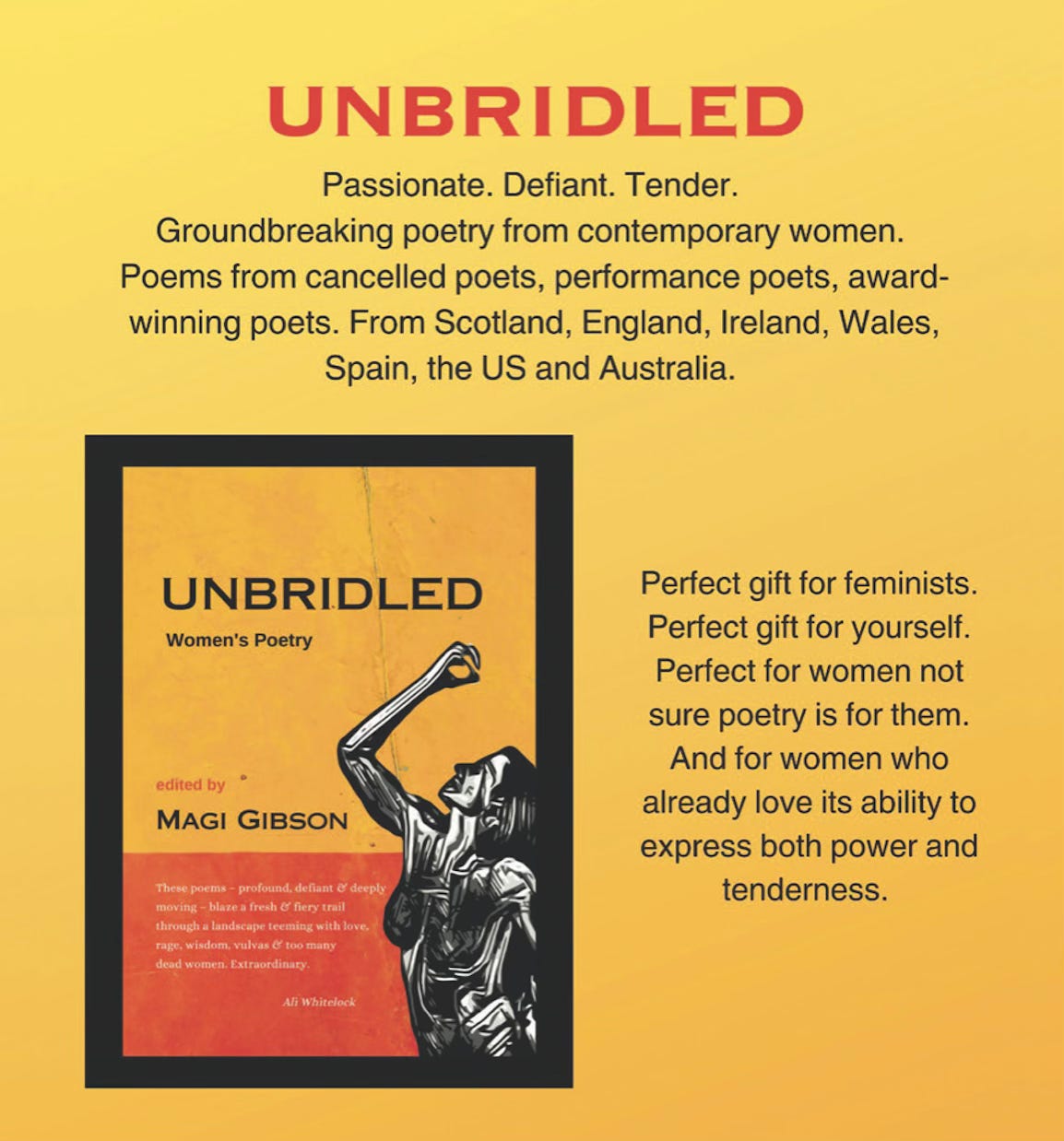
Buy a copy of Unbridled here
At the Glasgow launch that September we had absolutely amazing support. Poets from Ireland flew across especially, others came to join us from England. Such a joyous occasion! And on International Women’s Day 2024 we held a sold-out Unbridled event at The Scottish Poetry Library in Edinburgh, again with poets from Ireland and England.
Unbridled contains a wide range of women’s voices of all ages and backgrounds. At times the work is celebratory, at times angry, at times reflective and gentle. But always defiant.
Some women chose to use a pseudonym, others to be Anon, but most used their own names. The established poets included knew only too well that they were ‘outing’ themselves with the potential of knock-ons to their careers. I can’t thank all the poets in Unbridled enough for their generosity and courage.
I haven’t tried to get it stocked in bookshops. I simply don’t have the energy to do battle with activist employees who seem determined to not only demand that books like Unbridled are not stocked, but who will actively hide women’s books they disapprove of.
For me, the most important thing has been that at least some of the poetry produced by the women’s resistance now exists as a solid object. I lodged copies with The British Library where they will now be preserved for future feminists and others studying the resistance of women to their erasure.
Award-winning poet, Magi Gibson, has held three Scottish Arts Council Fellowships, a Royal Literary Fund Fellowship. She has been Writer in Residence with the Gallery of Modern Art in Glasgow and Reader in Residence with Glasgow Women’s Library. Her best-selling poetry collection, Wild Women of a Certain Age was published in a 21st anniversary edition in 2021.
Maya Angelou, one of the greatest female poets of the last 100 years, was a fervent fan of Robert Burns, Scotland’s bard, but was the hard-drinking, sometime womanising poet a feminist?
By Susan Dalgety
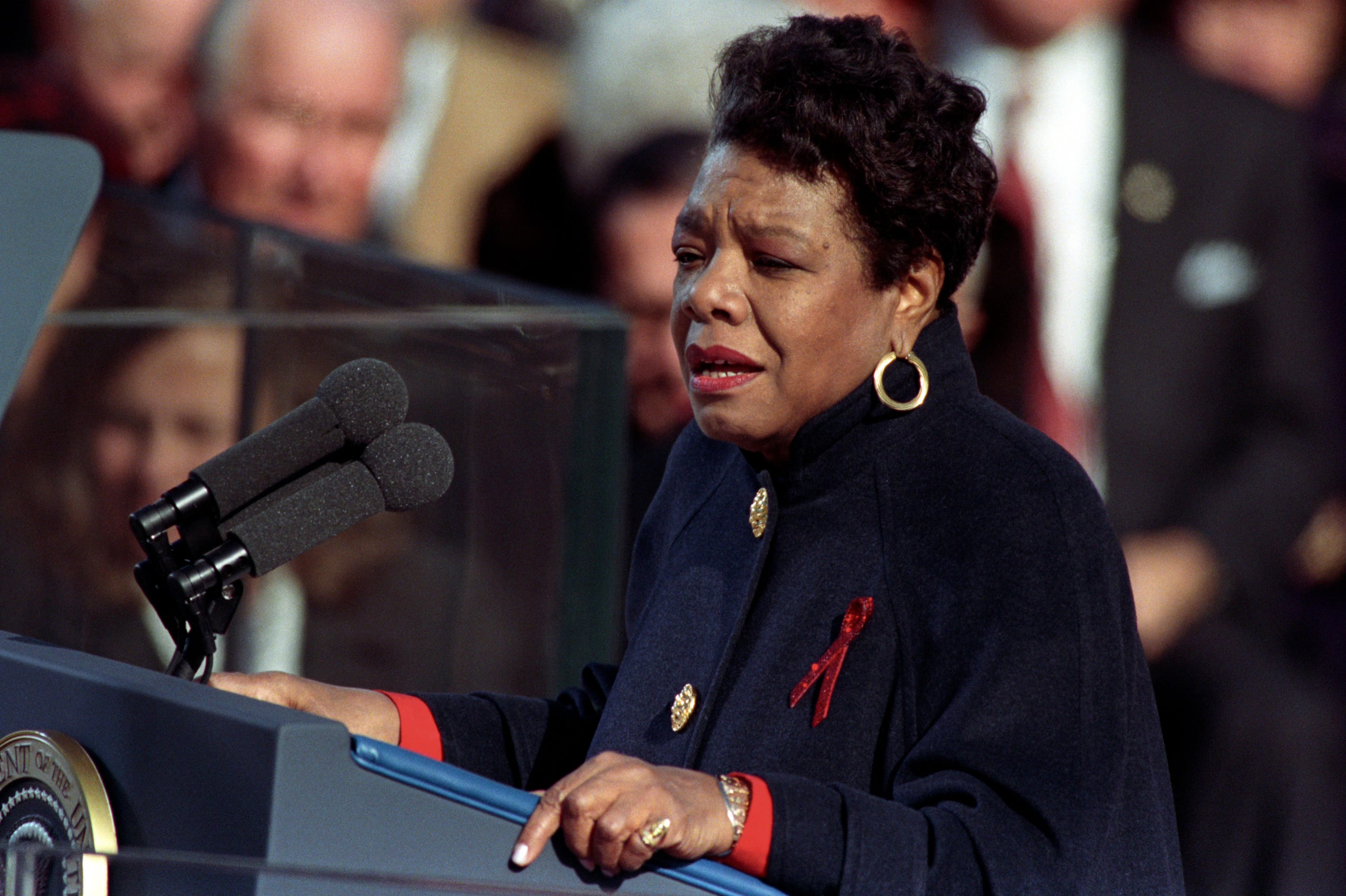
Maya Angelou reciting her poem On the Pulse of Morning at President Bill Clinton’s inauguration, January 1993. Pic from the Clinton Library, Public domain, via Wikimedia Commons
As a rather serious, bespectacled child, who preferred the company of books to that of people, I approached the work of Robert Burns with serious intent.
Growing up in rural south-west Scotland, only sixty miles from the poet’s birthplace, he was as much a part of my life as the Sunday Post’s Oor Wullie or the girl’s comic Bunty. Our primary school organised annual trips to the Ayrshire cottage where he was born and lived for the first seven years of his life.
Wandering round the four-roomed house with my bored classmates I was taken aback at how similar it was to the farm cottages I had lived in since my birth. There may have been two hundred years between Burn’s birth and mine, but progress in rural Scottish communities moved at a different pace to that in Britain’s industrial heartlands or cosy suburbs. I felt almost his contemporary.
And his verse was written as I spoke, as I still speak when with family or when I forget to moderate my voice, so our school’s annual Burns recital competition, organised by the Burns Federation, held no fears for me. I spent hours at home committing To A Mouse or sections of Tam O’Shanter to memory. Tucked away with my political memorabilia and concert programmes, lie two certificates proof of my excellence as junior Burns scholar.
So it came as no surprise to me to learn that Maya Angelou, the great African-American poet and author, was inspired as a child by the poetry of Robert Burns. In a BBC documentary, first shown in 1996 to mark the bicentenary of his death, she explains how, growing up dirt-poor in the segregated town of Stamps, Arizona, his poetry had helped restore her self-worth and find her voice after years of silence in the aftermath of being raped by her mother’s partner.
“I fell in love with poetry and, amazingly, in a small village, a hamlet in Arkansas, I met Robert Burns,” Angelou recalls in the film. “He was the first white man I read who seemed to understand that a human being was a human being, and we are more alike than unalike.” She described Burns as a man who “loved fairness, loved justice, who was fired and made passionate by injustice, who struggled against cruelties.”
But was he a feminist? Not in the 21st century sense of a feminist and he was nowhere as overtly political as his contemporary Mary Wollstonecraft whose 1792 book, A Vindication of the Rights of Woman, is a pioneering feminist tract. Indeed, he revelled in some aspects of 18th century patriarchy, in particular his tendency to pursue women as sexual objects.
But as Maya Angelou recognised as a young child, his writing was rooted in egalitarianism and guided by his core belief that human dignity should not be conferred by dint of class or sex. His clearest statement of equality is a A Man’s a Man for A’ That written in 1795.
“Then let us pray that come it may,
As come it will for a’ that,
That Sense and Worth, o’er a’ the earth,
Shall bear the gree, an’ a’ that.”
And while he doesn’t argue for equality, liberty and sisterhood for women in The Rights of Women, preferring instead to contend that a woman has the right to be treated well by the men in her life, the poem is still strongly pro-women.
While Europe’s eye is fix’d on mighty things,
The fate of Empires and the fall of Kings;
While quacks of State must each produce his plan,
And even children lisp the Rights of Man;
Amid this mighty fuss just let me mention,
The Rights of Woman merit some attention.
But, as a sometimes vulnerable, often scared, ten-year-old growing up in a society that judged me by my class and my sex, his classic poem To A Mouse held the most potency. His exploration of how hierarchies can casually destroy lives was as true in 1967 as it was in 1785, and as it remains today.
“I’m truly sorry Man’s dominion
Has broken Nature’s social union,”
Robert Burns may not have been a feminist, but his piercing attacks on social class and hypocrisy helped create a cultural and moral climate where the roots of feminism could begin to take hold.
The 1996 BBC documentary Angelou on Burns is available on iPlayer here.
The full text of most of the poems quoted above, and many others, is available on the Scottish Poetry Library’s website. The full text of The Rights of Women is available here.
Last of all, Lucy has persuaded Susan to read aloud To A Mouse - you can listen to her here.
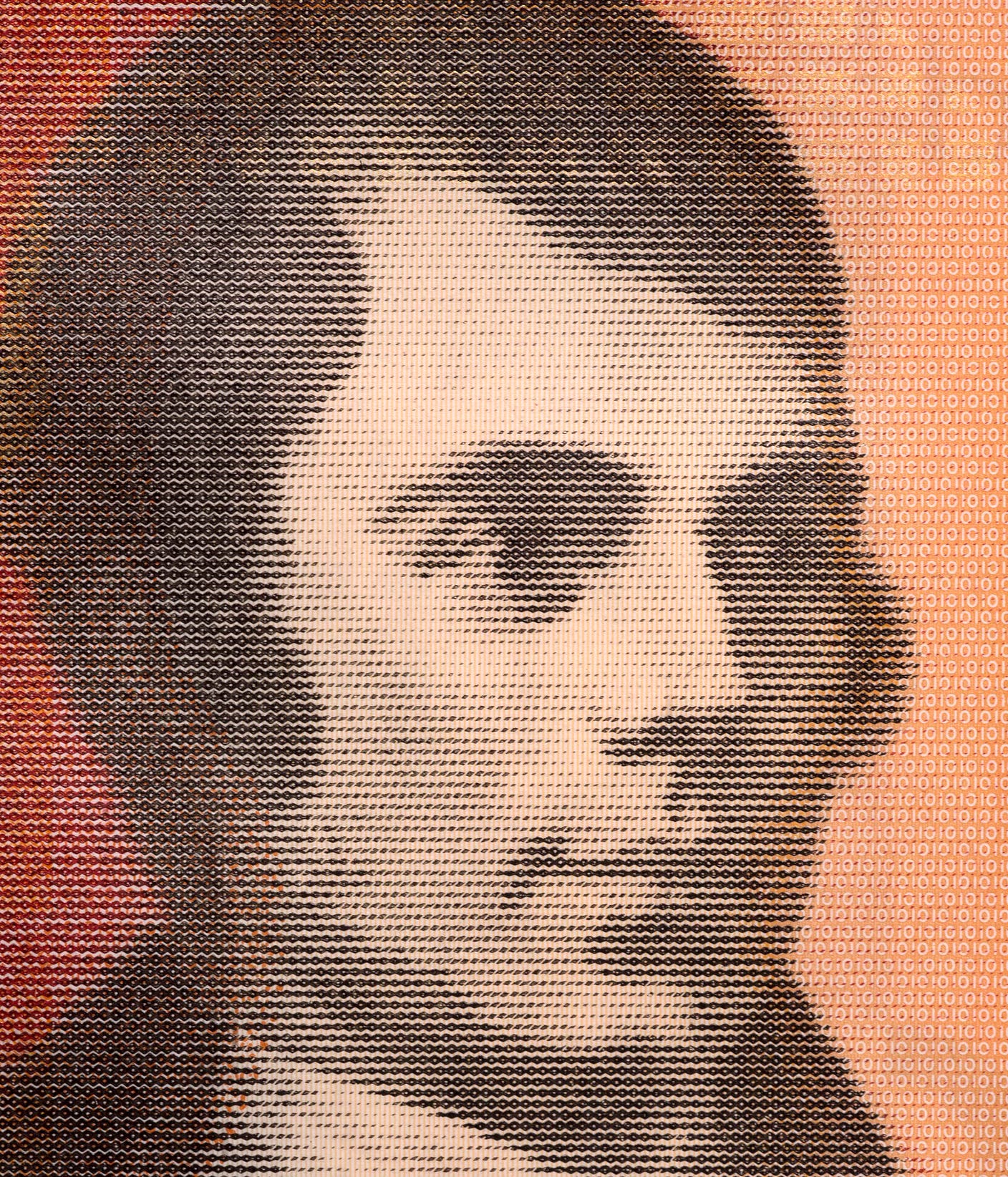
Robert Burns by Johan10 via iStock
POEMS
By Sonya Douglas
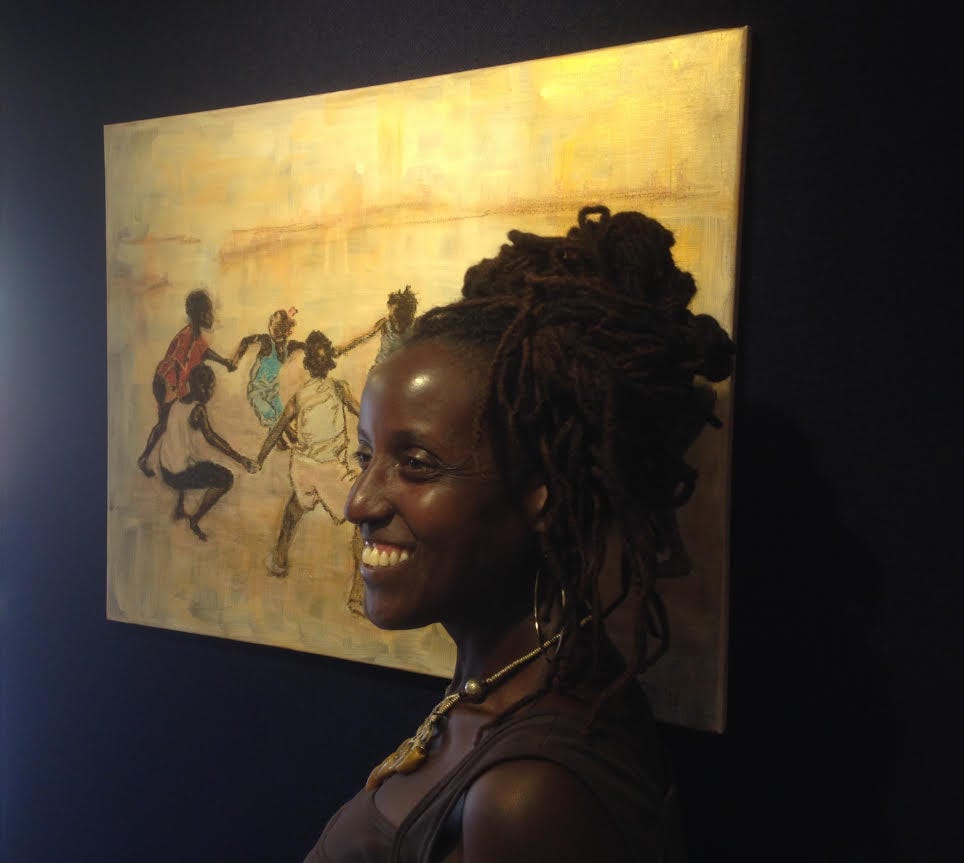
Sonya Douglas
This Is A Pen

This is a pen, he said, holding a pencil
What does it matter as long as it writes?
Ink is a construct of colonial oppression
Freedom was written in blood and graphite
All pens are pencils
All pencils are better than pens

This is a pen, he said, holding a kettle
There is no standard to which pens must conform
Its function transcends your narrow prescription
It will burn its truth on the skin of your arm
All pens are kettles
All kettles are better than pens

This is a pen, he said, holding a knife
See how it cuts to the heart of the matter
Do you agree that this knife is a pen?
Do you believe in its pattern of splatter?
All pens are knives and can draw blood on contact
This knife makes a better pen

This is a woman, he said


To Her A Blessing, To You A Curse

You may take my words
redefine them to subvert all meaning
yet will I make my intention clear
You may turn my platform into a public scaffold
yet you will see me stand and prosper there
You may hold my freedom as your hostage
You can’t make a prison of my mind
and tho you make of hope
a country with closed borders
yet will I enter over common ground
Men do not ban girls from all learning
if they are not afraid of what they’ll learn
You may seek possession of her future
but you will lose ascendance in your turn
The world is deeper than the pit of your desire
and all your action kindling to a flame
My word retain the power of its meaning
and bring to you a portion of the same


© Sonya Douglas
Artist and poet Sonya Douglas studied graphic design at Newport College of Art. She is married and lives in Cardiff.

Atta girl! As women of all ages take to the streets of Iran in a courageous show of protest against an authoritarian regime, Lily Craven pays tribute to Simin Behbahani, Iran’s greatest modern poet
By Lily Craven, known to her many fans on Twitter/X as @TheAttagirls
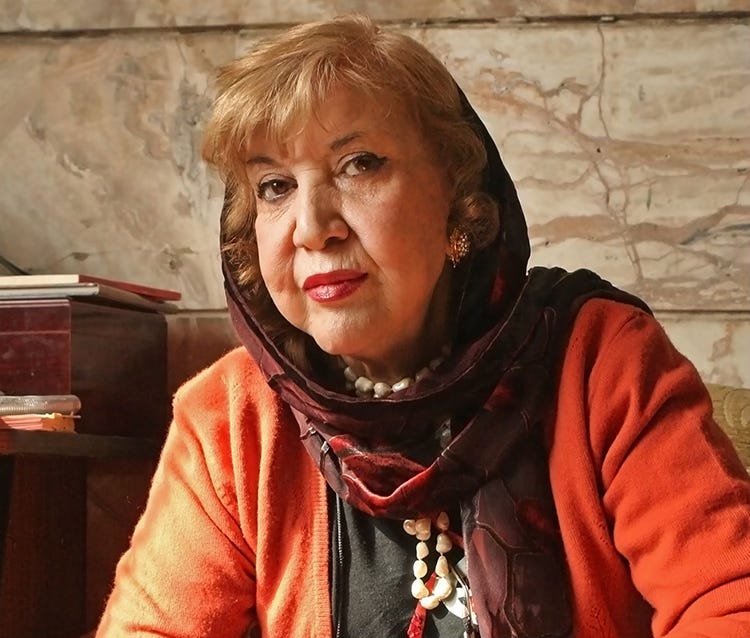
The Lioness of Iran: Poet Simin Behbahani. Pic by Romissa Mofidi, CC BY-SA 3.0 via Wikimedia Commons
A ghazal is a lyrical, ancient Arabic poetic form of related rhyming couplets, strung together like pearls on a necklace, and known for themes of love, loss, and mysticism. Traditionally, it is written from the perspective of a man admiring a woman, but Woman of the Week Simin Behbahani, Iran’s most famous poet, turned it on its head and wrote hers from a woman’s point of view.
She wrote of love and loss, but she also used ghazals to challenge the government of Iran on human rights violations, and its powerful religious authorities on matters such as the stoning of women who commit adultery. Revolution, the Iran/Iraq war, executions, poverty, prostitution, freedom of speech, and the oppression of women: all were pointedly raised in more than 600 poems, collected in 20 books.
Simin became “the elegant voice of dissent, of conscience, of nonviolence, of refusal to be ideological” and in doing so, she became “the voice of the Iranian people.” She was known as the Lioness of Iran.
“I’ve seen mothers running after the corpses of their martyred sons, oblivious to whether their headscarves or their chadors or their stockings and shoes were slipping off or not.” Simin Behbahani
Born in 1927 in Tehran to liberal parents - her mother was a feminist, poet and writer; her father, a newspaper editor exiled just before her birth - she grew up in a home that became a popular meeting place for writers and social activists. Her first poem was published in a magazine when she was 14, her first book when she was 24.
Simin studied to be a midwife but when she was falsely accused of writing an article criticising the school and expelled, she earned a law degree at the University of Tehran that she never used and turned to teaching physics and chemistry - later literature - at high school instead. And of course, she wrote poems.
Surviving the nightmare of censorship
The threat of censorship and arrest was constant, particularly after the 1979 Islamic Revolution which she initially supported but later criticised for its violence and repression. She endured harassment, defamation by the ultra-traditional media, travel bans, beatings, arrest, and interrogation, even into her eighties. Despite this, she insisted on writing the truth despite “the nightmare of censorship.”
“The fact that I’m a woman is as important to my work as a poet as the fact that Ahmad Shāmlu was a man was important to his work as a poet.”
On 12 June 2005, five days before Iran’s presidential election, thousands of women from all backgrounds came together to protest peacefully in front of the University of Tehran about the denial of women’s rights and to demand changes to discriminatory civil and penal codes. It was the largest show of dissent by women since the Revolution, and they were surrounded by the police who used batons to disrupt the gathering. Simin recited one of her poems to the police:
“Don’t boast about your superiority
We are your equal
Why are you shooting us?
We are your other half.”
When she attended another peaceful protest a few months later to commemorate International Women’s Day in Tehran, Simin - then 78 and almost blind - was attacked and beaten by Iranian police. A witness said, “Behbahani was beaten with a baton, and when people protested that she is in her seventies and can barely see, the security officer kicked her several times and continued to hit her with his baton.”
One Million Signatures
One of the first to sign the One Million Signatures campaign, a grassroots initiative by women in Iran in 2006 to draw attention to their plight despite the threat of arrests, imprisonment, surveillance, and website shutdowns, Simin wrote:
“You want to erase my being, but in this land, I shall remain
I will continue to dance as long as I sustain
I speak as long as I’m living, fury, roar, revolt
Your stones and rocks I fear not. I am flood. My flow you can’t halt.”
When 26-year-old philosophy student Neda Agha-Soltan was murdered in her car by government militia, Shimin dedicated a poem to her.
“You are not dead, nor will you die.
You will always live on; you have eternal life.
You embody the people’s call [Neda].”
Celebrated abroad - her literary awards included the Human Rights Watch Hellman/Hammett Grant in 1998, the Simone de Beauvoir Prize for Women’s Freedom in 2009, and two nominations for the Nobel Prize in Literature (1999 and 2002) - Simin was subjected to ordeal after ordeal at home.
In 2006, Iranian authorities shut down an opposition newspaper for printing one of her works. In March 2010, when she was 82 and nearly blind, she was barred from boarding a Paris-bound plane at Tehran airport thus preventing her from travelling to an International Women’s Day Conference. Her passport was revoked, and she interrogated throughout the night about the poems she had written about Iran’s 2009 elections. Those elections were criticised as fraudulent by opponents of the government.
Simin died in 2014 at the age of 87, long before the death of 22-year-old Mahsa Amini in police custody in Tehran in 2022. Two women, two different generations, both yearning to be free: I think we know where Simin would have stood in the Woman, Life, Freedom protests following Mahsa’s murder, and where she would stand today. The Lioness of Iran is still regarded as a symbol of resistance against authoritarianism in the fight for human rights in Iran.
“Anxious, agitated, sad, her face uncovered, her head unveiled,
not afraid of arrest or policeman, oblivious to the order, ‘Cover!’”
In her misspent youth, Lily Craven spent 28 years in prisons in England writing risk assessments, operational orders and contingency plans. Now retired, she spends her time finding ordinary women whose extraordinary achievements were buried in dusty footnotes in history books and writes about those instead.

Navigate the public policy maze with the editors as they keep a watching eye on the issues affecting women

Pic by: akinbostanci via iStock
We are all busy, so it is hard to keep up with what people in power are up to - particularly in relation to policies and services that affect women and girls. We can’t offer a full monitoring service but in each edition we will highlight a few things to watch out for, and where you can find more information.
Maternity care: new research and petition at Westminster

Image via iStock
The Oxford Population Health’s National Perinatal Epidemiology Unit, at the University of Oxford, published UK-wide research earlier this month on maternal mortality rates. The authors state that “the mortality rate for women who died during or soon after pregnancy between 2022 and 2024 was 20% higher than the maternal death rate between 2009 and 2011, when the UK government set an ambition to halve the rate of maternal deaths in England by 2025. Deaths due to COVID-19 have had a minimal impact on this figure, emphasising the importance of a renewed focus on efforts to tackle maternal mortality.”
A petition is currently before the Westminster Parliament calling on the UK government to appoint a maternity commissioner to improve maternity care. The petitioners have added this comment:
“A 2024 parliamentary birth trauma inquiry recommended a Maternity Commissioner be appointed alongside a National Maternity Strategy to ensure mums and their babies were safe and looked after with professionalism and compassion. As mothers affected by birth trauma, we believe the government should make this appointment to help restore confidence in maternity services which is why we are launching this petition”.
The petition is already due a written response from the UK government. If it reaches 100,000 signatures, it will be considered for a debate in the House of Commons. British citizens or UK residents can sign it here.
Other current Westminster petitions include a call for an inquiry into sexual violence in NHS hospitals and to cancel a proposed clinical trial on puberty blockers.
Wherever you live in the UK, make sure you are registered to vote on Thursday 7 May
2026 is a big year for elections in the UK. There are around 5,000 council seats in England up for grabs, including in all 32 London boroughs. In Scotland, voters will decide who will run the Scottish Parliament for the next five years and in Wales the Senedd election will elect 96 members to the expanded Welsh Parliament.
It is less than 100 years since women secured their full right to vote on equal terms with men when the Equal Franchise Act was passed in July 1928, so make sure you are registered to vote in May, and if you need a postal vote, secure one now. Access all the information you need here.
The UK Parliament Click here for future business
Northern Irish Assembly Click on ‘Business Diary’ for a week by week schedule
Scottish Parliament click on “Read today’s Business Bulletin”
Senedd Cymru | Welsh Parliament click on “View full calendar”