ISSUE 10: The Frontline
A 21st century feminist publication where women's voices have power
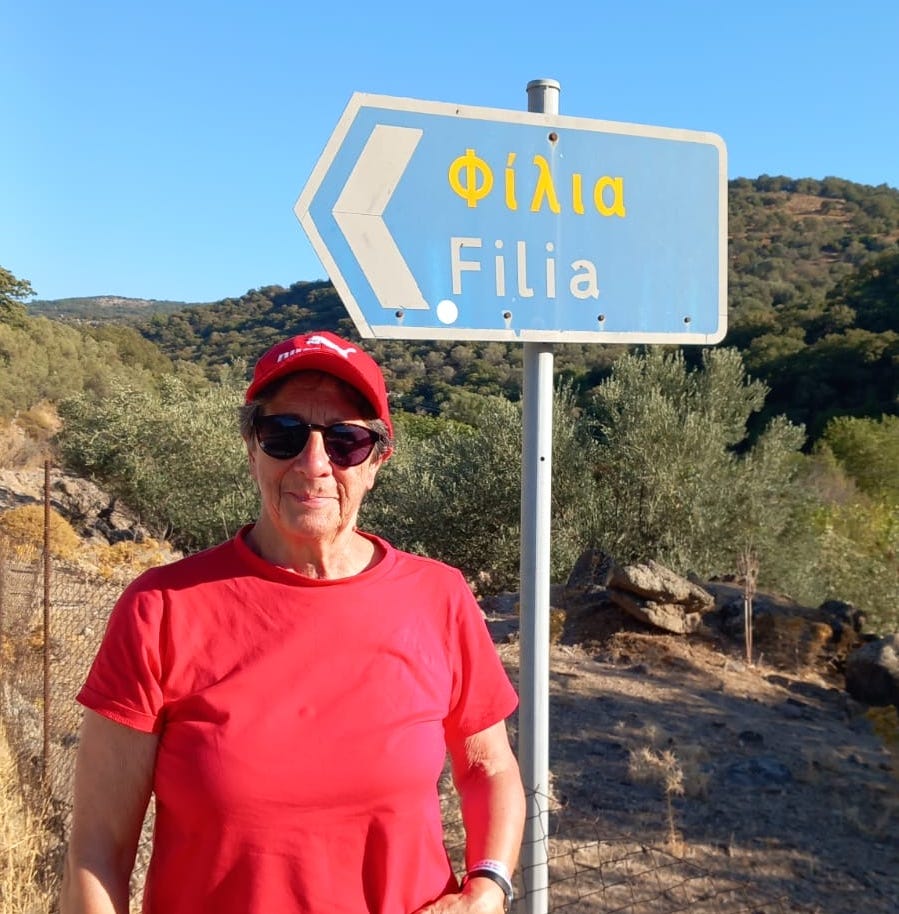
Sally Wainwright earlier this month looking forward to visiting Filia on the Greek island of Lesbos, just as thousands of women are in Brighton anticipating another inspiring FiLiA conference. Pic by Fiona Stobbart.

This edition of The Frontline has our youngest contributor yet, as we hear from a mother and daughter about their experience of home education. Recent figures showed that the number of children in home education in Scotland almost doubled in three years from 2021, with much larger increases in some local areas. England has also seen a sharp rise in home educated children, prompting this piece just yesterday. The same trend appears to stretch beyond the UK. Susan Ireland considers what messages this holds for those in charge of our schools, and what it means for families to take this step. Madeleine tells us her story of home education, raising questions about how teenagers are seen and treated in society more generally.
Meantime, the Scottish Government has, finally, revised its schools guidance in the light of the UK Supreme Court’s ruling in April that ‘sex’ means actual sex in the Equality Act. The limited changes and Ministers’ reluctance, still, to provide clear leadership in protecting single-sex spaces in schools have been strongly criticised by Women’s Rights Network Scotland (@WRNScotland), among others.
Our Woman of the Week is educationalist Emily Davies, who fought for women to have full equal access to, and recognition in, higher education, a process that took even longer than gaining the vote.
We also look ahead to FiLiA’s annual conference, being held this weekend in Brighton. We give a flavour of its broad, international agenda, and talk to women attending Europe’s largest grassroot feminist conference about what they are looking forward to, and what they have valued about previous events.
STOP PRESS…STOP PRESS…STOP PRESS…STOP PRESS…STOP PRESS…
Just as we were about to publish, news from Brighton reveals that overnight violent vandals, purporting to be trans activists, have smashed windows at the venue for the FiLiA conference. Julie Bindel writes on X: “Trans activists have smashed one of the large front windows of the Brighton Centre - the venue where 2500 feminists are meeting this weekend to talk about male violence, misogyny and the like. Why can’t EVERYONE see this movement for what it is?” Stay safe sisters.
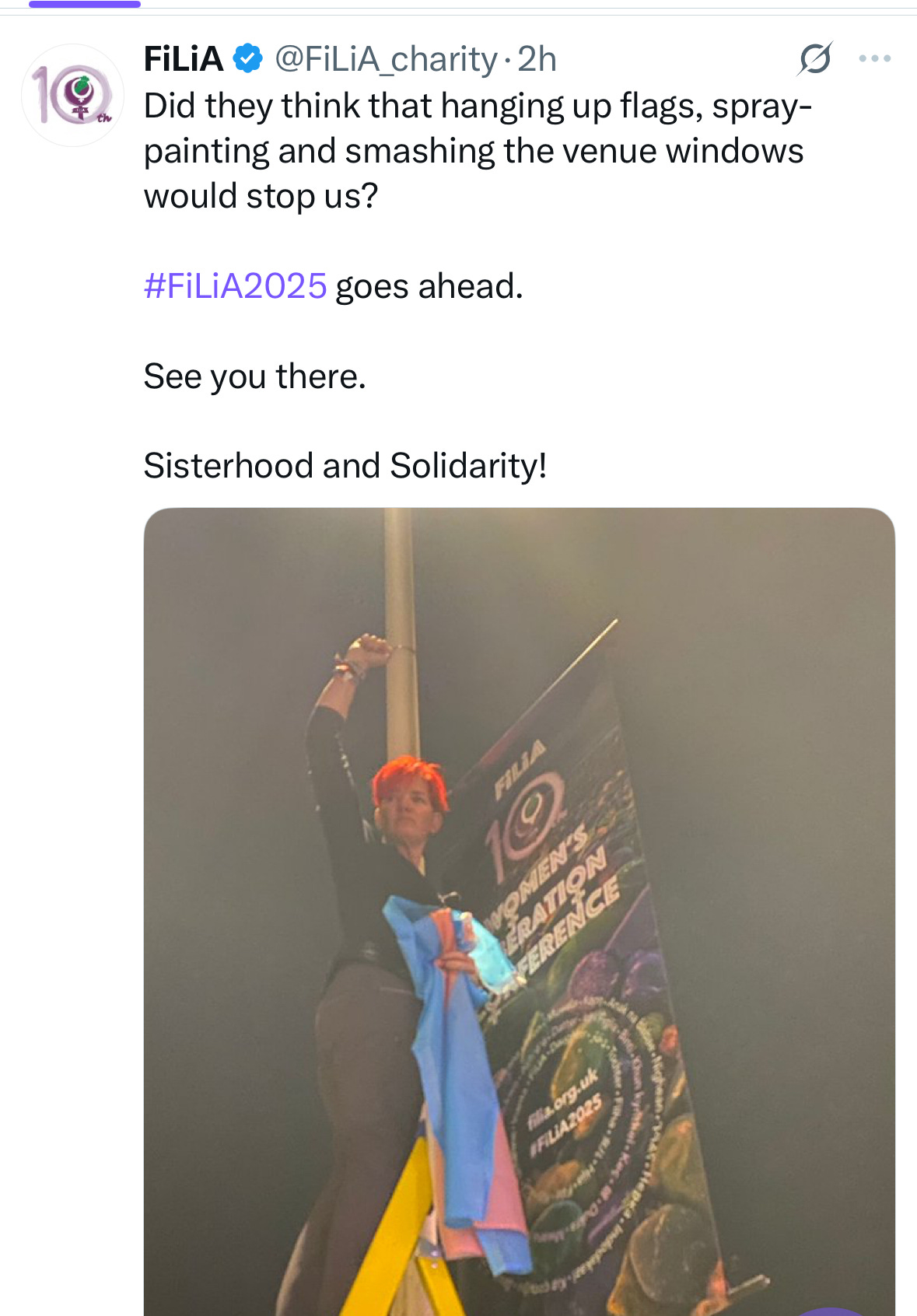
Lisa-Marie Taylor, co-founder of FiLiA in the early hours of Friday, 10th October. Screenshot via X/Twitter
The button at the end of this issue takes you to our subscriber chat. As ever, you can also find us in real time on X/Twitter, at @DalgetySusan and @LucyHunterB and our shared account @EthelWrites.
We are delighted that we can now plan for our fortnightly 21st century feminist publication to remain fully accessible. But we depend on some of our readers becoming paid subscribers so that we can pay our contributors, as well as keep the newsletter free so ALL women can access it. If you can afford a paid subscription, please consider getting one. Thank you.


Our girls are worth it: A mother describes her nine-year journey through home education where, in the woods, with botany books and Shakespeare under the stars, she and her daughter found joy – and a blueprint for real reform.
By Susan Ireland
Pic via iStock
About six weeks after my daughter started school, she leaned in and confided to me that she was “no good at learning”. I already had misgivings about the Scottish school system. Its focus on early academics was contrary to best practice, which champions child-led play and time spent in nature in the early years. I’d countered by electing for flexi-school - so she only attended four mornings a week - making it all the more impressive that it had taken a mere 100 hours of formal school to convince her she was rubbish. Little chubby hands are not suited to pencil grip; the boys in particular struggle to sit still and listen. As a softly spoken, compliant girl, her “learning partners” would always be boisterous boys. We lasted till the end of the year, and pulled out of school altogether.
In Scotland, every family has the right to home educate, conditional upon providing a suitable education for their child - where “suitable” is loosely interpreted in law as “fitting one for life in the community”. Home education is equal in law to sending children to school, and home educators here have immense latitude. You don’t have to follow any particular curriculum, or stick to school hours or school terms. Your child can learn at their own pace, in the way that suits them best. I have never met a family that follows the Scottish Curriculum for Excellence. There is an incredible diversity of approach as families meet children’s individual interests and learning styles, and there are flourishing collaborative home education communities across Scotland, especially in the cities.
Not surprising home educators are mostly mothers
Situated beyond institutional reach, home education promotes unprecedented autonomy. Given that caring responsibilities still fall disproportionately on women, it is perhaps no surprise that pretty much all principal home-ed parents are mothers. You do get single mother home educators, but in the main, home ed rests on a paradox: an empowered, female-centred community, supported by bread-winning men. So like some dystopian throwback, marital break-up remains a real risk that sends contented home-ed children back to school. Some women manage meaningful paid work; pretty much none of us are building a pension pot. With no institutional support of any kind, and much pulling children towards school, it attracts those with strong belief systems.
My daughter’s primary education was in many ways idyllic. We found similar-minded families who valued equality, empowerment and critical thought. We came together to do science experiments, to celebrate Harvest or organise Easter egg hunts, to dissect a daffodil or swim in the river. As a family, we visited the Pont du Gard to learn about the Romans, cosied up in bed to read books on chilly February mornings, and found maths curriculums that felt like intricate puzzles we were excited to try.
Whilst surveys report that Scottish girls experience more maths anxiety and confidence issues than boys, it never occurred to my daughter that maths wasn’t for her. She saw both boys and girls as equally eligible playmates, and climbed trees, clambered up rocks and built dens. When Covid came and stifled our choices, shutting us out of community spaces when schools were already back full-time, we took to the woods and studied botany and performed A Midsummers’ Night Dream. Light-footed and resourceful, the children remember it as the best summer of all.
Secondary education was a daunting prospect
I’d always envisaged that my daughter would probably go back to school at some point. At first I thought, I’ll try home-ed till Christmas - and then till she was eight or nine. High school without specialist teachers and facilities seemed daunting. Yet just at the point that we might have thought about returning, suddenly our community was flooded with children escaping school. Turning up like battle-worn troops, accompanied by mothers who had generally been fighting to keep them in school, and were exhausted from picking up the pieces. A lack of support for Additional Special Needs (ASN) and mental health, and a rising tide of violence and disruptive behaviour has created a perfect storm. Home-ed, for all its informality, had given us a safe, nourishing and joyful childhood.
I listened to the stories of teens pulling out; I looked at the falling PISA scores, the lack of safe single-sex facilities for girls and the stories of sexual violence on sites like Everyone’s Invited - and I didn’t fancy it at all. Nothing screams “people get bullied here” more than a bullying policy. I spied the Scottish Government’s Gender Based Violence School Framework, and I tiptoed quietly away.
Exams are costly for home educators
Incredible autonomy does, however, come with virtually no institutional support. Nowhere is this more cutting than exams. Scottish qualifications are almost exclusively structured on school-based continuous assessment. Earlier this year, the Scottish Government finally published its updated Home Education guidance, and despite its commitment to improving exam access after it was raised repeatedly as a burning issue at consultation stage, it offers no concrete measures.
Three paragraphs on how to access free period products sit alongside advice to think very carefully about exams before you start home educating, or consider riding the coattails of English GCSEs - which are accessible, but costly. This performative nonsense is dreary. If you’re lucky, home educated candidates can sometimes secure National 5 courses at FE colleges, but have to pay hundreds for each course - making our community the only children in Scotland who are paying for state-delivered basic qualifications.
We began as reluctant homeschoolers, always intending to return. We enjoyed the autonomy and flexibility, but ultimately it is the chaos of school that has kept us out. We are both dreamers and problem-solvers—practical, results-focused, and deeply invested in our children’s futures. As long as the government props up a school system it quietly knows is failing, and churns out performative policies instead of real reform, more of us will keep stepping away because our girls, and their education, are worth it.
Susan Ireland has a PhD in feminist geography, and spent a decade as a government policy adviser, before leaving to concentrate on family. She has been home educating for nine years.
Pic via iStock
Home education has opened up my world writes Madeleine
Being home educated is normal to me. Weird is going to the same building every day, wearing the same black clothes, only talking to people the same age, and not choosing what you study. As a home-ed teen I’m often asked if I have friends, can read, or take exams. The truth is, my life is rich and full of choice. I’ve been able to choose innovative curricula that avoid rote, immerse myself in world history, visit interesting places, listen to storytellers and go to the theatre. My friends circle was forged from long days playing outside, or as I’ve grown older, from the hobbies I’ve had time to pursue, like reading, cooking and fashion.
Society’s expectations of teenagers
As I’ve gotten older, the autonomy I enjoyed as a child has collided with society’s expectations of teenagers. You’re given a bus pass, but people are suspicious when you use it, or you’re challenged for walking around a museum—despite years of them encouraging you to visit as a child. It especially annoyed me when I started a home-ed teen book group in the public library. After two years, the group outgrew the tiny glass-walled room we were first given. But the library was reluctant to offer us a larger space because we could no longer be seen from the main floor. It was a blow—especially since they claimed we were a hard-to-reach demographic and had spent thousands trying to entice us with manga and activities. They didn’t trust us to sit in a room and talk about books, and we had to enlist adults to argue our case to the Chief Librarian. It felt tough.
Home education has given me freedom, confidence, and curiosity—what’s strange isn’t how I learn, but how little trust teens are often given when they do.
Madeleine Ireland is 14 years old. She has been home educated since she was six.
Thousands of women will gather in sisterhood and solidarity this weekend in Brighton for the 2025 FiLiA conference where they will discuss how to liberate women across the world from sex-injustices such as sexual violence, pornography and surrogacy
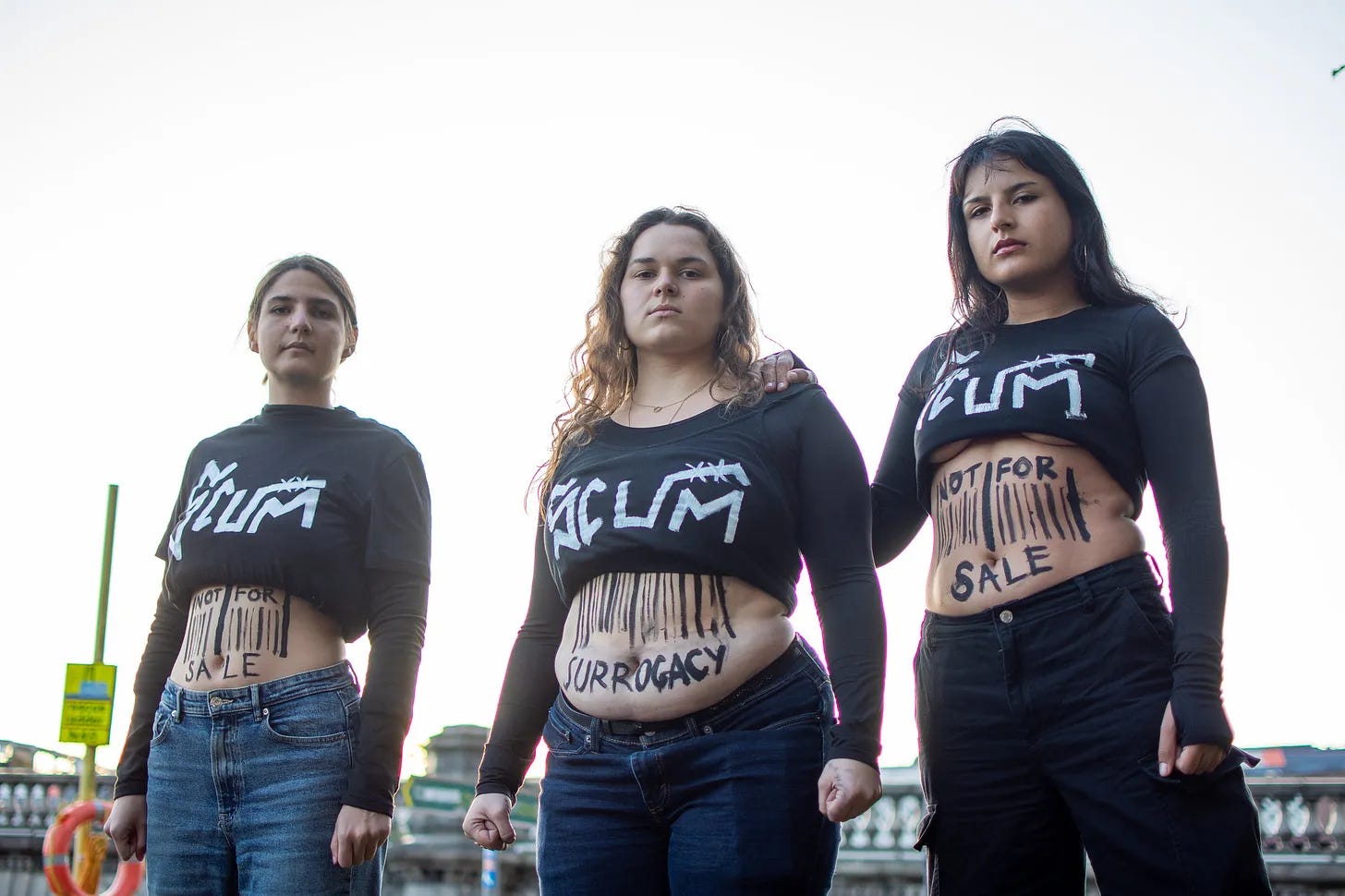
Women at the rally against surrogacy at FiLiA 2023 in Glasgow. Pic by Pauline Makoveitchoux on Flickr
More than 2,000 women from all corners of the United Kingdom and across the world are gathering today (Friday 10 October) for the 2025 FiLiA conference. They have come together to learn about women’s rights and global feminism, to meet other women who, like them, are challenging sex-based injustices, to build their feminist network and, above all, to be inspired and have fun.
Over three days, there will be a diverse range of panel discussions, workshops, performances, films and shopping opportunities. There are more than 250 speakers from 55 countries and a Femicide rally planned to remember the women murdered by men and to demand an end to male violence against women and girls.
Today’s sessions include a discussion led by feminist academics and activists Sundari Anitha and Ruth Pearson on the lasting impact of the 1976 Grunwick strike which, under the leadership of Jayaben Desai and other South Asian women, serves as an example in how to challenge racism, attacks on free speech and the demonisation of migrants and other workers.
Previous FiLiA conferences were held in Manchester, Cardiff, Glasgow, Portsmouth and Bradford. The FiLiA Women’s Assembly is hosting a session where women from these cities can meet and find out how they can become more involved in the women’s liberation movement.
And the winner of the annual Emma Humphreys Memorial Prize will be announced on Friday. Emma was a writer, campaigner and survivor of male violence who fought a historic struggle to overturn a murder conviction, supported by Justice for Women and other feminist campaigners. Tragically, Emma died in 1998, just three years after her release from prison.
STOP PRESS…STOP PRESS…STOP PRESS…STOP PRESS…STOP PRESS…
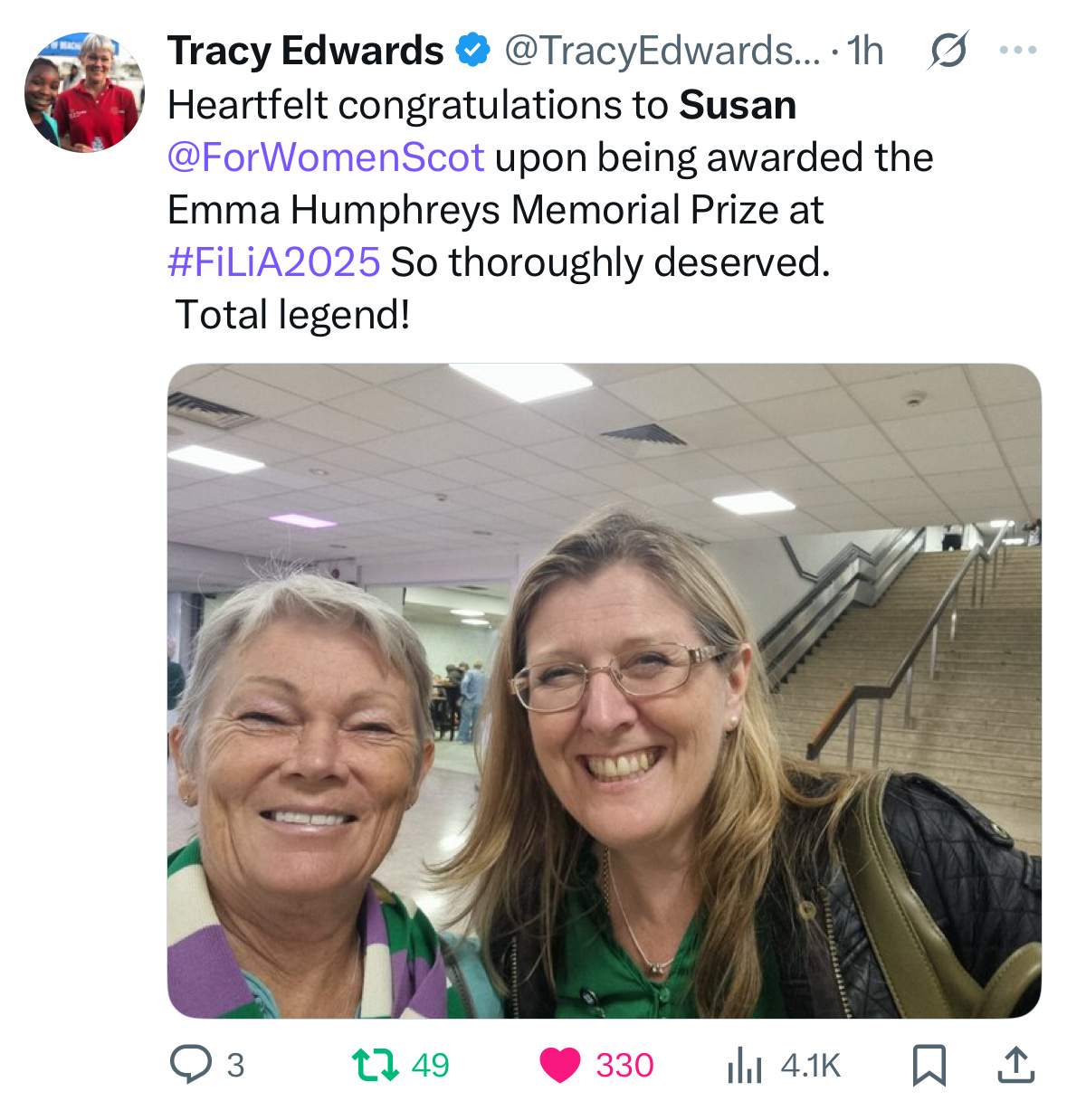
News just in from Brighton. The 2025 Emma Humphreys Memorial Prize winners include For Women Scotland, whose tenacity and courage resulted in April’s landmark Supreme Court judgement. Susan Smith, Marion Calder and Trina Budge are three amazing women to whom we all owe a huge debt of gratitude. The other two winners, Yasmin Jared (@yasminjaved5) and Samantha Walker-Roberts (@Samantha57594539) are equally as inspiring. Well done sisters.
The campaign to end male violence against women and girls continues
The theme of male violence against women is picked up again on Saturday with several powerful sessions including one on femicide, led by campaigner Karen Ingala Smith. The panel will explore the global dimensions of femicide, examining both the common threads and the cultural, legal, and political differences that shape how it manifests across countries.
Frontline contributor Laura Frexias will chair a session that explores motherhood as a fully human experience, rather than the stereotypes of the past. And the day will close with FiLiA’s now-famous women-only party.
On Sunday, the conference will take time to celebrate April’s historic Supreme Court judgment on sex. The panel, which includes Joanna Cherry KC, Susan Smith of For Women Scotland and Jenny Willmott of Scottish Lesbians, will consider how the judgement has strengthened women’s rights across the world.
There will be a chance to meet the organisations at the forefront of the global campaign to end surrogacy – a predatory system targeting women and children which is a new chapter in violence against women. And another session will confront the realities of today’s porn industry which is fuelling exploitation on a global scale.
In an extensive interview with the Herald newspaper in 2023, co-founder of FiLiA, Lisa-Marie Taylor, celebrated the range of topics that a FiLiA conference covers. She said: “Women know that female genital mutilation, femicide, economic abuse and systems which enable prostitution are all connected. They are keen to learn; to organise and to mobilise. FiLiA provides a space for that to happen.”
And she recalled how she embraced feminism in her late 30s via another series of women’s events – the Feminism in London conferences. She said: “I walked out of my first feminist event and saw the world in an entirely new way. These women had opened my eyes to what was being done to us collectively, and in turn this explained many of my own personal experiences for the first time. My life was changed forever, and I will be grateful to those women for the rest of my life.
“From that moment, my driving force has been to bring new women into the movement and FiLiA emerged with the help of my co-founder, Julian Norman. We gathered 13 women and put on our first event in 2013. We were quite terrified; politically naïve and had no organising experience. We had the unshakeable belief though, that by bringing women together, magic would happen.”
The magic of sisterhood and solidarity
And magic certainly does. Terry, who attended her first FiLiA conference in 2023, will be at Brighton this year, and recalls her experience. “I was blown away by the sense of community. To spend so much time just with women, talking, discussing and debating issues that impact women was exciting and exhausting in equal measure.
“I sought out other HR professionals and with support from both Maya Forstater and Civil Service SEEN, we launched SEEN in HR as a result of connections and conversations at FiLiA. This year all the recognised SEENs have a stall and there are already 17 separate SEENs launched. It’s uplifting to get to meet in person, women I have chatted to online”.
It will be Tracy Edwards’ first time at FiLiA. The world renowned sailor and founder of The Maiden Factor, which promotes education for girls, told The Frontline she is attending because she can “can finally speak up about women’s rights in sport”.
“It was so frustrating having to work behind the scenes whilst I couldn’t. It has been so depressing watching sporting governing bodies ignore the Supreme Court Ruling, I need to surround myself with female energy.”
And another first-timer, Roz Adams, who works at Beira’s Place, a sexual support service for women and girls, is looking forward to renewing friendships and meeting new women. She said: “I’m hoping to learn from wise women about feminism from all angles, especially the deep dives into matriarchy and maternalism from a global perspective. Coming from Beira’s Place, I’d love to connect with women from Brighton’s Sisters Salon and Vancouver Rape Relief to share stories of the trials of defending single sex spaces. And of course anticipating fun and connection with the magnificent women I’ve already met.
“It matters to me that women have places like FiLiA to connect internationally, to share knowledge and ideas, to strengthen the movement of feminism relationally, through face-to-face meetings. We need it.”
The Frontline won’t be at this year’s conference, but like many women across the world, we will catch up online. For a taster of FiLiA 2025, have a look at Glasgow’s 2023 event here.

Atta girl! Emily Davies and the fireside chat that led to the liberation of women in education and at the ballot box
By Lily Craven, known to her many fans on Twitter/X as @TheAttagirls
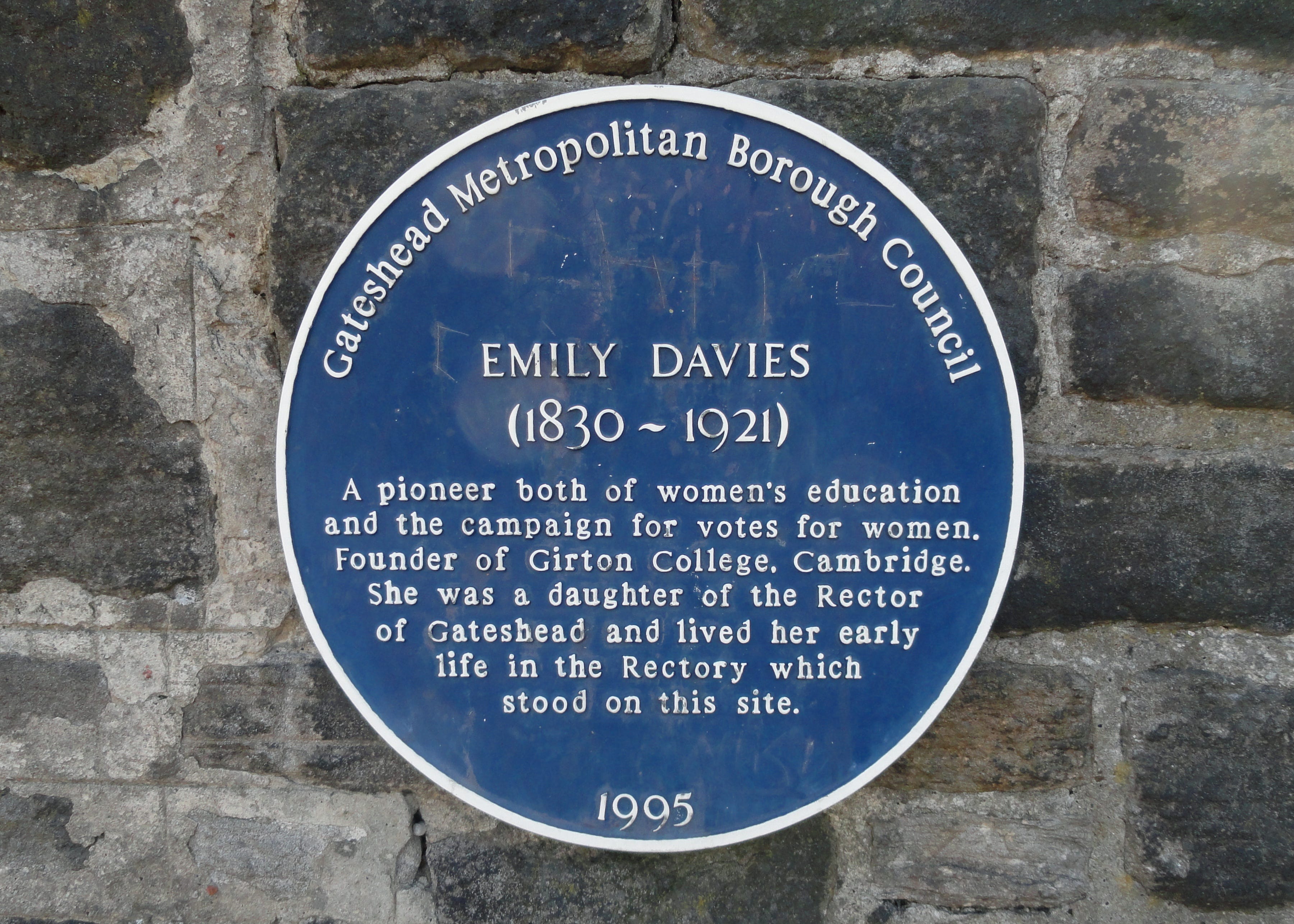
Pic via Open Plaques
Woman of the Week is suffragist Emily Davies, born in 1830 in Southampton, founder of the first women’s college in the UK, lifelong campaigner for equal rights and one of the first women to address a Royal Commission as an expert witness.
Her father had traditional views about education for girls. His sons attended private schools and university; his daughters sat at home and practised needlework. Emily wanted to study medicine - after meeting Barbara Bodichon, founder of the English Woman’s Journal, she wrote an article entitled Female Physicians in May 1860 – but knew her poor education was a barrier.
Vow to open university education to women
1860 was quite a pivotal year. While staying with friends in Aldeburgh, 29-year-old Emily sat by the fireside debating the future for women with the daughters of the house, 23-year-old Elizabeth and 13-year-old Millicent, all three brushing their hair.
Emily was clear: “Women can get nowhere unless they are as well educated as men. I shall open the universities.” Elizabeth agreed, “Yes, we need education, but we need an income too and we can’t earn that without training and a profession. I shall start women in medicine. But what shall we do with Millie?” Emily turned to the youngest girl, “After these things are done, we must see about getting the vote. You are younger than we are, so you must attend to that.”
She started immediately: set up the local branch of the Society for Promoting the Employment of Women, wrote letters promoting women’s rights, supported Elizabeth in her medical studies, was a founding member of the women’s discussion group, the Kensington Society, and campaigned for girls to sit secondary school exams in order to prepare them for higher education.
In October 1862, as committee secretary with the job of getting women into university, Emily found 83 girls to sit local exams in Cambridge as a trial run. It was a success. Almost 1,000 teachers signed a petition in support of official secondary school exams for girls in Cambridge and the right was granted in 1865.
Universities were a harder nut to crack. The Universities of Oxford, Cambridge and London were exclusively male and refused to admit women. Emily made it her mission to change their policies.
In 1866 - another pivotal year - she published The Higher Education of Women and argued: “Many persons will reply without hesitation that the one object to be aimed at, the ideal to be striven after in the education of women, is to make good wives and mothers. And the answer is a reasonable one, so far as it goes, and with explanations. Clearly, no education would be good which did not tend to make good wives and mothers; and that which produces the best wives and mothers is likely to be the best possible education. But having made this admission, it is necessary to point out that an education of which the aim is thus limited, is likely to fail in that aim.”
The same year, Emily co-organised John Stuart Mill’s petition to Parliament arguing for the vote for women, and persuaded Elizabeth to be the first to sign. It was the largest known petition to Parliament, signed by 15,000 women from all over the country and from every walk of life.
Three years later, Emily led the campaign to found Britain’s first women’s college with the support of Barbara Bodichon and others. Girton Collage started off in Hertfordshire but in 1873, moved to Cambridge where Emily pressed for a curriculum equivalent to those offered to male students. The University’s ruling body refused, but as Mistress of the College from 1873 to 1875, Emily trained women students for the Cambridge Mathematical Tripos whether the University liked it or not.
The Tripos is famously difficult: 12 papers and 192 progressively more complex questions over eight days. For those aiming for the title of Senior Wrangler – first prize and the key to a glittering career – there were a further three days of exams consisting of 63 even more testing problems. Preparation took months.
The first Girton student to take first place in the Tripos was Philippa Garrett Fawcett, who knocked spots off the male second-place candidate in June 1890 with a score 13% higher than his. For a woman to beat a man at maths was unthinkable. When the results were announced, the chief examiner stuttered over her name and then added “Above the Senior Wrangler.”
That’s right. Only men could be named Senior Wrangler. The title went to the man who came second.
Undeterred, Emily continued preparing her women students and watched the Tripos results like a hawk. Just a month before her death, she wrote to congratulate Miss K. Snell of Girton on taking the position above the first man in the second part of the Law Tripos.
Women’s degrees blocked
Cambridge University was swift to respond to what it saw as the growing threat of Girton’s success. It blocked the official award of degrees to women and refused to recognise them as university members. Not until 1948 did it finally concede.
Emily did not live to see it. She died in 1921 at 91, but she did see women admitted as doctors. Her fireside friend, Elizabeth Garrett Anderson, delivered on her promise by achieving this in 1865.
She also lived to see the vote granted to women. Millie - Millicent Garrett Fawcett - delivered on her promise too. In December 1918, when British women voted for the first time in national elections, 88-year-old Emily entered the polling station with head held high.
Today, women have equal access to higher education, and no one thinks it remarkable. Now, that is Emily’s achievement.
In her misspent youth, Lily Craven spent 28 years in prisons in England writing risk assessments, operational orders and contingency plans. Now retired, she spends her time finding ordinary women whose extraordinary achievements were buried in dusty footnotes in history books and writes about those instead.

Navigate the public policy maze with the editors as they keep a watching eye on the issues affecting women

Pic by: akinbostanci via iStock
We are all busy, so it is hard to keep up with what people in power are up to - particularly in relation to policies and services that affect women and girls. We can’t offer a full monitoring service but each edition we will highlight a few things to watch out for, and where you can find more information.
The Northern Ireland Executive has recently opened a consultation on Disability and Work: A Strategy for Northern Ireland, with a closing date of 12 January 2026: see here.
The Welsh Government is currently consulting on National Minimum Standards for Regulated Childcare, with a closing date of 10 December: see here.
Before the conference recess, the Women and Equalities Committee at Westminster issued a report warning that Female Genital Mutilation (FGM) is both taking place in the UK and that UK citizens or residents are being taken abroad to undergo this brutal form of violence against girls and young women. The Committee argued more action is needed by government to prevent this, and to support survivors. You can read the report here.
Today, Friday 10th October, the UN General Assembly will discuss a report on surrogacy by Reem Alsalem, the United Nations Special Rapporteur on Violence Against Women and Girls. Her report, released in July, calls for UN member states to move towards the total prohibition of surrogacy in all forms, while also raising significant concerns about the practice of egg donation and its consequences for young women.
The report states that in 2023, the global surrogacy market was valued at $14.95 billion and is projected to reach $99.75 billion by 2033. Globally, most surrogate mothers come from lower-income backgrounds and have lower social status compared to commissioning parents. Many surrogate mothers lack access to effective legal remedies or advocacy mechanisms. Read the full report here
Reem Alsalem will also speak at FiLiA’s conference this weekend. Here she is in conversation with Joanna Cherry KC at the 2023 event in Glasgow.

Northern Ireland Assembly in Belfast. Pic by RogerBradley via iStock
The UK Parliament returns from its annual Conference recess next week. (Click here for future business).
Northern Irish Assembly (click on “View full agenda” for the detailed forward look)
Scottish Parliament (click on “Read today’s Business Bulletin”)
Senedd Cymru | Welsh Parliament (click on “View full calendar”)